Facts
The petitioners (legal heirs of the original defendant No. 1, Gangaram) challenged a compromise decree passed by a Lok Adalat on February 13, 2016, in R.C.S. No. 47 of 2016
Source reference: p. 2The respondent No. 1 had filed a suit for declaration and injunction regarding land bearing Gat No. 23/4/3, which the original petitioner claimed was his exclusive "Hadola Inam" property held since 1950
Source reference: p. 4The Trial Court record (Rojnama) indicated that summons were ordered on January 25, 2016, but were never served
Source reference: p. 3Despite the lack of service, the matter was referred to the Lok Adalat on January 29, 2016, where a compromise was recorded stating the land was ancestral property
Source reference: p. 3, 8The petitioners alleged that Gangaram—who was 76 years old, illiterate, and 82% physically disabled—was misled into providing his thumb impression on the compromise terms under the pretext of signing documents for his son’s employment
Source reference: p. 3, 8Issues
1. Whether a compromise decree passed by a Lok Adalat can be challenged through a writ petition under Articles 226 and 227 of the Constitution of India on the grounds of fraud
Source reference: p. 6, 92. Whether the compromise decree dated February 13, 2016, was obtained by practicing fraud upon the original petitioner and the court
Source reference: p. 9Law Applied
Section 21 of the Legal Services Authorities Act, 1987, which stipulates that a Lok Adalat award is final, binding, and deemed a civil court decree, with no appeal lying against it
Source reference: p. 6The court relied on the Supreme Court precedent in State of Punjab v. Jalour Singh, which established that while Lok Adalat awards are final, they can be challenged under Article 226/227 on limited grounds such as fraud
Source reference: p. 6The principle from Bhaurao Dagdu Paralkar v. State of Maharashtra, holding that "fraud vitiates all solemn acts" and "unravels everything"
Source reference: p. 9Reasoning
The court found that the procedural trajectory of the suit evidenced bad faith.
Source reference: p. 7-8Specifically, the Trial Court referred the matter to the Lok Adalat only four days after the suit's institution without ensuring the service of summons on the defendants
Source reference: p. 7-8The court noted that the original petitioner's extreme physical disability (82%) and illiteracy rendered him vulnerable to misrepresentation regarding the nature of the proceedings
Source reference: p. 8It further observed a stark contradiction between the long-standing revenue records, which showed the land as the petitioner's exclusive Inam property, and the compromise recitals, which claimed it was ancestral property divided in 2005
Source reference: p. 8The court determined that the exclusion of the petitioner’s legal heirs as necessary parties and the haste in concluding the proceedings pointed toward a fraudulent intent to grab the property
Source reference: p. 8-9Consequently, the court held that the foundation of the compromise was vitiated by fraud, justifying interference under writ jurisdiction
Source reference: p. 9-10Holding
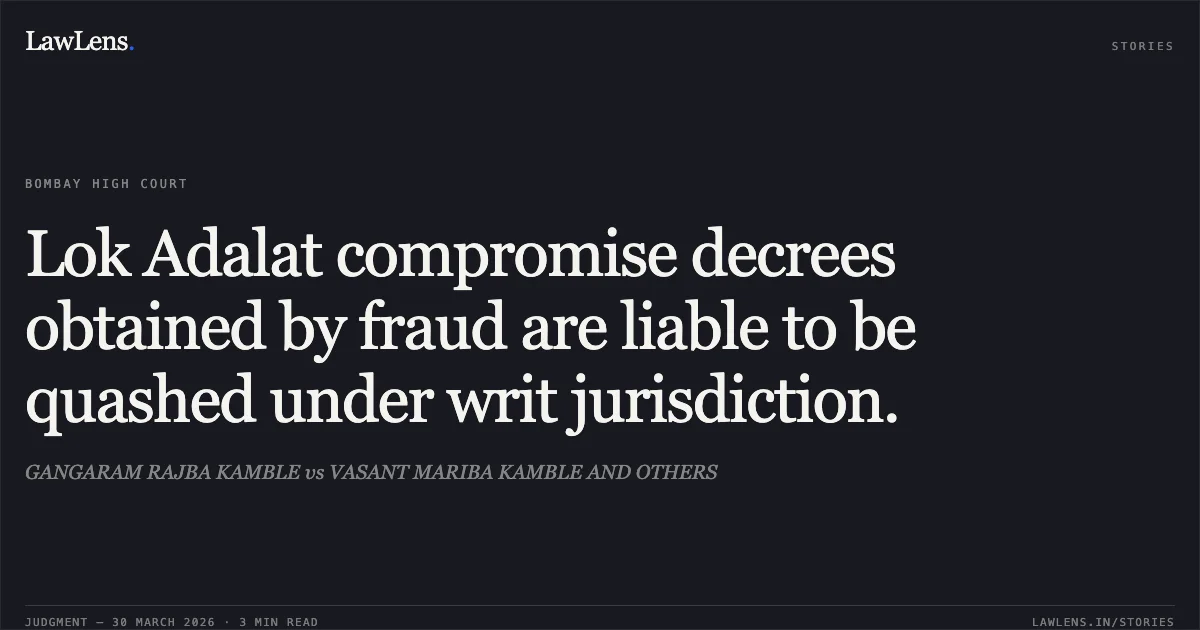
The High Court allowed the Writ Petition, quashing and setting aside the compromise decree dated February 13, 2016
The court held that once fraud is established, the finality of a Lok Adalat award under the Legal Services Authorities Act cannot bar judicial review under Article 227
Source reference: p. 9The court ordered the restoration of R.C.S. No. 47 of 2016 to the file of the Trial Court for a fresh hearing on its merits, ensuring all parties are given a fair opportunity to be heard
Source reference: p. 10Acts & Sections Cited
1 provisions across 1 statute referred to in this judgment. Each provision opens on LawLens.
Legal Services Authorities Act, 19871
Original Court PDF
GANGARAM RAJBA KAMBLEvsVASANT MARIBA KAMBLE AND OTHERS
Click to open original judgment
Original judgment, available to read, download and summarize on LawLens.in