Facts
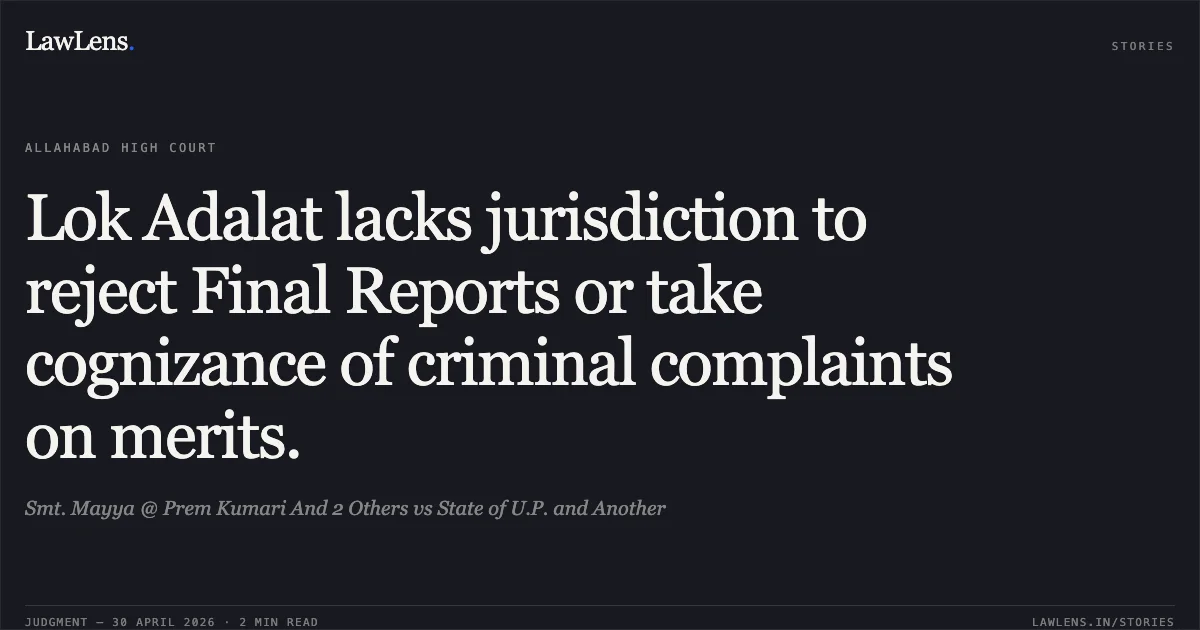
The applicants challenged an order dated 09.12.2017 passed by the Judicial Magistrate, Banda, in a National Lok Adalat, which rejected a police Final Report (FR) in NCR No. 141/2015 and treated the protest petition filed by the complainant as a complaint case.
Source reference: para. 5-6Following this registration, the applicants were subsequently summoned via an order dated 28.03.2024 to face trial under Sections 323, 504, and 506 of the IPC.
Source reference: para. 6, 20The applicants moved the High Court under Section 528 of the BNSS (formerly Section 482 Cr.P.C.) seeking to quash the proceedings on the grounds that a Lok Adalat lacks the jurisdiction to perform such judicial functions.
Source reference: para. 6Issues
1. Whether a Magistrate, while presiding over a Lok Adalat, has the jurisdiction to reject a police Final Report and register a matter as a complaint case.
Source reference: para. 8, 122. Whether a summoning order and subsequent criminal proceedings are legally sustainable if they originate from a jurisdictional nullity passed in a Lok Adalat.
Source reference: para. 14, 16Law Applied
The Court primarily applied Sections 20 and 21 of the Legal Services Authorities Act (LSA), 1987, which mandate that Lok Adalats are conciliatory forums limited to facilitating settlements; if no compromise is reached, the record must be returned to the regular court.
Source reference: para. 9, 18The Court relied on State of Punjab v. Ganpat Raj (2006) and Estate Officer vs. Colonel HV Mankotia (2021), which established that Lok Adalats lack adjudicatory power to decide cases on merits.
Source reference: para. 7, 15The court cited Pepsi Foods Ltd. v. Special Judicial Magistrate (1998) regarding the requirement for judicial mind in summoning orders, and the principle that jurisdictional nullity taints every consequential step.
Source reference: para. 11, 14Reasoning
The Court reasoned that a Magistrate's role in a Lok Adalat is strictly limited to facilitating consent-based settlements. Rejecting a Final Report and taking cognizance under Section 190 Cr.P.C./BNSS are purely judicial functions that must be performed in a regular court setting, not within a Lok Adalat panel.
Source reference: para. 8, 12In the present case, the Lok Adalat assumed an adjudicatory role by rejecting the Final Report and ordering the registration of a complaint in the absence of any consensus between parties.
Source reference: para. 17Since Section 20(5) of the LSA Act requires the Lok Adalat to return the case to the regular court if no settlement is reached, the order dated 09.12.2017 was a jurisdictional nullity. Consequently, as the foundation of the case was void, the subsequent summoning order dated 28.03.2024 was deemed vitiated.
Source reference: para. 12, 14, 16Holding
The Court held that Lok Adalats are not adjudicatory forums and cannot pass judicial orders such as rejecting a police report or taking cognizance.
The application was allowed, and the High Court quashed the order dated 09.12.2017, the summoning order dated 28.03.2024, and the entire proceedings of Complaint Case No. 725/नौ/2017.
Source reference: para. 21-22Acts & Sections Cited
5 provisions across 3 statutes referred to in this judgment. Each provision opens on LawLens.
Bharatiya Nagarik Suraksha Sanhita, 20231
Legal Services Authorities Act, 19873
Court-Fees Act, 18701
Original Court PDF
Smt. Mayya @ Prem Kumari And 2 OthersvsState of U.P. and Another
Click to open original judgment
Original judgment, available to read, download and summarize on LawLens.in


