Facts
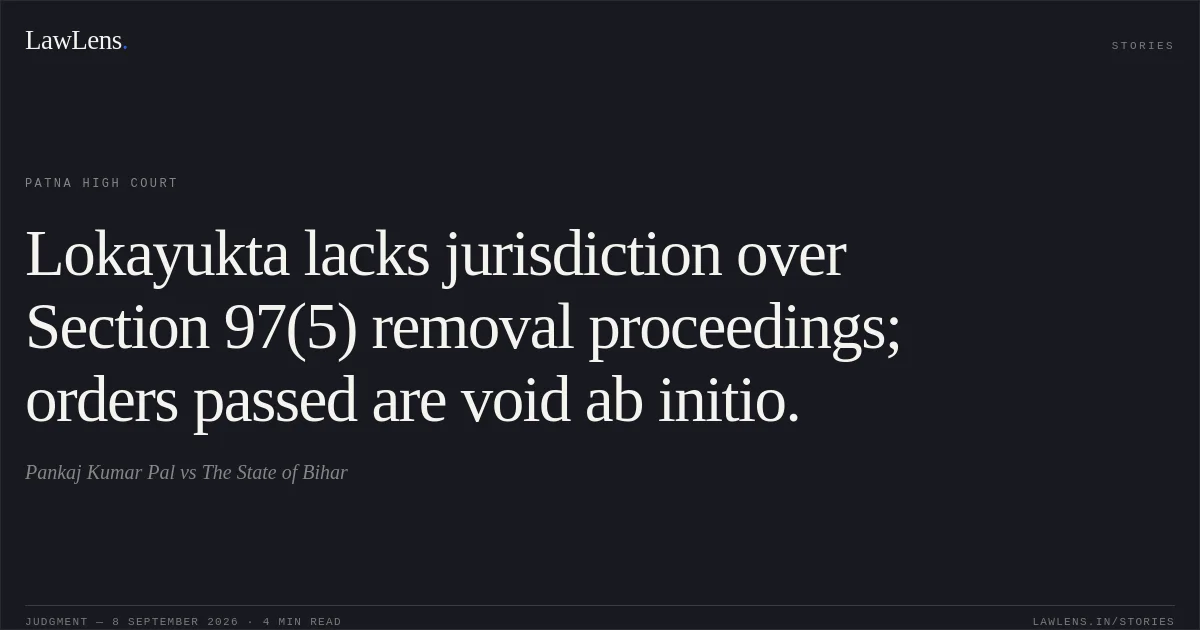
The petitioner, who was District Magistrate, Bhojpur, challenged the order dated 06.05.2021 passed by the Judicial Member, Lokayukta, Bihar in Case No. 05/Lok (Panchayat) 177/2012, whereby adverse observations were made against him and directions were issued to the concerned authorities to take appropriate action.
Source reference: p.1; para. 2In 2011, Reeta Devi was elected Sarpanch and Karishma Devi Up-Sarpanch of Gram Katchahry, Dhamar.
Source reference: pp.2–3; para. 5Following disputes between them, Reeta Devi filed a complaint against Karishma Devi before the Principal Secretary, Panchayati Raj Department under Section 97(5) of the Bihar Panchayati Raj Act, 2006 on 15.03.2012, while Karishma Devi filed a counter-complaint against Reeta Devi before the Lokayukta on 18.10.2012 seeking her removal under the same provision.
Source reference: pp.2–3; para. 5Pursuant to directions issued in an earlier writ petition, the petitioner obtained an enquiry report through the Sub-Divisional Officer and forwarded it to the Panchayati Raj Department on 01.07.2014.
Source reference: pp.4–5; para. 8By 2016, the terms of the Sarpanch and Up-Sarpanch had expired and fresh elections had been held, but the Lokayukta proceeded with the matter and passed the impugned order in 2021.
Source reference: pp.6–10; paras. 10–15Issues
Whether the Judicial Member, Lokayukta, Bihar had jurisdiction to entertain and decide a complaint seeking removal of a Sarpanch under Section 97(5) of the Bihar Panchayati Raj Act, 2006, when that power was vested in the Government.
Source reference: pp.7–10; paras. 13–16Whether the Lokayukta could make adverse findings and recommend disciplinary action against the petitioner, a District Magistrate, in the absence of any allegation or finding of corruption, lack of integrity, or an offence under the Prevention of Corruption Act, 1988.
Source reference: pp.13–21; paras. 21–29Whether the impugned order was liable to be set aside as void for want of subject-matter jurisdiction.
Source reference: pp.10–13, 20–22; paras. 16–20, 28–31Law Applied
Section 97(5) of the Bihar Panchayati Raj Act, 2006 vests the Government with the power to remove a Sarpanch or Up-Sarpanch, after providing a reasonable opportunity of explanation, on the statutory grounds specified therein.
Source reference: pp.7–9; para. 13Under the Bihar Lokayukta Act, 2011, the Lokayukta’s power to recommend disciplinary proceedings against a public servant is conditioned by the statutory requirements, particularly Section 27, including a finding disclosing commission of an offence under the Prevention of Corruption Act, 1988.
Source reference: pp.13–16; paras. 21–23The Court relied on Bipin Bihari Singh v. State of Bihar, C.W.J.C. No. 18053 of 2019, holding that the Lokayukta cannot direct disciplinary proceedings in the absence of the jurisdictional conditions under Section 27.
Source reference: pp.16–18; paras. 24–26The Court further relied on Dharmendra Kumar v. State of Bihar, C.W.J.C. No. 3599 of 2020, holding that the Lokayukta is not a “super executive” and cannot directly impose or order service-related measures beyond the Act.
Source reference: pp.18–20; para. 27The Court further applied the principle that an order passed by an authority lacking inherent subject-matter jurisdiction is a nullity and void ab initio, as recognised in Pimpri Chinchwad New Township v. Vishnudev Cooperative Housing Society, Balvant N. Viswamitra v. Yadav Sadashiv Mule, and Chiranjilal Shrilal Goenka v. Jasjit Singh.
Source reference: pp.10–13; paras. 17–20Reasoning
The Court held that Section 97(5) of the 2006 Act assigned the power to remove a Sarpanch or Up-Sarpanch exclusively to the Government, particularly the competent authority in the Panchayati Raj Department.
Source reference: pp.7–10; paras. 13–16Therefore, the complaint filed before the Lokayukta seeking Reeta Devi’s removal was outside the Lokayukta’s subject-matter jurisdiction.
Source reference: pp.7–10; paras. 13–16The Lokayukta’s further adverse findings against the petitioner were independently unsustainable because the original complaint contained no allegation against him or any other governmental authority, and there was no finding of corruption, lack of integrity, or commission of an offence under the Prevention of Corruption Act, 1988.
Source reference: pp.20–21; para. 28Consequently, the statutory conditions for action or recommendation under Section 27 of the 2011 Act were absent.
Source reference: pp.20–21; para. 28The Court also noted that the terms of the concerned Sarpanch and Up-Sarpanch had expired in 2016, rendering the underlying dispute academic, yet the Lokayukta continued the proceedings and issued the impugned order in 2021.
Source reference: p.9; para. 15Since the Lokayukta lacked inherent jurisdiction over the subject matter, the proceedings and consequential adverse directions were void and could not be sustained.
Source reference: pp.10–13, 20–22; paras. 16–20, 28–30Holding
The High Court answered the jurisdictional issues in favour of the petitioner.
It held that the Judicial Member, Lokayukta, Bihar had no jurisdiction to entertain the complaint under Section 97(5) of the Bihar Panchayati Raj Act, 2006 or to issue adverse directions against the petitioner in the absence of the statutory requirements under the Bihar Lokayukta Act, 2011.
Source reference: pp.20–22; paras. 28–30The order dated 06.05.2021 was declared wholly without jurisdiction and void ab initio and was set aside.
Source reference: p.22; paras. 30–32The writ petition was allowed, with no order as to costs.
Source reference: p.22; paras. 30–32Acts & Sections Cited
8 provisions across 3 statutes referred to in this judgment. Each provision opens on LawLens.
Bihar Lokayukta Act, 20115
BIHAR PANCHAYAT RAJ ACT, 20062
Court Fees (Bihar Amendment) ACT, 20081
Original Court PDF
Pankaj Kumar PalvsThe State of Bihar
Click to open original judgment
Original judgment, available to read, download and summarize on LawLens.in