Facts
Respondent No. 1–Union raised a demand for regularisation of 34 workers. The dispute was referred to the Industrial Tribunal, Ahmedabad, in Reference (I.T.) No. 242 of 2016. The reference was ultimately pursued in respect of 27 workers who had worked as daily-wage Safai Kamdars from different dates, including 2004, 2007 and 2008.
Source reference: p.2The Industrial Tribunal partly allowed the reference by directing the petitioners to appoint the 27 workers as permanent Safai Workmen from their respective dates of appointment, while denying back wages for the period preceding the award dated 28 November 2025 and treating that period as notional. It also directed consideration of retirement benefits such as pension and gratuity.
Source reference: p.2The Municipality challenged the award under Articles 226 and 227 of the Constitution, contending that the workers had not been appointed through the prescribed recruitment procedure, had not established completion of 240 days in the preceding 12 months, and that regularisation would impose an unsustainable financial burden.
Source reference: p.3The evidence showed continuous service, payment of wages, availability of vacant Safai Kamdar posts, and appointment of other Safai Kamdars in 2012 while the concerned workers remained daily wagers.
Source reference: pp.4, 6–7Issues
1. Whether the Industrial Tribunal erred in directing regularisation of the 27 daily-wage Safai Kamdars despite their appointment not having been made strictly in accordance with the prescribed recruitment procedure.
Source reference: pp.3–52. Whether the petitioners’ alleged financial constraints constituted a valid ground to deny regularisation to workers who had rendered long and continuous service.
Source reference: p.53. Whether the Tribunal’s award suffered from perversity or illegality warranting interference under Articles 226 and 227 of the Constitution.
Source reference: p.8Law Applied
The Court exercised its judicial-review jurisdiction under Articles 226 and 227 of the Constitution.
Source reference: p.1It distinguished between an illegal appointment, which violates the core constitutional scheme or statutory recruitment requirements and cannot ordinarily be regularised, and an irregular appointment, involving procedural lapses such as failure to notify an employment exchange or conduct open competitive selection, which may be regularised in appropriate cases where the employee has rendered long-standing service.
Source reference: pp.4–5The Court further applied the principle that continuous and uninterrupted service for a prolonged period, particularly against available sanctioned or vacant posts, may justify regularisation where the employer has consistently accepted the employee’s services.
Source reference: pp.5–7The Gujarat Municipality Act and applicable recruitment requirements were considered in the context of the petitioners’ contention, but no specific statutory provision or precedent was expressly cited in the judgment.
Source reference: p.3; no citationReasoning
The Court found that the 27 workers had continuously worked for approximately 14 to 26 years and had been paid wages for their services, a factual position that the petitioners could not effectively controvert.
Source reference: pp.4–5Although the appointments were not shown to have followed every prescribed recruitment procedure, the Court held that the petitioners had not established that the appointments were against sanctioned and valid posts or that the workers lacked the requisite qualifications; consequently, the appointments were treated as irregular rather than illegal.
Source reference: p.5The evidence also disclosed 49 posts for Safai Kamdars, vacancies in 2025, and the appointment of other Safai Kamdars in 2012, despite the continued availability of the concerned workers.
Source reference: p.6This circumstance supported the Tribunal’s finding of unfair labour practice.
Source reference: pp.6–7The plea of financial incapacity was rejected because the petitioners produced no material proving an actual financial crisis, and financial hardship alone could not defeat the workers’ claim after prolonged service.
Source reference: p.5Since the petitioners failed to demonstrate perversity, illegality, or infirmity in the award, the Court declined to exercise supervisory jurisdiction.
Source reference: p.8Holding
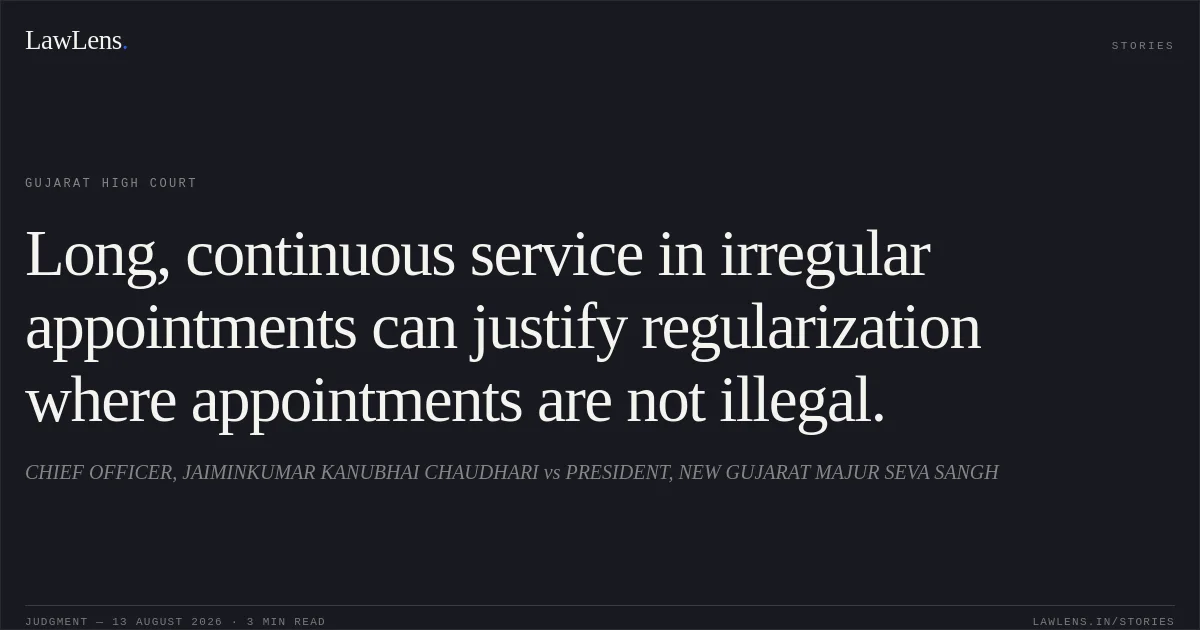
The High Court held that the workers’ appointments were irregular, not illegal, and that their long, continuous service, the existence of vacancies, and the Municipality’s conduct justified the Tribunal’s direction for regularisation.
The alleged financial constraints were insufficiently proved and did not warrant denial of relief.
Source reference: p.5The petition was dismissed on merits, the Rule was discharged, and the petitioners were directed to comply with the Industrial Tribunal’s award dated 28 November 2025 within six weeks.
Source reference: p.8Original Court PDF
CHIEF OFFICER, JAIMINKUMAR KANUBHAI CHAUDHARIvsPRESIDENT, NEW GUJARAT MAJUR SEVA SANGH
Click to open original judgment
Original judgment, available to read, download and summarize on LawLens.in