01Facts
The respondents instituted Title Suit No. 10 of 2022 against the petitioners’ predecessor, seeking declaration of right, title and interest over land known as Wahlakhiat.
¶ 3In the connected injunction proceeding, the Trial Court directed the parties to maintain status quo by order dated 9 June 2023.
¶ 3After the petitioners filed proceedings alleging violation of the status quo direction, the respondents preferred Misc. Civil Appeal No. 10 of 2024 on 3 September 2024, accompanied by an application under Section 5 of the Limitation Act seeking condonation of 294 days’ delay.
¶ 3, 8–9The respondents attributed the delay principally to the illness of their advocate and relied on medical prescriptions.
¶ 3, 8–9The petitioners contended that the actual delay was 392 days, that the certified copy was applied for only on 16 December 2023—130 days after the order—and that the respondents remained represented and participated in the Trial Court proceedings during the relevant period.
¶ 4–7, 9, 17–18The District Council Court condoned the delay by order dated 10 November 2025, leading to the present revision petition.
¶ 1, 302Issues
i.Whether the District Council Court was justified in condoning the respondents’ delay in filing the appeal solely on the ground of the alleged illness and inability of their advocate, without a satisfactory explanation for the entire period of delay.
¶ 10–16ii.Whether the respondents were required to explain the delay both during the prescribed limitation period and after its expiry, including the 130-day delay in applying for the certified copy.
¶ 15–17iii.Whether the Appellate Court erred by condoning 294 days when the actual delay was allegedly 392 days, without independently calculating the period of delay.
¶ 1803Law Applied
The Court applied Section 5 of the Limitation Act, 1963, under which delay may be condoned only upon showing “sufficient cause” for the entire period from commencement of limitation until actual filing.
¶ 15–16Section 12(2) permits exclusion of the time requisite for obtaining a certified copy, but does not dispense with an explanation for delay in applying for that copy.
¶ 17The Court relied on Rafiq v. Munshilal, (1981) 2 SCC 788, concerning the principle that a litigant should not ordinarily suffer for counsel’s lapse, but clarified through Rajneesh Kumar v. Ved Prakash, (2024) 12 SCC 336, and Salil Dutta v. T.M. & M.C. Private Ltd., (1993) 2 SCC 185, that counsel’s negligence is not by itself sufficient to condone long and inordinate delay.
¶ 11–12It further applied Shivamma (Dead) by LRs v. Karnataka Housing Board, 2025 SCC OnLine SC 1969, holding that courts must reject gross negligence, deliberate inaction and casual indifference, while requiring stronger justification as the length of delay increases.
¶ 13The Court distinguished the liberal approach in Collector, Land Acquisition, Anantnag v. Mst. Katiji, (1987) 2 SCC 107, because that case involved only four days’ delay.
¶ 13It also held, consistently with Mukesh Ramdevji Agarwal v. Balmukund Dhruvanarayan Lohiya, that exclusion of certified-copy time does not eliminate the obligation to explain the delay in seeking the copy.
¶ 17Provisions in the judgment · 2 · Linked ones open on LawLens
Limitation Act, 1963 Section 12Section 5
04Reasoning
The Court found that the respondents had not explained why they failed to challenge the 9 June 2023 order within the prescribed period or why they waited 130 days to apply for its certified copy.
¶ 16–17Their continued participation in the Trial Court proceedings, including representation on several dates and filing of a list of witnesses on 7 June 2024, demonstrated awareness of the litigation and undermined the assertion that they were wholly dependent on an incapacitated advocate.
¶ 9, 14The medical prescriptions did not establish that the advocate was bedridden or totally incapable throughout the relevant period, and the Appellate Court failed to scrutinize the medical material or the Trial Court record.
¶ 10, 14Given the delay of more than nine months as claimed, and more than one year in actual terms, the respondents bore a heightened burden to provide a cogent explanation for every period of delay.
¶ 12, 14, 18–19The Appellate Court therefore acted improperly in accepting the advocate-illness explanation mechanically and in failing to determine whether the actual delay was 294 or 392 days.
¶ 12, 14, 18–1905Holding
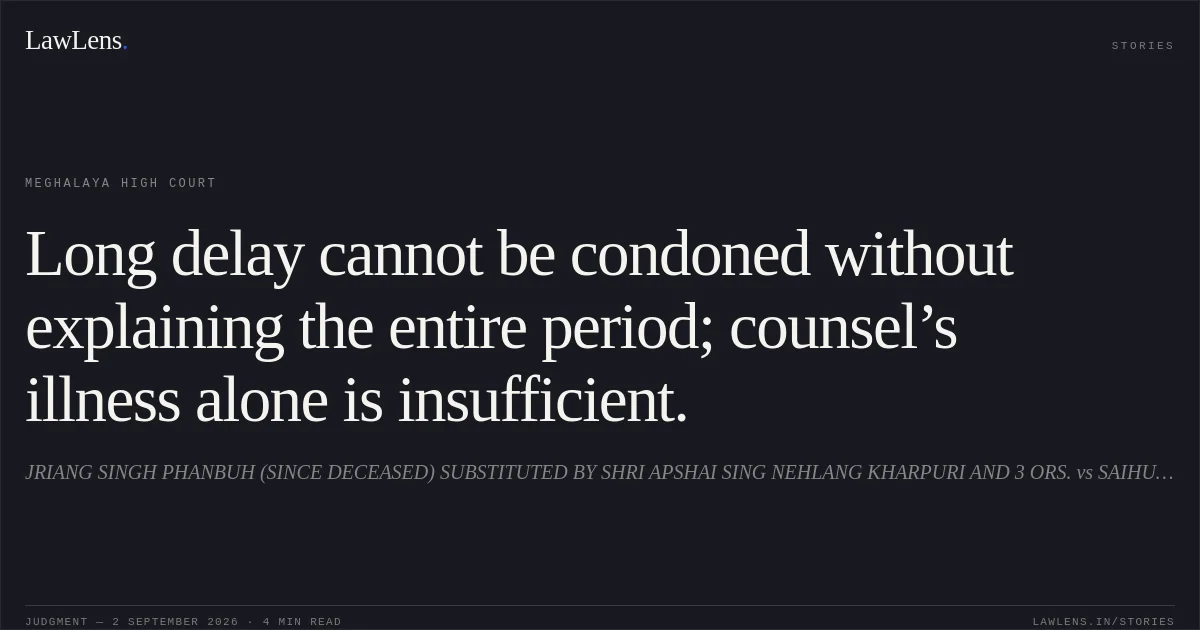
The High Court held that the respondents failed to establish sufficient cause for the entire period of delay and that the District Council Court erred in condoning the delay without examining the relevant record or calculating the actual period of delay.
¶ 16, 18–19The order dated 10 November 2025 in Misc. Case No. 139 of 2024 was set aside and quashed.
¶ 20Consequently, Misc. Civil Appeal No. 10 of 2024 pending before the Judge, District Council Court, Shillong, was also quashed.
¶ 21The civil revision petition was allowed.
¶ 20–21Original Court PDF
JRIANG SINGH PHANBUH (SINCE DECEASED) SUBSTITUTED BY SHRI APSHAI SING NEHLANG KHARPURI AND 3 ORS.vsSAIHUNLANG PHANBUH AND ANR.
Click to open original judgment
Original judgment, available to read, download and summarize on LawLens.in