Facts
The plaintiffs sued for possession of land, alleging that the defendant had encroached upon it in 1985 and constructed a dwelling.
Source reference: para. 2–3The defendant claimed that Sarnu had orally gifted him the land in 1949; alternatively, he claimed title by adverse possession.
Source reference: para. 2–3The Trial Court found the plaintiffs to be owners, rejected the adverse-possession plea, and partly decreed the suit: it awarded the plaintiffs the vacant portion but not the portion under the defendant’s construction, directing payment of the average market value for the constructed portion.
Source reference: para. 7The First Appellate Court reversed, holding that the defendant had acquired title by adverse possession.
Source reference: para. 8The plaintiffs appealed.
Source reference: no citationIssues
1. Whether the First Appellate Court erred in holding that the defendant had acquired title by adverse possession, when his case included a claim of possession under an alleged gift from Sarnu
Source reference: para. 92. Whether the plaintiffs’ title-based suit for possession was barred by limitation because the defendant’s possession began before the alleged 1985 encroachment
Source reference: paras. 12, 30–36Law Applied
Under Article 65 of the Limitation Act, 1963, a title-based suit for possession must be brought within twelve years from when the defendant’s possession becomes adverse to the plaintiff; the plaintiff need not prove possession within twelve years of filing if the defendant fails to establish adverse possession.
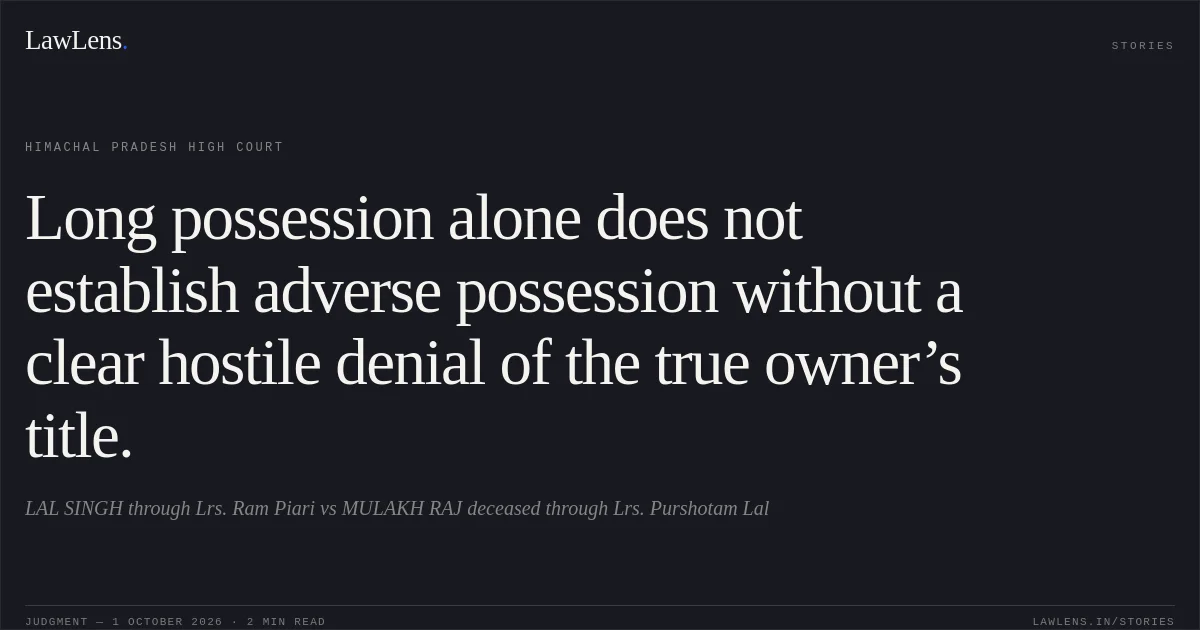
Source reference: paras. 30–34Adverse possession requires clear pleading and proof of possession that is open, peaceful, continuous, and hostile to the true owner’s title, with the claimant identifying when and how the possession became hostile; mere long possession is insufficient.
Source reference: paras. 24–29The Court relied on, among other authorities, Tilak Raj v. Bhagat Ram, Shishi Ram v. Megh Chand, Pritu alias Pritam Singh v. Balwant Singh, and Bhag Singh v. Basant Kaur for these principles.
Source reference: paras. 24–28, 30–33Reasoning
Evidence of house-tax payments and the electricity connection supported the conclusion that the defendant had occupied the property for many years, but did not establish that his possession had become hostile to the plaintiffs’ title.
Source reference: paras. 17–19, 23, 29The defendant did not produce his application before the revenue authorities to show that he had asserted a hostile claim, and the revenue entry recording his possession followed an order made in 1986.
Source reference: paras. 17–19, 23, 29His alleged gift was not proved, but the failure of that claim did not itself prove adverse possession.
Source reference: paras. 20–24, 29Because the defendant did not establish when or how his possession became hostile, the First Appellate Court wrongly equated long possession with adverse possession.
Source reference: paras. 20–24, 29The limitation objection therefore failed: the defendant had not proved the adverse possession necessary to start the Article 65 period.
Source reference: paras. 30–36Holding
The High Court answered the substantial question of law in favour of the plaintiffs, holding that the First Appellate Court erred in finding that the defendant had acquired title by adverse possession.
It allowed the appeal, set aside the First Appellate Court’s judgment and decree, and restored the Trial Court’s judgment and decree, including its directions concerning the vacant and constructed portions of the land.
Source reference: para. 38Original Court PDF
LAL SINGH through Lrs. Ram PiarivsMULAKH RAJ deceased through Lrs. Purshotam Lal
Click to open original judgment
Original judgment, available to read, download and summarize on LawLens.in