Facts
The petitioners, serving as lecturers or instructors in Government Polytechnic Colleges for periods ranging from approximately 12 to 25 years, challenged orders dated 5 January 2024 rejecting their requests for regularisation from their respective initial appointment dates.
Source reference: paras. 2–3, 5–6; pp. 2–6They had initially been engaged on a part-time basis and were brought under consolidated pay from 2019; the State contended that their appointments did not comply with the recruitment rules or reservation requirements and were not against sanctioned posts.
Source reference: paras. 2–3, 5–6; pp. 2–6The petitioners sought regularisation and consequential benefits under Article 226 of the Constitution.
Source reference: p. 2Issues
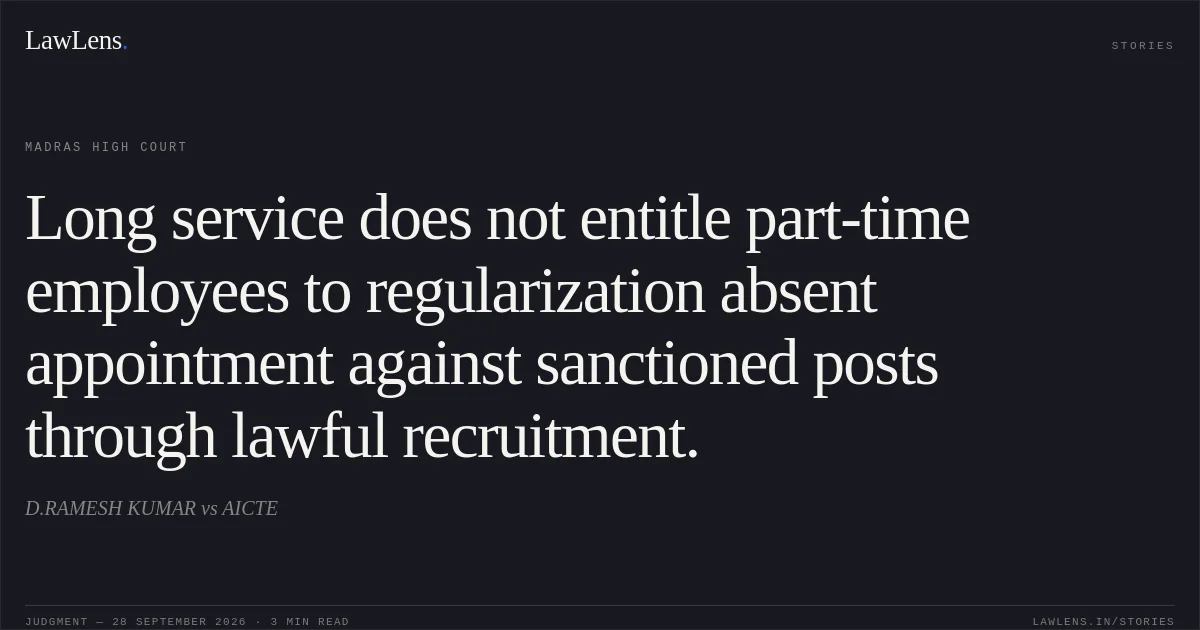
Whether the petitioners’ long service in Government Polytechnic Colleges entitled them to regularisation or absorption, notwithstanding that they were engaged on a part-time basis and their appointments did not follow the prescribed recruitment process.
Source reference: paras. 9–14; pp. 8–10Whether the impugned orders rejecting regularisation were liable to be quashed in light of the preference and age relaxation provided to the petitioners in the recruitment process, and the Division Bench’s decision in a similar matter.
Source reference: paras. 11–17; pp. 8–14Law Applied
The Court applied the principle that long service, by itself, does not entitle an employee to regularisation where the initial appointment was illegal or was not made through a lawful, open recruitment process against a sanctioned vacant post.
Source reference: paras. 14–16; pp. 10–14It relied on Secretary to Government, School Education Department, Chennai v. R. Govindaswamy, (2014) 4 SCC 769, and the Division Bench decision in W.A. No. 1063 of 2022 and connected cases (20 April 2022), which declined regularisation in a similar context while recognising preference in recruitment subject to applicable rules and cut-off marks.
Source reference: paras. 14–16; pp. 10–14The Court also construed G.O. (Ms.) No. 74 as extending regularisation to full-time, but not part-time, employees.
Source reference: para. 12; p. 9The petitioners’ reliance on Dharam Singh v. State of U.P., 2025 INSC 998, and Sukhendu Bhattacharjee v. State of Assam, 2026 INSC 523, was noted, but the Court found the question whether the petitioners held sanctioned posts decisive.
Source reference: para. 13; p. 10Reasoning
The Court accepted that breaks in service during college vacations were artificial, but held that this did not resolve the central question of the legality and nature of the initial appointments.
Source reference: para. 8; p. 7It found that reservation requirements and recruitment rules had not been followed and that adequate publicity had not been given.
Source reference: para. 9; p. 8The appointment order for the lead petitioner described him as a part-time Instructor, not as a Lecturer appointed against a sanctioned post; the Court further observed that no sanctioned Instructor post existed.
Source reference: para. 14; p. 10Long service therefore could not create a right to regularisation.
Source reference: para. 14; p. 10The Court also noted that the petitioners had been allowed to compete in recruitment with age relaxation up to 57 years and two additional marks, and that G.O. (Ms.) No. 74 did not extend regularisation to part-time employees.
Source reference: paras. 10–12; pp. 8–9Following the Division Bench ruling in the materially similar case, the Court found no basis to interfere with the rejection orders.
Source reference: paras. 15–17; pp. 10–14Holding
The Court held that the petitioners were not entitled to regularisation on the basis of their long service, given the nature and deficiencies of their appointments and the absence of a right to regularisation under the applicable Government Order.
It dismissed all the writ petitions and closed the connected miscellaneous petitions, with no order as to costs.
Source reference: paras. 17–18; p. 14Original Court PDF
D.RAMESH KUMARvsAICTE
Click to open original judgment
Original judgment, available to read, download and summarize on LawLens.in