Facts
The appellant, belonging to the general category, applied for the post of Junior Clerk pursuant to an advertisement dated 11 July 1997. After undergoing the written examination and interview, he was placed second in the select list dated 31 July 1997. An appointment letter dated 12 September 1997 was issued to him, and he joined service. The appointment was described as temporary, although the appellant contended that it was against a substantive vacancy.
Source reference: paras. 3–4The respondents subsequently asserted that the appellant had been appointed against a leave vacancy caused by Smt. Pratima Saxena. It was further contended that the two advertised general-category posts had been filled by Shri Vimal Saxena through compassionate appointment and Shri Syed Akram Ali, who had ranked first in the selection. On that basis, the appellant’s appointment was treated as being against a non-existent or leave vacancy, and his services were terminated by order dated 13 September 2000.
Source reference: paras. 5–7The learned Single Judge dismissed the appellant’s writ petition challenging the termination. In the intra-court appeal, the appellant relied upon his long and uninterrupted service from 1997 and submitted that, having been selected and appointed pursuant to the advertised recruitment process, he could not be deprived of service and retirement benefits because of an administrative error attributable to the State.
Source reference: paras. 2, 8–9, 13Issues
Whether the appellant, having been selected and appointed pursuant to an advertisement for substantive vacancies, could be terminated on the ground that the vacancies had subsequently ceased to exist or had been filled through compassionate appointment.
Source reference: paras. 8–9, 16Whether the State could alter the basis of the recruitment after completion of the selection process and issuance of the appointment order, thereby adversely affecting the appellant’s accrued rights.
Source reference: paras. 15–17Whether, after nearly thirty years of service, the appellant was entitled at least to retirement benefits notwithstanding the dispute concerning the existence or status of the post.
Source reference: paras. 20–22Law Applied
The Court applied Article 14 of the Constitution and the principles of non-arbitrariness, fairness, legitimate expectation, and protection against changing the “rules of the game” after commencement or completion of a recruitment process.
Source reference: paras. 15–21Relying on Tej Prakash Pathak v. Rajasthan High Court, the Court held that the recruitment procedure must be transparent, non-discriminatory, rational, and consistent with the applicable rules and advertisement.
Source reference: paras. 15–17The Court also referred to Jaggo v. Union of India for the principle that the State cannot misuse temporary classifications to deny fairness and security to employees who have rendered long, continuous service in essential governmental functions.
Source reference: paras. 10–14Bholanath v. State of Jharkhand and Basheshar Nath v. Commissioner of Income Tax were relied upon for the proposition that contractual or temporary terms cannot operate as a waiver of constitutional protections where State action is violative of Article 14.
Source reference: paras. 18–19The Court further invoked legitimate expectation and held that retirement benefits accrued by reason of length of service need not remain dependent upon the continued existence of the post.
Source reference: paras. 20–22Reasoning
The Court found that two general-category posts had been advertised and that the appellant had completed the selection process, received an appointment order, and joined service. The State did not issue any corrigendum or otherwise inform candidates that the vacancies had been reduced or superseded by subsequent compassionate appointments.
Source reference: para. 9Consequently, the State could not, after creating a legitimate expectation through the selection and appointment process, rely upon its own subsequent administrative action to prejudice the appellant.
Source reference: paras. 16–17Although the respondents characterized the appointment as one against a leave or non-existent vacancy, the Court placed emphasis on the appellant’s bona fide selection, long tenure, absence of any allegation of misconduct, and the State’s role in permitting him to continue in service for almost thirty years.
Source reference: paras. 13, 20–21The Court therefore moulded the relief: even if the status of the post was disputed, denial of retirement benefits after such prolonged service would be inequitable, particularly because the entitlement to such benefits was treated as arising from the length of service rather than the continued existence of the post.
Source reference: para. 22Holding
The Special Appeal was allowed.
The Court set aside the learned Single Judge’s order dated 31 August 2012 and directed the respondent authorities to calculate and release the appellant’s admissible retirement benefits, including pension and gratuity, within thirty days of receiving a certified copy of the judgment.
Source reference: para. 23The Court thus granted relief on the basis of fairness, legitimate expectation, long and undisputed service, and the constitutional prohibition against arbitrary State action, without treating the disputed status of the post as defeating the appellant’s claim to retirement benefits.
Source reference: paras. 22–24Original Court PDF
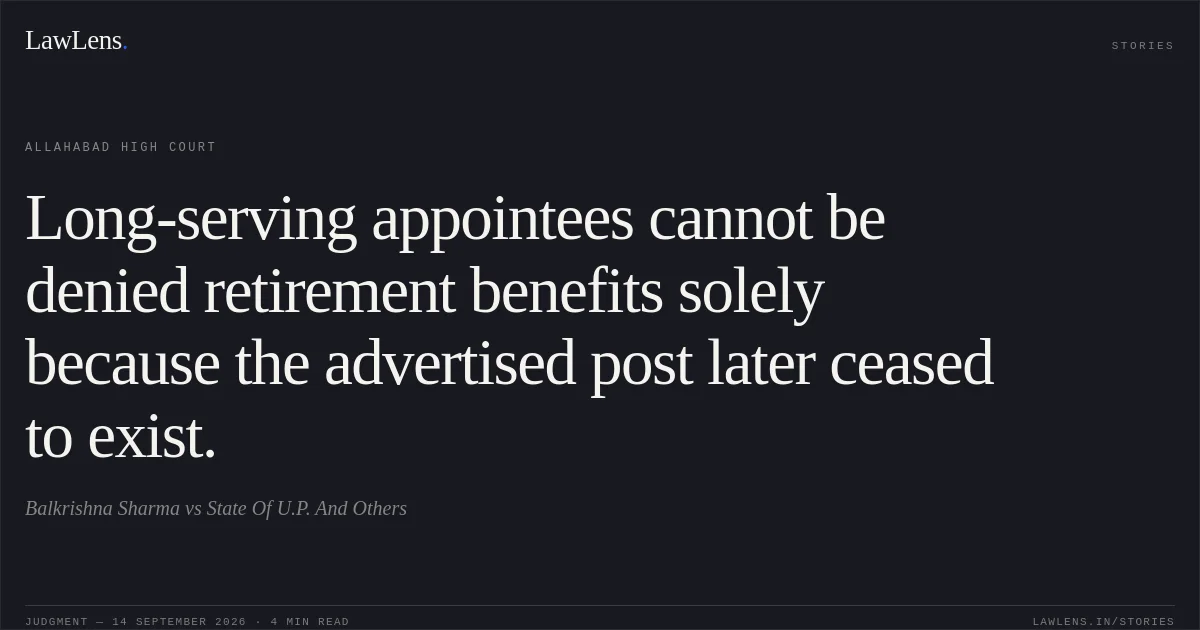
Balkrishna SharmavsState Of U.P. And Others
Click to open original judgment
Original judgment, available to read, download and summarize on LawLens.in