Facts
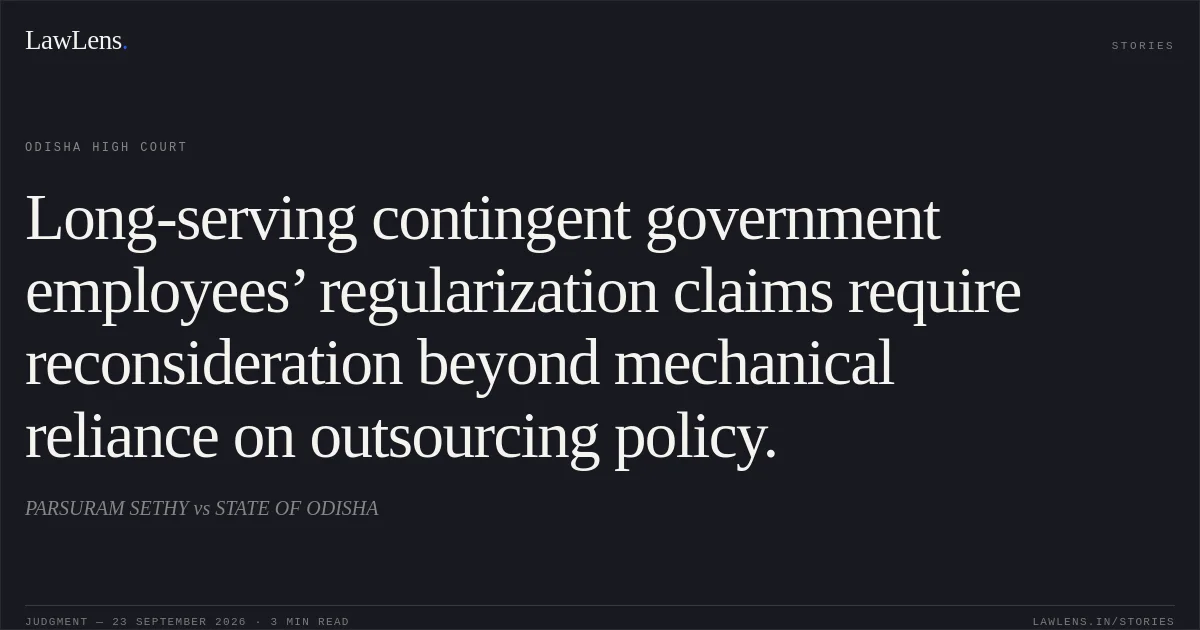
The petitioner was engaged as a contingent-paid Night Watcher in the office of the Child Development Project Officer, Satyabadi, pursuant to an order dated 3 July 2001, and joined on 4 July 2001.
Source reference: p.20, para. 6He continued in service for several years and sought regular absorption as a Night Watchman or Peon against an existing vacant post in the concerned office or an ICDS project within Puri District.
Source reference: p.2, para. 3Pursuant to an earlier order of the High Court dated 4 June 2021 in W.P.(C) No. 17149 of 2021, the petitioner’s claim was rejected by order dated 16 March 2022.
Source reference: p.20, para. 4The rejection relied, inter alia, on the Government notification dated 12 November 2013, under which such posts were to be filled through outsourcing.
Source reference: p.20, para. 5It was undisputed that the petitioner continued to work even after rejection of his claim.
Source reference: p.20, para. 6.1Issues
1. Whether the rejection of the petitioner’s claim for regularization, based primarily on his contingent-paid status and the outsourcing policy, was legally sustainable in light of his prolonged and continuing service?
Source reference: pp.20–21, paras. 5–6.22. Whether the petitioner’s claim was required to be reconsidered in light of the principles laid down by the Supreme Court in Jaggo, Shripal, Dharam Singh, Bhola Nath, and Sukhendu Bhattacharjee concerning exploitative temporary employment and the State’s duty to act as a model employer?
Source reference: pp.3–19, paras. 4.1–4.6; p.20, para. 6.13. Whether the petitioner should be protected from coercive action pending reconsideration of his claim?
Source reference: p.19, para. 4.7; p.21, para. 6.3Law Applied
The Court applied the constitutional guarantees of non-arbitrariness, equality of opportunity, and dignified livelihood under Articles 14, 16 and 21 of the Constitution.
Source reference: pp.7–10, paras. 17–20Relying on Jaggo v. Union of India, it treated prolonged engagement in essential, recurring and integral governmental work as relevant to determining whether temporary employment had been misused to deny stability and regular benefits.
Source reference: pp.3–6, paras. 4.2 and 4.6Shripal v. Nagar Nigam, Ghaziabad established that Uma Devi cannot be used as a shield to justify exploitative engagements continuing for years and that bureaucratic limitations cannot override the rights of workers performing perennial duties.
Source reference: p.6, para. 4.3Dharam Singh v. State of U.P. deprecated outsourcing and ad hoc engagement as devices to evade lawful recruitment and sanctioned posts, and emphasized the State’s status as a constitutional employer.
Source reference: pp.6–10, para. 4.4Bhola Nath v. State of Jharkhand held that contractual nomenclature cannot immunize arbitrary State action and that long-serving employees cannot be abruptly discontinued without cogent reasons and a speaking decision.
Source reference: pp.10–12, para. 4.5Sukhendu Bhattacharjee v. State of Assam clarified that Uma Devi is not an absolute bar to regularization, particularly where appointments are irregular rather than illegal and employees have performed essential governmental functions continuously for long periods.
Source reference: pp.12–19, paras. 4.6 and 74–79The Court also considered the State’s outsourcing policy dated 12 November 2013, but held that the petitioner’s claim required fresh consideration rather than mechanical rejection.
Source reference: p.20, paras. 5–6.1Reasoning
The Court found that the petitioner had been continuously serving as a Night Watcher since 2001 and remained in service even after the impugned rejection.
Source reference: p.20, para. 6His continued engagement indicated that the work had not ceased to be necessary or merely temporary.
Source reference: p.20, para. 6In light of the Supreme Court’s recent emphasis on the perennial nature of duties, the constitutional obligations of the State as an employer, and the impermissibility of relying mechanically on temporary nomenclature or outsourcing, the earlier rejection could not be sustained without a fresh and legally informed examination.
Source reference: pp.3–19, paras. 4.1–4.6; p.20, para. 6.1The Court did not itself declare the petitioner entitled to regularization; instead, it held that the competent authority had to reconsider his claim by taking the cited Supreme Court decisions into account.
Source reference: p.21, para. 6.2Pending that decision, protection from coercive action was warranted because the petitioner continued to discharge the same work and his claim remained under adjudicatory reconsideration.
Source reference: p.21, paras. 6.2–6.3Holding
The High Court quashed the rejection order dated 16 March 2022.
Opposite Party No. 1 was directed to take a fresh decision on the petitioner’s claim for regularization, specifically considering Jaggo, Shripal, Dharam Singh, Bhola Nath, and Sukhendu Bhattacharjee, within three months from receipt of the order.
Source reference: p.21, para. 6.2The petitioner was permitted to submit the judgment and the cited authorities to the competent authority.
Source reference: p.21, para. 6.3Until the fresh decision was taken, no coercive action was to be taken against him.
Source reference: p.21, para. 6.3The writ petition was accordingly disposed of, without granting immediate regularization.
Source reference: p.21, para. 7Original Court PDF
PARSURAM SETHYvsSTATE OF ODISHA
Click to open original judgment
Original judgment, available to read, download and summarize on LawLens.in