Facts
The employees were initially engaged by Delhi Technological University (“University”) on contractual/temporary terms in 2010–2011 for posts including Office Assistant, Assistant Librarian, Driver, Technical Assistant, Mechanic and Storekeeper, pursuant to a newspaper advertisement and a walk-in selection process.
Source reference: para. 14, p. 7At the time, no recruitment rules were in force. They continued working for the University for more than fifteen years, without adverse material being placed against their performance.
Source reference: para. 14, p. 7The employees previously sought regularisation in W.P. (C) 4221/2014, which was permitted to be withdrawn with liberty to pursue the claim if the University failed to regularise them.
Source reference: paras. 15–17, pp. 7–9In separate proceedings, the High Court directed payment of allowances equivalent to those available to regular employees, which the University implemented.
Source reference: para. 18, p. 9The University conducted a regular recruitment process in 2018–2019, granting age relaxation to the contractual employees; only one employee was successful.
Source reference: para. 19, p. 10The employees thereafter filed W.P. (C) 10830/2020. The learned Single Judge directed the University to undertake a structured review of sanctioned strength and vacancies, create or augment posts where institutionally required, and consider regularisation.
Source reference: paras. 1–4, pp. 2–4Both sides appealed: the employees sought direct regularisation from the date of initial engagement, while the University challenged the regularisation directions altogether.
Source reference: paras. 1–4, pp. 2–4Issues
1. Whether employees initially engaged on contractual terms through a walk-in selection process, without recruitment rules or appointment against sanctioned posts, could be considered for regularisation after more than fifteen years of continuous service?
Source reference: paras. 20–26, pp. 10–172. Whether the absence of sanctioned vacancies or posts barred the Court from directing consideration of regularisation, or justified creation of supernumerary posts?
Source reference: paras. 28–29, pp. 18–203. Whether the employees were entitled to automatic regularisation from the date of their initial engagement, rather than merely consideration for regularisation?
Source reference: paras. 3, 9, 26 and 29, pp. 3, 6, 17 and 20Law Applied
The Court applied State of Karnataka v. Umadevi (3), (2006) 4 SCC 1, which prohibits regularisation of illegal or backdoor appointments but distinguishes such appointments from irregular appointments of qualified persons made through a selection process and continued for long periods against sanctioned posts; paragraph 53 of Umadevi contemplates one-time consideration of such irregular appointees.
Source reference: paras. 20–21, pp. 10–12It relied on Vinod Kumar v. Union of India, (2024) 9 SCC 327, holding that continuous service in duties indistinguishable from those of regular employees and selection through a process resembling regular recruitment may justify reconsideration of temporary status, and that procedural non-compliance does not necessarily render an appointment illegal.
Source reference: paras. 21–22, pp. 10–13The Court further relied on Jaggo v. Union of India, 2024 SCC OnLine SC 3826, Shripal v. Nagar Nigam, 2025 SCC OnLine SC 221, and Pawan Sharma v. State (NCT of Delhi), 2025 SCC OnLine Del 8313, which recognise that prolonged, continuous and unblemished service in essential and recurring functions may warrant regularisation where the initial appointment was not illegal, mala fide, surreptitious or a backdoor entry.
Source reference: paras. 23–25, pp. 13–17It also relied on Sukhendu Bhattacharjee v. State of Assam, 2026 SCC OnLine SC 909, which holds that Umadevi is not an absolute bar to regularisation merely because the initial engagement was not against sanctioned posts, particularly where the State has retained employees for long periods in essential recurring functions and acted arbitrarily in denying fair treatment.
Source reference: para. 28, pp. 18–20Reasoning
The Court held that the employees’ initial engagement was irregular but not illegal.
Source reference: para. 22, p. 12Although the appointments were not made under recruitment rules and followed a walk-in process advertised only in Delhi newspapers, the employees had undergone a selection process and their appointments could not be characterised as backdoor entries, particularly since no recruitment rules existed in 2010–2011.
Source reference: para. 22, p. 12Their uninterrupted service for more than fifteen years, performance of perennial and institutionally necessary duties, absence of adverse material, and treatment comparable to regular employees in respect of allowances demonstrated that the temporary character of their engagement had substantially evolved over time.
Source reference: paras. 14, 18–19 and 26, pp. 7, 9–10 and 17Applying the distinction in Umadevi between illegal and irregular appointments, and the later decisions recognising fairness in cases of prolonged contractual employment, the Court rejected the University’s contention that regularisation was legally impermissible.
Source reference: paras. 26–29, pp. 17–20However, it did not grant automatic regularisation from the initial date of engagement.
Source reference: paras. 26–29, pp. 17–20It modified the Single Judge’s directions by requiring consideration against the relevant posts and, where posts or vacancies were unavailable, through creation of supernumerary posts.
Source reference: paras. 26–29, pp. 17–20Holding
The appeals were disposed of and the Single Judge’s judgment was modified.
The University was directed to consider regularisation of the employees on the respective posts against which they were engaged in 2010–2011, if vacancies were available.
Source reference: paras. 29–31, pp. 20–21If the relevant posts were not sanctioned or vacancies were unavailable, the University was directed to create supernumerary posts for the purpose of considering regularisation.
Source reference: paras. 29–31, pp. 20–21Such supernumerary posts would cease upon the superannuation of the employees regularised against them.
Source reference: paras. 29–31, pp. 20–21The entire exercise was required to be completed within three months from 19 August 2026.
Source reference: paras. 29–31, pp. 20–21No order as to costs was made.
Source reference: paras. 29–31, pp. 20–21Original Court PDF
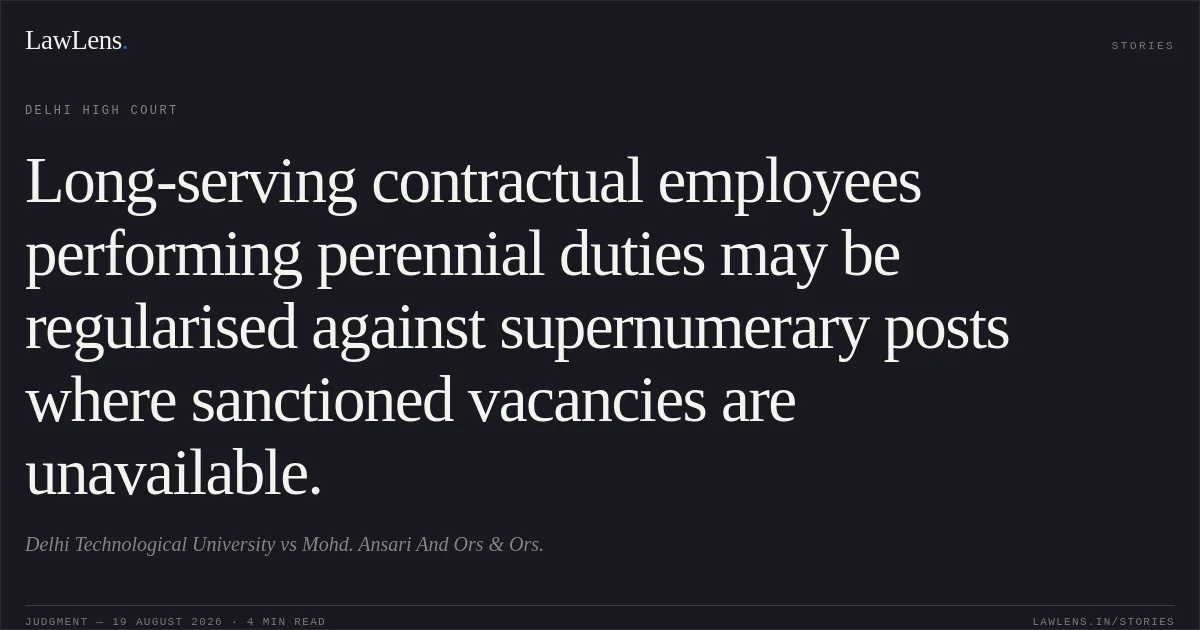
Delhi Technological UniversityvsMohd. Ansari And Ors & Ors.
Click to open original judgment
Original judgment, available to read, download and summarize on LawLens.in