01Facts
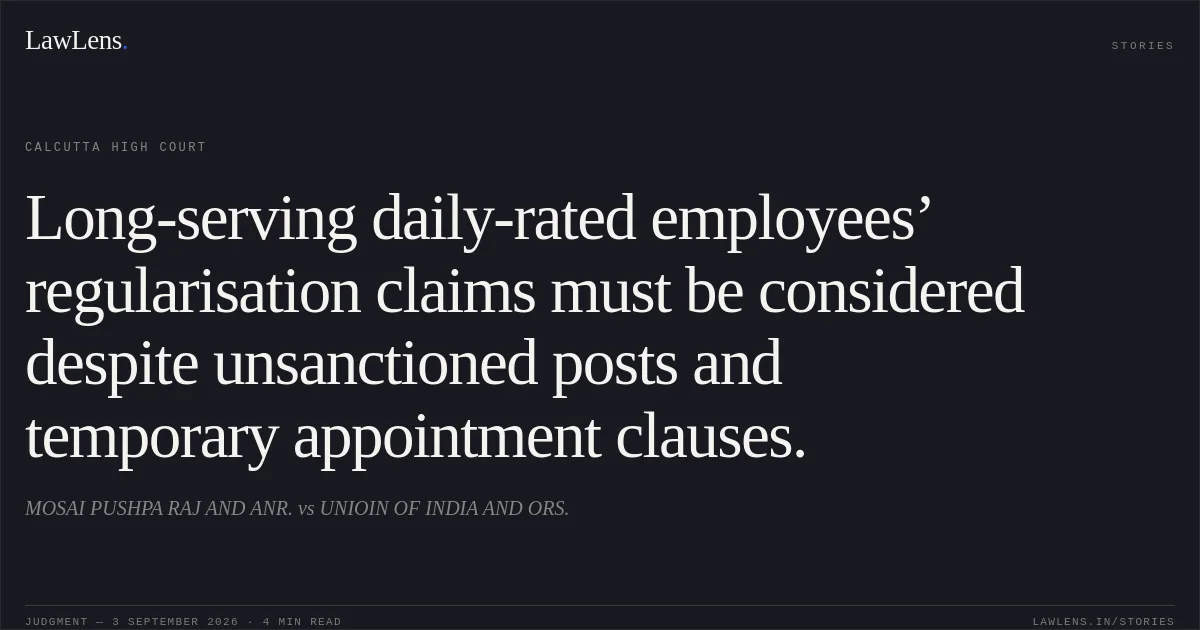
The petitioners in WPA/484/2023 were engaged as Mazdoors/DRMs on a daily-rated basis in 2011 after their names were sponsored by the Employment Exchange and they participated in an interview conducted by a Selection Committee.
¶ 3The petitioners in WPA/485/2023 were appointed as Data Entry Operators in 2012–2013 after responding to a public advertisement, satisfying the prescribed qualifications and passing a trade test.
¶ 3Their appointment orders initially limited engagement to three months and expressly stated that they would not claim regular appointment or continuation in service.
¶ 3–7Despite these terms, all petitioners were repeatedly continued in service and had completed more than ten years of uninterrupted and satisfactory service by the time the writ petitions were filed.
¶ 8They sought regularization from their initial dates of appointment with consequential benefits and payment under the Office Memorandum dated 7 June 1988, namely, 1/30th of pay plus dearness allowance at the minimum of the relevant pay scale where their duties were equivalent to those of regular employees.
¶ 9–13The respondents opposed regularization on the grounds that the petitioners were engaged only as a stop-gap arrangement, against non-sanctioned posts, and under appointment terms disclaiming any right to regularization.
¶ 14–1802Issues
i.Whether employees appointed through an employment-exchange/public selection process and continued for more than ten years on a daily-rated basis could be considered for regularization despite their engagement against non-sanctioned posts and the restrictive clauses in their appointment orders.
¶ 20–24, 34–39ii.Whether the petitioners were entitled to payment under the Office Memorandum dated 7 June 1988 at the rate of 1/30th of pay plus dearness allowance at the minimum of the relevant pay scale, subject to a determination that their duties were equivalent to those of regular employees.
¶ 11–12, 23, 35–4003Law Applied
The Court applied the principle in Secretary, State of Karnataka v. Umadevi (3), (2006) 4 SCC 1, that employees who have worked for ten years or more without the protection of an interim or judicial order should be considered under an appropriate regularization scheme, ordinarily against duly sanctioned posts.
¶ 34It also relied on the Office Memorandum dated 7 June 1988, which discourages engagement of daily-rated workers for regular work and provides for payment of 1/30th of pay plus dearness allowance at the minimum of the relevant pay scale where daily-rated and regular employees perform the same work.
¶ 11–12The Court further relied on Jaggo v. Union of India, Vinod Kumar v. Union of India, Union of India v. K. Velajagan, Dharam Singh v. State of U.P., Bhola Nath v. State of Jharkhand, Mohammad Sagir v. Nagar Nigam Kanpur and Sukhendu Bhattacharjee v. State of Assam, which emphasize that the substance and perennial nature of the work, rather than contractual labels, are relevant; prolonged temporary engagement for integral work cannot be used to perpetuate exploitative or arbitrary service conditions; and contractual terms cannot, by themselves, defeat constitutional scrutiny or consideration for regularization.
¶ 25–33Regularization remains an executive and policy function, requiring consideration by the competent authority and, where necessary, creation of sanctioned or supernumerary posts.
¶ 33–3504Reasoning
The Court found that the petitioners had not entered service through a wholly illegal or clandestine appointment: the Mazdoors were selected after Employment Exchange sponsorship and interview, while the Data Entry Operators were selected through public advertisement, qualification assessment and a trade test.
¶ 20Their continuous renewals for over a decade, absence of performance complaints and performance of work integral to the functioning of the District and Sessions Judge’s office indicated that their work was perennial rather than merely temporary or stop-gap.
¶ 21–23The Court held that the absence of sanctioned posts and the disclaimers in the appointment orders could not, standing alone, justify refusing even to consider regularization, particularly where the respondents had continuously extracted the petitioners’ services for more than ten years.
¶ 24, 30, 34–38At the same time, recognizing that regularization and creation of posts fall within the competent authority’s administrative domain, the Court directed consideration rather than granting automatic regularization.
¶ 33–35, 39With respect to remuneration, the Court treated denial of both regularization and the benefit contemplated by the 1988 Office Memorandum as inequitable.
¶ 35–36It therefore directed the respondents to ascertain whether the petitioners’ duties were the same as those performed by regular employees and, if so, to implement the prescribed payment formula.
¶ 4005Holding
The writ petitions were disposed of with a direction to the competent respondent authority to consider the petitioners’ regularization from their respective initial dates of appointment, along with consequential benefits, and to pass and communicate a reasoned decision within twelve weeks from communication of the judgment.
¶ 39Pending that decision, the respondents were directed to examine, within the same period, whether the petitioners performed work equivalent to that of regular employees and, if so, pay them 1/30th of the relevant pay plus dearness allowance at the minimum of the applicable pay scale under the Office Memorandum dated 7 June 1988.
¶ 40The connected applications were disposed of, with no order as to costs.
¶ 41–42Original Court PDF
MOSAI PUSHPA RAJ AND ANR.vsUNIOIN OF INDIA AND ORS.
Click to open original judgment
Original judgment, available to read, download and summarize on LawLens.in