Facts
The six applicants were appointed as "Labour (Temporary)" in 1996 and 1997 at the 58 Forward Medical Stores Depot (FMSD) in Guwahati
Source reference: p. 4, para. 2Although initially temporary, they completed a one-year probation and were treated as regular Central Government employees for nearly 32 years, receiving benefits such as GPF membership, pay fixation under the 2008 Revised Pay Rules, and various allowances (SDA, CEA, HRA)
Source reference: p. 4-5, para. 2; p. 8, para. 7In July 2025, the applicants were verbally informed of their termination and barred from the office premises
Source reference: p. 5, para. 2The respondents contended that the unit (58 FMSD) had permanently relocated to a field/operational area in Jammu & Kashmir
Source reference: p. 6, para. 4Under the Field Service Rules, 1957, civilians over the age of 45 are ineligible for deployment in such areas. Since all applicants exceeded this age, the respondents issued termination notices on 12.06.2025, which the applicants (except Applicant No. 3) allegedly refused to accept
Source reference: p. 6-7, para. 4Issues
1. Whether the summary termination of the applicants’ services, after 32 years of regularized service, was legally sustainable under the CCS Rules and principles of natural justice
Source reference: p. 9, para. 82. Whether the relocation of a unit to a field area and the age restrictions under Field Service Rules justify the termination of long-serving employees without offering an option for continued service
Source reference: p. 9-10, para. 9Law Applied
The court examined the terms of the initial appointment letters which governed probation and termination
Source reference: p. 7, para. 6The respondents relied on the Field Service Rules, 1957 (amended 1969), which prohibits the deployment of civilians over 45 years of age in counter-insurgency operational areas
Source reference: p. 6, para. 4The applicants invoked the Central Civil Services (CCS) Rules, arguing that proper procedures for the termination of regular employees must be followed
Source reference: p. 5, para. 3The Tribunal applied the principle that long-term employment status creates a right against arbitrary termination without due process or the exploration of alternatives
Source reference: p. 9, para. 8Reasoning
The Tribunal observed that the applicants had functioned as regular employees for over three decades, supported by evidence of GPF deductions, CGHS benefits, and official pay bills indicating their projected retirement dates
Source reference: p. 8-9, para. 7The court found that the respondents’ decision to "throw out" the applicants without notice, solely due to the unit’s relocation and the applicants' age, was whimsical and not sustainable in law
Source reference: p. 9, para. 8The Tribunal reasoned that while the Field Service Rules might restrict deployment based on age, the respondents erred by not providing the applicants an option to serve in the new location or adopting a proper legal procedure before termination.
Source reference: p. 9, para. 8-9The court emphasized that the long tenure of service (32 years) necessitated a more equitable approach than summary verbal termination
Source reference: p. 9, para. 8-9Holding
The Tribunal held that the respondents' action was unsustainable in the eye of law
It directed the respondents to take an option from the applicants regarding their willingness to work in Jammu & Kashmir.
Source reference: p. 9-10, para. 9If the applicants agree to work at the new location, the department must re-engage them immediately and allow them to continue until their respective dates of retirement
Source reference: p. 9-10, para. 9Conversely, if the applicants decline the option to work in J&K, the respondents are at liberty to terminate their services
Source reference: p. 10, para. 9The O.A. was disposed of with no order as to costs
Source reference: p. 10, para. 10Original Court PDF
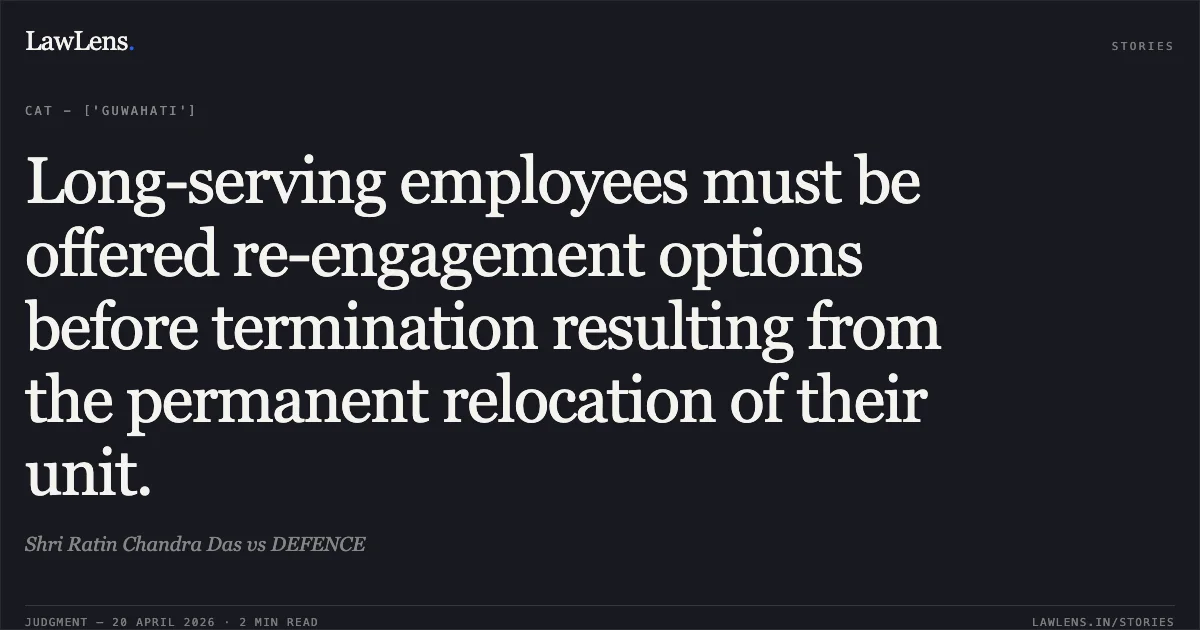
Shri Ratin Chandra DasvsDEFENCE
Click to open original judgment
Original judgment, available to read, download and summarize on LawLens.in