01Facts
The petitioners were engaged as primary/secondary teachers and Class III/Class IV employees in Government Ashram Schools administered by the Tribal Development Department in remote tribal areas of Thane District. Their appointments were made on daily-wage, clock-hour or honorarium terms, allegedly after interviews, but without prior public advertisements. By the time of the present petition, each petitioner claimed to have completed ten or more years of service, with service periods ranging from approximately ten to thirteen years.
¶ 4–7After hearings and verification of documents, the Additional Commissioner, Tribal Development, rejected the petitioners’ claims through orders dated 13 and 14 January 2026. The stated grounds included absence of proof of interviews, non-compliance with prescribed procedure, lack of advertisement, and, in the case of some teachers, failure to possess TAIT/TET-related qualifications.
¶ 7 · pp. 5–7The petitioners challenged those orders under Article 226 of the Constitution and sought quashing of the orders, regularization, pay-scale benefits and protection against termination.
¶ 2 · pp. 2–302Issues
i.Whether the Additional Commissioner’s orders dated 13 and 14 January 2026, rejecting regularization on the grounds of lack of advertisement, alleged absence of interviews and procedural deficiencies, were legally sustainable in view of the earlier decisions of the High Court?
¶ 13–19ii.Whether employees who had completed ten years or more of service in Government Ashram Schools were entitled to regularization in accordance with the principles laid down in Madhukar Bhavanrao Sadgir?
¶ 14, 17–19iii.Whether the petition was maintainable under Article 226 notwithstanding the State’s objection that the petitioners had an alternative remedy before the Maharashtra Administrative Tribunal?
¶ 12 · pp. 9–1003Law Applied
The Court exercised its jurisdiction under Article 226 of the Constitution to review the legality and arbitrariness of the impugned administrative orders.
¶ 2It applied the principles in Secretary, State of Karnataka v. Umadevi, under which illegal back-door appointments cannot ordinarily be regularized, but irregular appointments against sanctioned posts involving long, continuous service may be considered as a one-time measure.
¶ 12, 14–16Relying principally on Madhukar Bhavanrao Sadgir v. State of Maharashtra, the Court held that employees continuously working for ten years or more in sanctioned posts in Government Ashram Schools, performing essential functions for a prolonged period on meagre honorarium, must be considered for regularization, particularly where the State itself failed to undertake a proper selection process.
¶ 14 · pp. 12–14The Court also relied on Bhola Nath v. State of Jharkhand and Jaggo v. Union of India, which distinguish irregular appointments from illegal appointments and hold that prolonged contractual or temporary labels cannot defeat equitable consideration for regularization where employees perform necessary State functions for extended periods.
¶ 15–16State of Rajasthan v. Daya Lal was distinguished as involving appointments not made against sanctioned posts and lacking the relevant circumstances present here.
¶ 1504Reasoning
The Court found it undisputed that the petitioners had completed at least ten years of service by the date of the petition and that they had been engaged to perform continuing and essential teaching and non-teaching functions in Government Ashram Schools.
¶ 13The Court held that the respondents’ reliance on the absence of public advertisements and alleged procedural deficiencies was untenable because the same circumstances had already been considered in Madhukar Bhavanrao Sadgir, where regularization was directed in the context of remote tribal schools and prolonged service on meagre honorarium.
¶ 14, 18The earlier order in the petitioners’ own case had also recorded that they had participated in a selection process and had been selected after interviews.
¶ 10 · pp. 8–9Accordingly, the impugned orders failed to properly apply the binding principles governing regularization and adopted an unduly technical approach inconsistent with the State’s obligation to act as a model employer.
¶ 14, 17–19The Court further held that the State’s reliance on Umadevi and Daya Lal did not assist it because the petitioners’ cases involved long and continuous service in sanctioned and necessary functions, rather than back-door or wholly illegal appointments.
¶ 15–1605Holding
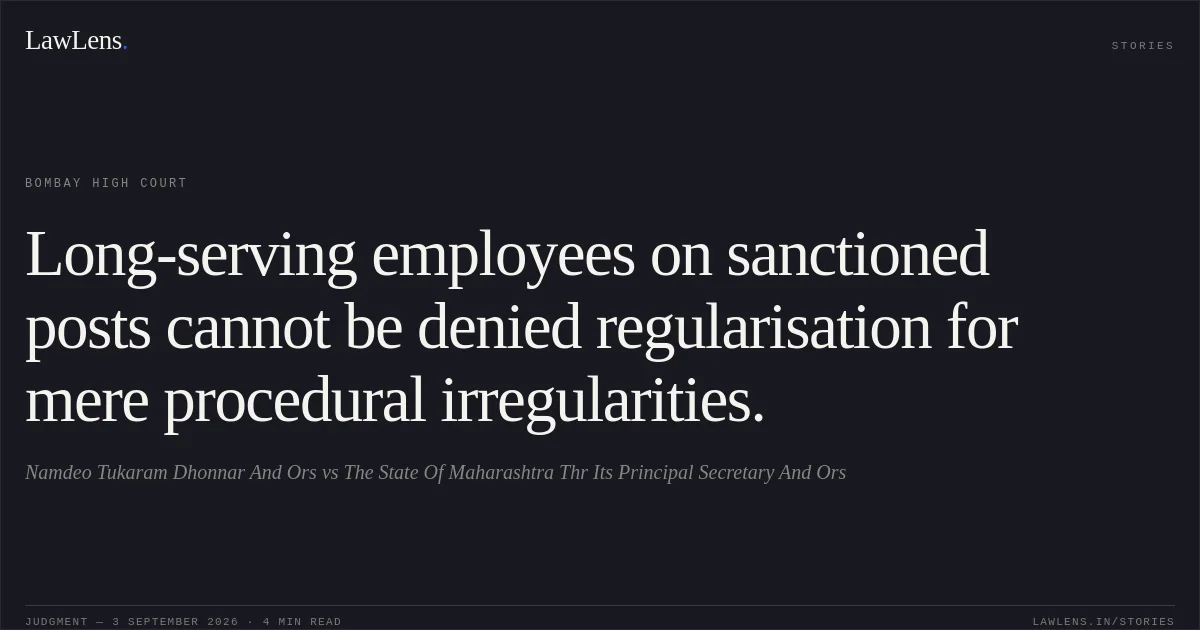
The High Court allowed the petition and quashed the orders dated 13 and 14 January 2026 issued by the Additional Commissioner, Tribal Development.
¶ 19(i)The respondents were directed to regularize the services of petitioners who had completed ten years of service, with effect from the date of completion of ten years or the date of filing of the present writ petition, whichever was later.
¶ 19(ii)Any petitioner terminated after completing ten years of service during the pendency of the petition was directed to be reinstated from the date of filing or the date of completion of ten years, whichever was later.
¶ 19(iii)The petitioners were also granted financial benefits from the date of completion of ten years of service or the date of filing the earlier writ petition, W.P. No. 6693 of 2023, whichever was earlier.
¶ 19(iv)The directions were to be complied with within three weeks of the order being made available to the respondents. Rule was made absolute and the petition was disposed of without costs.
¶ 19(v)–(vi)Original Court PDF
Namdeo Tukaram Dhonnar And OrsvsThe State Of Maharashtra Thr Its Principal Secretary And Ors
Click to open original judgment
Original judgment, available to read, download and summarize on LawLens.in