Facts
The petitioner was appointed as a Section Writer on 4 November 1995 after due procedure and continued to be engaged by the State Government for approximately 31 years.
Source reference: para. 2; p. 3His name appeared in information furnished by the Collector concerning regularization of Section Writers.
Source reference: para. 2; p. 2Several allegedly junior and similarly situated Section Writers were absorbed or regularized as Assistant Grade-III pursuant to orders passed in earlier writ proceedings, while the petitioner’s claim was not considered.
Source reference: para. 2; p. 2In an earlier writ petition, the High Court directed the respondents to consider the petitioner’s case in light of Vishnu Prasad Shrivastava & Ors. and at par with already regularized employees; however, his representation was rejected on 20 January 2022, principally on the ground that he had crossed 40 years of age.
Source reference: para. 2; p. 2The petitioner also sought the benefit of the State Government’s policy dated 7 October 2016, which contemplated classification of eligible daily-wage employees as permanent employees and payment of the minimum of the applicable pay scale.
Source reference: paras. 2.1, 3; pp. 2–3The State contended that the petitioner had not been appointed against a sanctioned vacant post and was therefore not entitled to regularization or classification under the policy.
Source reference: para. 3; p. 3Issues
Whether the petitioner was entitled to regularization or absorption from the date on which allegedly junior and similarly situated Section Writers were regularized, together with consequential seniority and monetary benefits.
Source reference: para. 2; p. 2Whether the petitioner, having been continuously engaged by the State Government for more than ten years, was entitled to classification as a permanent employee and payment of the minimum of the applicable pay scale under the policy dated 7 October 2016.
Source reference: paras. 2.1, 5–8; pp. 3, 7–8Law Applied
The High Court exercised jurisdiction under Article 226 of the Constitution and applied the State Government policy/circular dated 7 October 2016, under which eligible daily-wage employees continuously working for the requisite period could be classified as permanent employees in the appropriate skilled, semi-skilled or unskilled category and paid the minimum of the corresponding pay scale.
Source reference: paras. 5–6; pp. 3–7The Court relied on Articles 38, 39(a) and 43 of the Constitution, which require the State to promote social and economic justice, secure adequate means of livelihood, and endeavour to provide workers with a living wage and a decent standard of life.
Source reference: para. 5; p. 3It further followed the coordinate Bench decisions in Ravi Thakur and Another v. State of Madhya Pradesh and Others, W.P. No. 16466/2018, and Paras Rathore and Another v. State of Madhya Pradesh, W.P. No. 5832/2017, which directed consideration of eligible daily-wage employees for permanent classification and minimum pay under the same policy.
Source reference: para. 6; pp. 4–7The earlier direction concerning consideration of the petitioner’s case in light of Vishnu Prasad Shrivastava & Ors., 2020 (1) MPJR SN 5, was also noted.
Source reference: para. 2; p. 2Reasoning
The Court found that, although the petitioner’s engagement was initially for limited terms, the State repeatedly extended it and continued to utilise his services for more than three decades, demonstrating a continuing requirement for his work.
Source reference: para. 5; p. 3; para. 7; p. 7The Court treated the 7 October 2016 policy as a welfare measure intended to protect long-serving daily-wage employees who could not be regularized because of the absence of sanctioned vacant posts.
Source reference: para. 5; p. 3Applying the coordinate Bench decisions, the Court held that the petitioner could not be denied the policy’s benefits merely because he was treated as temporary or had not been appointed against a sanctioned post, particularly when he had been continuously engaged for well over ten years.
Source reference: paras. 6–7; pp. 4–7The Court did not grant the claimed retrospective regularization, seniority or arrears against the junior employees; instead, it resolved the matter on the narrower basis of entitlement to classification and minimum pay under the 2016 policy.
Source reference: no citationHolding
The petition was allowed and disposed of.
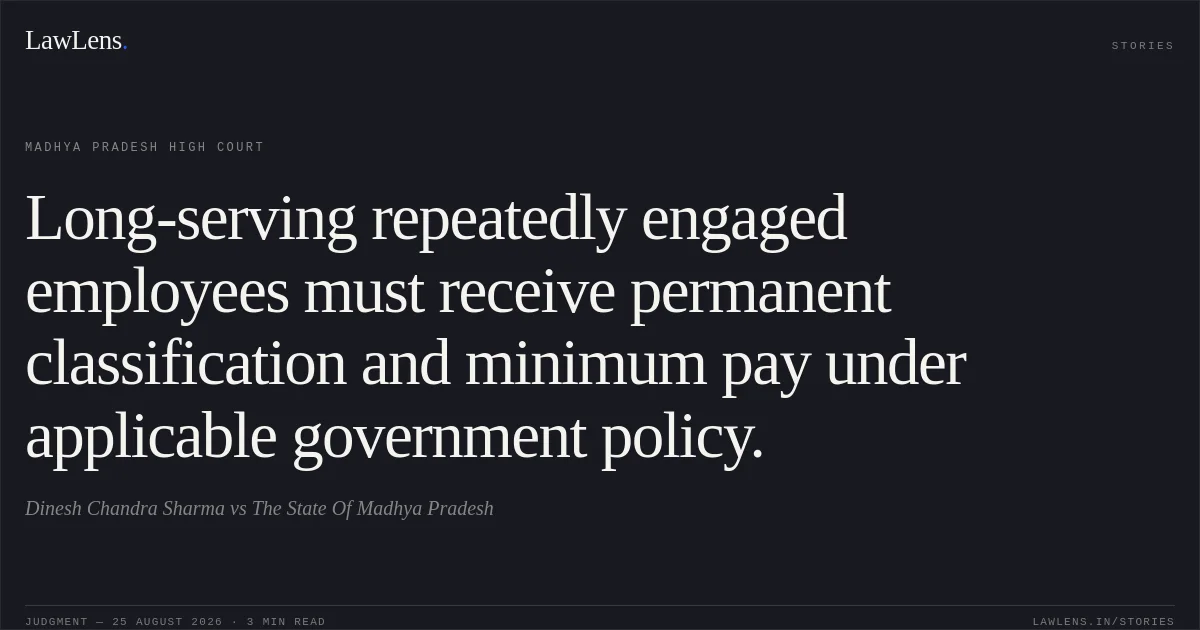
The respondents were directed to pass appropriate orders classifying the petitioner in accordance with the policy/circular dated 7 October 2016 and to extend all consequential benefits available under that policy.
Source reference: para. 8; p. 8The Court consequently granted the petitioner the benefit of permanent classification and the applicable minimum pay-scale-related benefits, but did not expressly order retrospective regularization from the date of regularization of the allegedly junior employees, restoration of seniority, or payment of arrears with 18% interest.
Source reference: paras. 8–9; p. 8Original Court PDF
Dinesh Chandra SharmavsThe State Of Madhya Pradesh
Click to open original judgment
Original judgment, available to read, download and summarize on LawLens.in
![Courts will not interfere with transfers absent mala fides or violation of statutory rules.. M Ramya vs EMPLOYEES STATE INSURANCE CORPORATION (ESIC). CAT - ['Chennai']. LawLens](/stories/thumbnails/courts-will-not-interfere-with-transfers-absent-mala-fides-or-violation-of-statutory-rules-a6845e9ca6f548fca284c51c8351957f.webp)
![Courts cannot direct one-time recruitment age relaxation absent authority in the governing rules or advertisement.. UT OF PUDUCHERRY vs M ANDAL. CAT - ['Chennai']. LawLens](/stories/thumbnails/courts-cannot-direct-one-time-recruitment-age-relaxation-absent-authority-in-the-governing-895d78fde47143e2a8ed0207c4b6a44f.webp)
![A review cannot correct an allegedly erroneous decision absent an error apparent on the record.. Ajit Kumar Jha vs RAILWAY BOARD. CAT - ['Delhi']. LawLens](/stories/thumbnails/a-review-cannot-correct-an-allegedly-erroneous-decision-absent-an-error-apparent-on-the-re-8ac952fd4eba470c92f7da20af72a220.webp)