Facts
WAPCOS had engaged the Petitioners as contractual employees in non-technical categories, with several serving continuously for approximately 10–16 years through successive renewals.
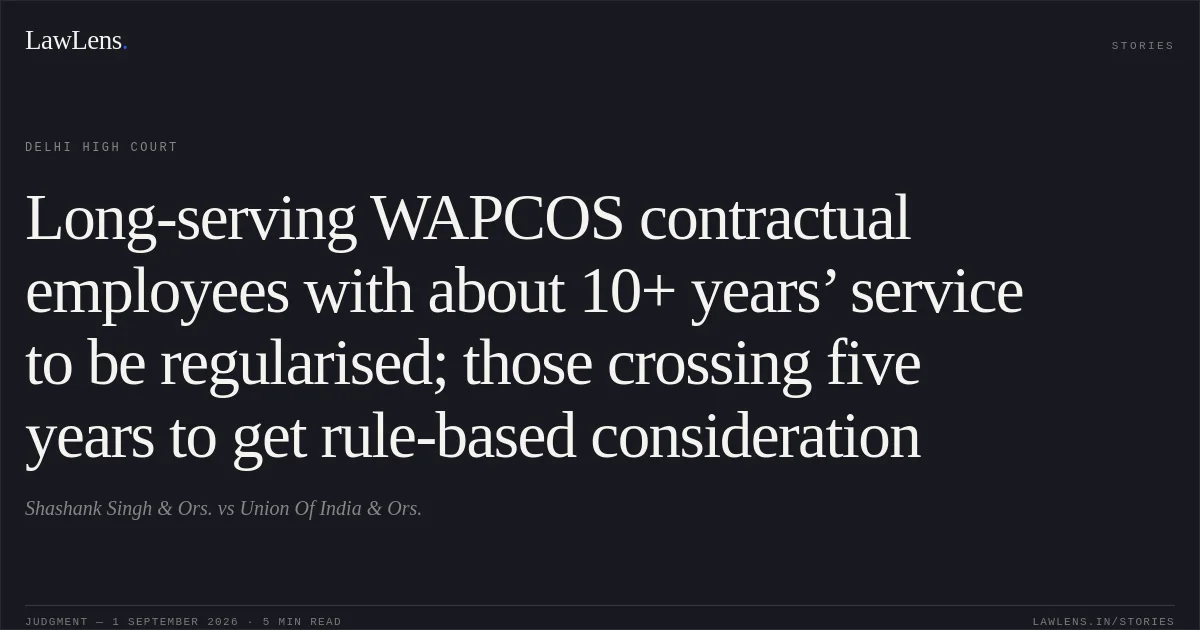
Source reference: paras. 42–48WAPCOS’s Recruitment and Promotion Rules (“R&P Rules”), particularly Guideline (j), contemplated preference and an opportunity for suitable and efficient contractual employees who had completed at least five years of service to be considered for regular appointment against direct-recruitment vacancies, subject to suitability and assessment by a Selection Committee.
Source reference: paras. 42–48Despite retaining and deploying many Petitioners in continuing institutional functions, WAPCOS did not undertake the Guideline (j) exercise in their cases.
Source reference: paras. 49–55On 10 November 2025, WAPCOS decided to discontinue further extensions of contractual engagements in non-technical categories, citing organisational rationalisation, automation, outsourcing and changing manpower requirements.
Source reference: paras. 18–21Notices dated 30 January 2026 invoked the contractual one-month termination clause and sought to end several engagements on 28 February 2026, even where WAPCOS had already granted contractual terms extending up to later dates.
Source reference: paras. 22–25During the proceedings, WAPCOS disclosed that approximately 195 contractual employees had previously been regularised, but stated that subsequent review revealed irregularities in several such exercises.
Source reference: paras. 31–35WAPCOS also relied on a June 2026 restructuring proposal involving surrender of vacant posts and reorganisation of sanctioned strength; the Court held that this later proposal could not retrospectively justify the earlier discontinuance decision.
Source reference: paras. 36–38, 91–97Issues
Whether WAPCOS could discontinue or prematurely terminate the Petitioners’ contractual engagements pursuant to its 10 November 2025 policy and the notices dated 30 January 2026, notwithstanding subsisting contractual terms.
Source reference: paras. 88–102Whether contractual employees who had completed at least five years of service were entitled to consideration under Guideline (j) of WAPCOS’s R&P Rules, despite not having been initially appointed against sanctioned regular posts.
Source reference: paras. 47–55, 103–107Whether long-serving contractual employees who had completed approximately ten years or more of service were entitled to substantive regularisation rather than merely a direction for consideration under Guideline (j).
Source reference: paras. 108–114Whether the Petitioners could claim regularisation on the basis of earlier regularisations carried out by WAPCOS, particularly where WAPCOS alleged that those exercises contained irregularities.
Source reference: paras. 85–87What relief should be granted to Petitioners who had completed five years of service and to those who had not crossed that threshold.
Source reference: paras. 115–119Law Applied
The Court applied the constitutional principles governing public employment under Articles 14 and 16, as explained in Secretary, State of Karnataka v. Umadevi, holding that regularisation is not an independent mode of recruitment and cannot validate an illegal or clandestine initial appointment.
Source reference: para. 56State of Karnataka v. M.L. Kesari was relied upon for the limited scope of the one-time regularisation exercise contemplated in Umadevi.
Source reference: para. 57The Court further relied on Jaggo v. Union of India, Bhola Nath v. State of Jharkhand, Pawan Sharma v. Government of NCT of Delhi, Government of NCT of Delhi v. Pawan Sharma, Mohd. Ansari v. Delhi Technological University and Om Prakash Gaur v. Delhi Technological University to hold that long and continuous service, recurring institutional work, qualifications, a non-illegal mode of entry and the employer’s conduct may justify regularisation or structured consideration; however, Madan Singh v. State of Haryana reaffirmed that long service cannot cure constitutionally impermissible entry.
Source reference: paras. 58–65Under WAPCOS’s own R&P Rules, Guideline (j) created a preferential zone of consideration after five years of contractual service, but did not confer automatic regular status; management’s discretion had to be exercised on relevant, objective and petitioner-specific considerations.
Source reference: paras. 47–55A contractual appointment was not illegal merely because it was not against a sanctioned regular post or did not follow the recruitment process applicable to regular appointments, provided the engagement was made through a recognised and fair contractual recruitment route.
Source reference: paras. 74–84, 103–107Reasoning
The Court held that WAPCOS was entitled prospectively to discontinue the practice of repeatedly extending non-technical contractual engagements, and therefore upheld the 10 November 2025 policy as a future manpower measure.
Source reference: paras. 88–90, 120(i)However, the policy did not repeal Guideline (j) or extinguish claims of employees who had already crossed its five-year threshold after being repeatedly retained by WAPCOS.
Source reference: paras. 90, 97The January 2026 notices were unsustainable insofar as they prematurely terminated subsisting contractual terms: Clause 7 could not be used as a blanket device to curtail terms already granted merely because WAPCOS had decided against future extensions, particularly without petitioner-specific material showing cessation of work or surplusage.
Source reference: paras. 98–101The Court distinguished an illegal “backdoor” appointment from a contractual appointment made under Annexure V; absence of a sanctioned regular post did not by itself invalidate the initial engagement.
Source reference: paras. 74–84, 103–105Earlier regularisations could not establish a claim of negative equality, but they demonstrated that movement from contractual to regular service formed part of WAPCOS’s own framework; defects in earlier exercises could not justify ignoring Guideline (j) altogether.
Source reference: paras. 85–87Employees with ten years or more of actual contractual service, or within six months of completing ten years, were placed in Category A because repeated renewals, continuing institutional work and prolonged failure to apply Guideline (j) made a further open-ended remand inadequate.
Source reference: paras. 108–114Subject only to limited verification of service, qualifications, service record and the legality of entry, they were entitled to regularisation.
Source reference: paras. 108–114Employees who had completed five years but did not fall within Category A were placed in Category B and were entitled to genuine, individual and time-bound consideration by the Selection Committee, while employees below five years fell in Category C and could not invoke Guideline (j).
Source reference: paras. 115–119Holding
The petitions were disposed of with the 10 November 2025 policy upheld prospectively, but the 30 January 2026 notices were set aside insofar as they prematurely terminated subsisting contractual terms.
Category A Petitioners—those with at least ten years of actual contractual service or within six months of that period—were directed to be regularised after limited verification of service, qualifications, adverse records and the legality of their mode of entry; they were to be adjusted against suitable vacancies or, if necessary, provided personal supernumerary posts without disturbing the cadre, reservation roster or seniority of regular employees.
Source reference: para. 120(iii)–(vi)Presently serving Category A employees were to continue until regularisation, while those displaced pursuant to the impugned policy were to be restored prospectively, without back wages for periods of non-service.
Source reference: para. 120(vii)–(ix)Category B Petitioners were to be re-engaged or continued on the same contractual terms and placed before the Selection Committee for petitioner-specific consideration under Guideline (j), with the exercise to be completed within three months.
Source reference: para. 120(xi)–(xviii), (xxi)Category C Petitioners, who had not completed five years by the relevant date, were denied consideration under Guideline (j), without prejudice to independent statutory remedies.
Source reference: para. 120(xix)WAPCOS was directed to complete Category A verification and regularisation within six weeks, and Category B consideration within three months; no order as to costs was made.
Source reference: para. 120(xxi)–(xxii)Original Court PDF
Shashank Singh & Ors.vsUnion Of India & Ors.
Click to open original judgment
Original judgment, available to read, download and summarize on LawLens.in