Facts
The petitioners claimed ownership of 40.34 acres of land in Plot No. 1702, Khata No. 113, Village Tetari, based on a 1912 registered sale deed from the descendant of an Ex-Zamindar
Source reference: para. 5-6Although recorded as "Gairmazarua Khas," the land had been subject to private Jamabandis, rent payments, and even official land acquisitions in 1954 and 2019
Source reference: para. 6-7In 2020, the Circle Officer initiated Jamabandi cancellation proceedings, labeling the land as ‘Sairat’ (government water body) for the "Jal Jeevan Hariyali" scheme and commenced excavation
Source reference: para. 5, 8-9During the pendency of this writ, the Additional Collector cancelled the Jamabandis on 10.01.2026 via I.A. No. 1 of 2026
Source reference: para. 3The State contended the land was a "Jalkar" (fishery) and that the petitioners had alternative remedies
Source reference: para. 10, 15Issues
1. Whether the State can summarily cancel long-standing Jamabandis and excavate land claimed as private property without following due process or seeking civil court intervention.
Source reference: para. 29, 322. Whether the availability of an alternative statutory remedy (appeal) ousts the jurisdiction of the Writ Court when the authorities act with a lack of jurisdiction or overreach judicial propriety.
Source reference: para. 33-353. Whether the impugned order of Jamabandi cancellation passed during the pendency of the writ petition is legally sustainable.
Source reference: para. 31, 37-38Law Applied
The court applied the principle that a long-standing Jamabandi cannot be cancelled by revenue authorities through summary proceedings; the State must instead seek a declaration of title from a Civil Court, as established in Maya Devi & Ors. v. The State of Bihar & Ors. (2014)
Source reference: para. 30, 32Regarding maintainability, the court relied on Rikhab Chand Jain v. Union of India (2025) and Thansingh Nathmal v. Superintendent of Taxes, holding that alternative remedies do not oust writ jurisdiction in cases of jurisdictional error or violation of fundamental rights
Source reference: para. 34It also invoked the "cardinal principle" from the Full Bench in The King v. Parmanand and Others (1949) that executive officials must not take actions that prejudge or disturb a matter sub-judice before a court
Source reference: para. 37Reasoning
The court found significant discrepancies in the State's evidence, noting that the 'Sairat' register cited a different plot (No. 761) and a much smaller area (5.83 acres) than the disputed land (40.34 acres), suggesting a post-facto attempt to justify the excavation
Source reference: para. 23-25The entry "Man" in the Khatiyan could denote seasonal wetlands used privately, and the history of registered transfers and rent receipts supported the petitioners' raiyati claims
Source reference: para. 26-28Critically, the court observed that the Additional Collector’s order to cancel the Jamabandi was passed while the High Court was actively seized of the matter
Source reference: para. 31The court reasoned that such an act was a "truculent" overreach of executive authority intended to circumvent judicial scrutiny
Source reference: para. 38Relegating the petitioners to an appellate authority after five years of litigation would be futile and unjust
Source reference: para. 36Holding
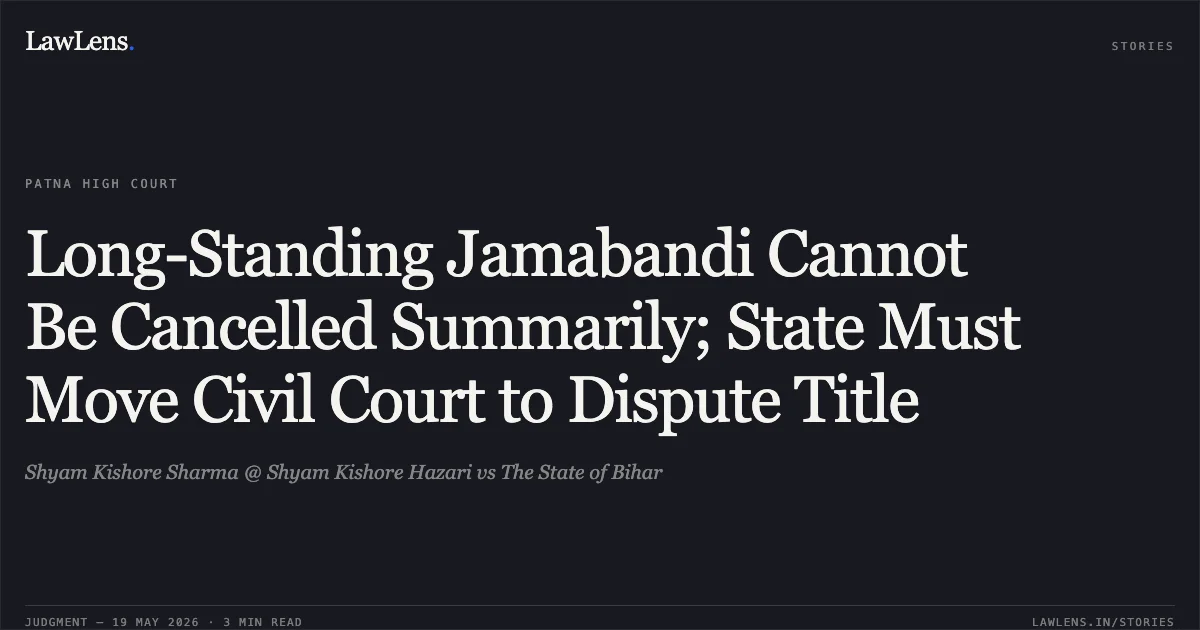
The Court held that if the State disputes the Jamabandi, its only recourse is to file a suit in a Civil Court to set aside the deeds
The Court allowed the writ petition and I.A. No. 1 of 2026, setting aside the Jamabandi cancellation order dated 10.01.2026 as illegal and an overreach of authority
Source reference: para. 38-39, 42The State was directed to refill the excavated portions of the petitioners' private lands and restore the earth
Source reference: para. 40Acts & Sections Cited
2 provisions across 2 statutes referred to in this judgment. Linked provisions open on LawLens.
Petroleum And Minerals Pipelines (Acquisition Of Right Of User In Land) Act, 19621
Right To Fair Compensation And Transparency In Land Acquisition, Rehabilitation and Resettlement Act, 20131
Original Court PDF
Shyam Kishore Sharma @ Shyam Kishore HazarivsThe State of Bihar
Click to open original judgment
Original judgment, available to read, download and summarize on LawLens.in