Facts
The petitioner was engaged as a COPA Instructor on an "academic arrangement" basis at ITI Mendhar vide Order No. 1004 of 2007 dated 30.11.2007
Source reference: p. 4, 8Despite the initial engagement being for one session, the petitioner continued to serve for over 12 years against a sanctioned post created in 2008
Source reference: p. 4, 7His case was recommended for regularization by various local authorities, including the Deputy Commissioner Poonch, but the claim was repeatedly rejected by the Director of Technical Education
Source reference: p. 4-6The respondents contended that the petitioner was not a "contractual" employee under SRO 255 of 2003, but rather an academic arrangement appointee who had executed an affidavit undertaking not to claim regularization
Source reference: p. 8-10The matter was transferred from the Hon'ble High Court of Jammu and Kashmir to the Central Administrative Tribunal (CAT), Jammu Bench
Source reference: p. 2Issues
1. Whether the nature of the petitioner's engagement as an "academic arrangement" excludes him from the purview of the J Civil Services (Special Provisions) Act, 2010
Source reference: p. 17 / para. 132. Whether an undertaking/affidavit executed by an employee can override statutory rights for regularization provided under beneficial legislation
Source reference: p. 18 / para. 153. Whether the petitioner is entitled to regularization after completing more than seven years of continuous service
Source reference: p. 31 / para. 28Law Applied
Jammu and Kashmir Civil Services (Special Provisions) Act, 2010, which mandates the regularization of ad-hoc, contractual, or consolidated appointees after seven years of service
Source reference: p. 5-6, 32Articles 14 and 16 regarding equal opportunity in public employment
Source reference: p. 12, 16Secretary, State of Karnataka v. Uma Devi (2006) regarding the distinction between "illegal" and "irregular" appointments
Source reference: p. 16, 26Jaggo v. Union of India (2024), which held that long-term continuous service in sanctioned functions demands a fair resolution and that procedural formalities should not perpetually deny substantive rights
Source reference: p. 23-27Reasoning
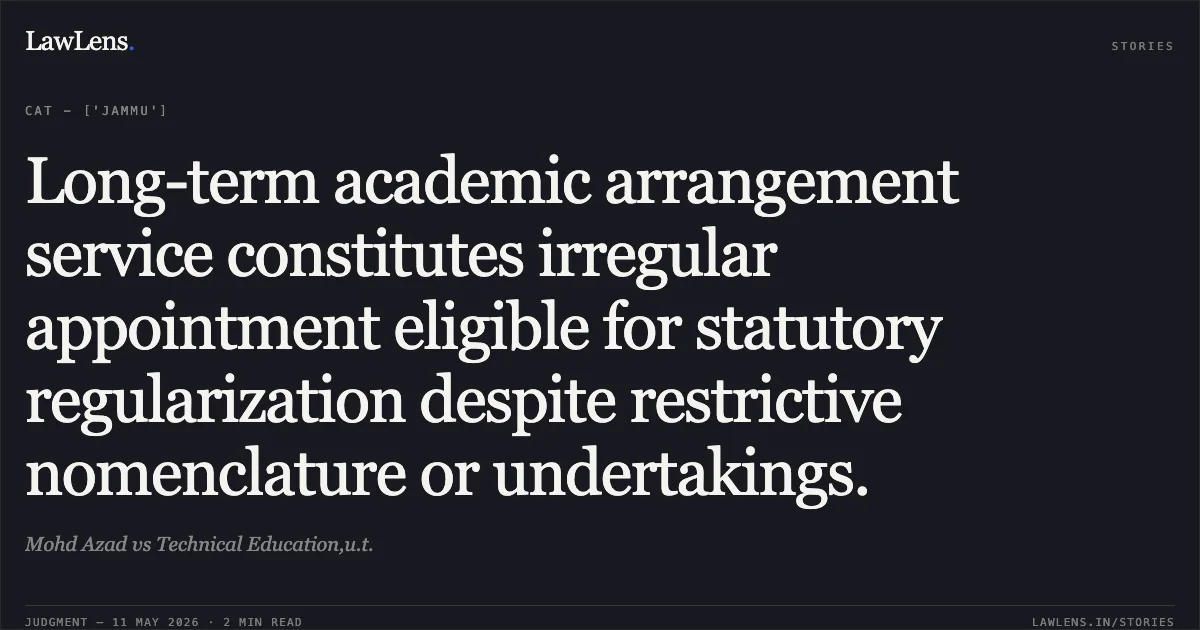
The Tribunal rejected the respondents' argument that the "academic arrangement" label automatically disqualified the petitioner from statutory benefits. It held that in service jurisprudence, the substance of engagement—continuity, nature of duties, and departmental control—prevails over nomenclature
Source reference: p. 17-18 / para. 14The court observed that the State cannot extract long-term service (12 years) to meet perennial institutional needs and then cite the temporary nature of the initial contract to deny regularization
Source reference: p. 25-26 / para. 21Regarding the petitioner's undertaking, the Tribunal ruled that such affidavits cannot act as a bar against the operation of a statute (the 2010 Act) or the principles of fairness and equity
Source reference: p. 18 / para. 15Following the logic in Jaggo, the Tribunal noted that the petitioner’s appointment was at most "irregular," not "illegal," as it was performed against sanctioned functions, thus qualifying for the one-time regularization measure intended by law
Source reference: p. 23, 26Holding
The Tribunal allowed the Transfer Application in its entirety. It held that the petitioner is entitled to regularization as a Consolidated Employee under the J Civil Services (Special Provisions) Act, 2010, having completed the requisite seven years of service
The respondents were directed to: (a) quash the communications rejecting the petitioner’s claim; (b) issue a formal regularization order within 12 weeks; (c) grant consequential service benefits including pay fixation; and (d) count the prior service for eligibility and continuity purposes. Monetary arrears were restricted prospectively.
Source reference: p. 32-34Acts & Sections Cited
2 provisions across 2 statutes referred to in this judgment. Linked provisions open on LawLens.
Jammu and Kashmir Civil Services (Special Provisions) Act, 20101
Act, 1861 (alias, unresolved)1
Original Court PDF
Mohd AzadvsTechnical Education,u.t.
Click to open original judgment
Original judgment, available to read, download and summarize on LawLens.in