Facts
The Appellant, Uttarakhand Power Corporation Ltd. (UPCL), is a distribution licensee that sought to levy cross-subsidy surcharge (CSS) on Respondent Nos. 1 to 3, who are Mid-Term Open Access (MTOA) consumers.
Source reference: p. 3UPCL issued a demand for Rs. 33,42,186/- from Respondent No. 1, claiming the surcharge was previously omitted by mistake.
Source reference: p. 3Respondent No. 1 resisted the demand, citing Regulation 22 of the UERC (Terms and Conditions of Intra State Open Access) Regulations, 2015, which allegedly exempts mid-term consumers.
Source reference: p. 3The Uttarakhand Electricity Regulatory Commission (UERC) initiated suo-moto proceedings and, via an order dated 12th April 2018, held that long-term and mid-term open access consumers are not liable to pay CSS, directing UPCL to refund amounts already recovered.
Source reference: p. 2-3Issues
1. Whether the representation of the 1st Respondent revealed only a “Billing Dispute” which ought not to have been entertained by the Commission but rather by the Consumer Grievance Redressal Forum (CGRF)?
Source reference: p. 4, para. 6(i)2. Whether, in view of the 2nd proviso to Regulation 22 of UERC Open Access Regulations, 2015, cross-subsidy surcharge is to be levied from long-term and mid-term open access consumers?
Source reference: p. 4-5, para. 6(ii)Law Applied
Regulation 22 of the UERC Open Access Regulations, 2015, specifically the second proviso regarding exemptions for certain consumer classes.
Source reference: p. 11MSEDCL v. MERC (Appeal No. 36 of 2011), which established that disputes involving the statutory mandate of Open Access fall under the Commission's jurisdiction, not the CGRF.
Source reference: p. 6Uttar Gujarat Vij Company Ltd. v. GERC, asserting that the power to clarify or interpret a tariff order lies with the Commission that authored it.
Source reference: p. 7-8The "Golden Rule" of statutory interpretation and Lord Denning’s principle from Seaford Court Estates Ltd. v. Asher, allowing judges to "iron out the creases" to fulfill the legislator's intent when a drafting defect is present.
Source reference: p. 17-18Reasoning
Regarding the first issue, the Tribunal rejected UPCL’s argument that the matter was a mere billing dispute; it held that because the dispute required the interpretation of statutory Regulations and the rights of open access consumers, the Commission had exclusive jurisdiction under the Electricity Act.
Source reference: p. 5-10On the second issue, the Tribunal analyzed the syntax of the second proviso to Regulation 22. While acknowledging the proviso was poorly drafted and grammatically incorrect (specifically the redundant use of the word "such"), the Tribunal determined that the use of the disjunctive "and" created two distinct exempt categories: (a) long-term/mid-term consumers and (b) captive generation plant users.
Source reference: p. 14-16The Tribunal reasoned that if CSS were intended to apply to all except captive users, the Regulation would have included a formula for determination, which it currently lacks for long-term/mid-term consumers.
Source reference: p. 16The Tribunal deferred to the Commission's own clarification that the intent was to promote open access due to power shortages.
Source reference: p. 19Holding
The Tribunal answered the first issue in the negative, holding that the Commission correctly exercised jurisdiction as the dispute involved regulatory interpretation rather than a simple billing error.
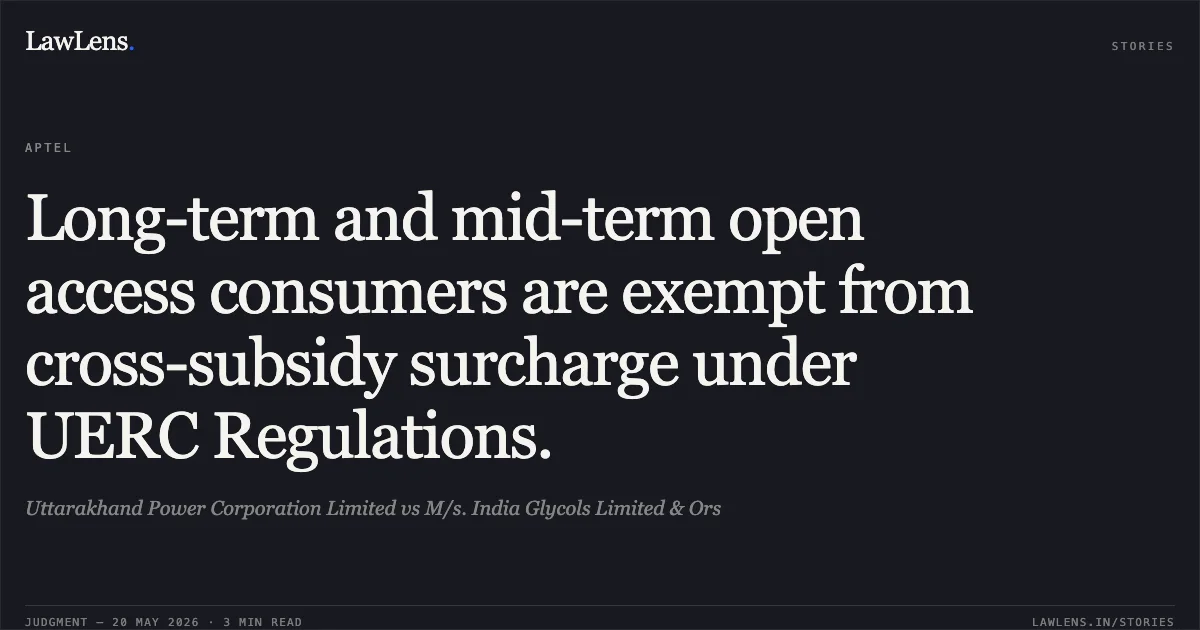
On the second issue, it held that long-term and mid-term open access consumers are exempt from cross-subsidy surcharge under Regulation 22.
Source reference: p. 16, 19The appeal was dismissed, and the impugned order of the Commission, including the direction for UPCL to refund the recovered surcharge amounts, was upheld.
Source reference: p. 19Acts & Sections Cited
9 provisions across 1 statute referred to in this judgment. Each provision opens on LawLens.
Original Court PDF
Uttarakhand Power Corporation LimitedvsM/s. India Glycols Limited & Ors
Click to open original judgment
Original judgment, available to read, download and summarize on LawLens.in


