Facts
The petitioners were appointed as Assistant Project Directors (APDs) on a contractual basis in various District Rural Development Agencies (DRDAs) following a merit-based selection process in 2010.
Source reference: p. 2They executed annual agreements and continued in service for over a decade.
Source reference: p. 3In 2014, the post of APD was re-designated as Programme Manager (PM).
Source reference: p. 3In 2022, the Government of Odisha abolished DRDAs, merging them with Zilla Parishads, and created 150 posts of PMs against which the petitioners were allowed to continue.
Source reference: p. 4, 20The petitioners sought regularization under the Orissa Group-B Posts (Contractual Appointment) Rules, 2013, having completed more than six years of service.
Source reference: p. 4The State opposed this, arguing that DRDAs were independent societies and the recruitment was not through a regular competitive process.
Source reference: p. 5, 21Issues
1. Whether the contractual engagement of the petitioners for over a decade, following a government-approved selection process, entitles them to regularization despite the absence of a formal "regular" recruitment process.
Source reference: p. 212. Whether the merger of the DRDAs into Zilla Parishads (Local Authorities/State under Article 12) necessitates the regularization of existing employees as a one-time measure.
Source reference: p. 22-23Law Applied
The Court primarily applied the principles of regularization as interpreted in Secretary, State of Karnataka v. Umadevi (3), which distinguishes between "illegal" and "irregular" appointments.
Source reference: p. 12-13It heavily relied on the recent Supreme Court precedents in Jaggo v. Union of India and Dharam Singh v. State of Uttar Pradesh, which caution against the "pervasive misuse of temporary employment contracts" to evade long-term obligations and emphasize that outsourcing or contractual labels cannot be used as a shield to justify exploitation when work is perennial.
Source reference: p. 10, 14-16The Court also referenced the Orissa Group-B Posts (Contractual Appointment) Rules, 2013, regarding the path to regularization after six years.
Source reference: p. 4, 18-19Reasoning
The Court reasoned that while the petitioners did not undergo a "regular" competitive recruitment process, their selection was not "backdoor" or "illegal" because it followed a government-approved advertisement and scrutiny by a committee led by the District Collector.
Source reference: p. 19, 21Applying Umadevi (3), the Court classified their appointment as "irregular" but valid for regularization consideration.
Source reference: p. 21The Court found the work performed by the petitioners to be perennial and identical to regular employees.
Source reference: p. 3, 20It further noted that after the 2022 merger, the petitioners became employees of Zilla Parishads, which are "Local Authorities" and part of the "State" under Article 12 of the Constitution.
Source reference: p. 22Consequently, the Court held that the State cannot perpetuate "ad hocism" or exploit workers by denying them social security and job permanence after decades of service.
Source reference: p. 13, 23Holding
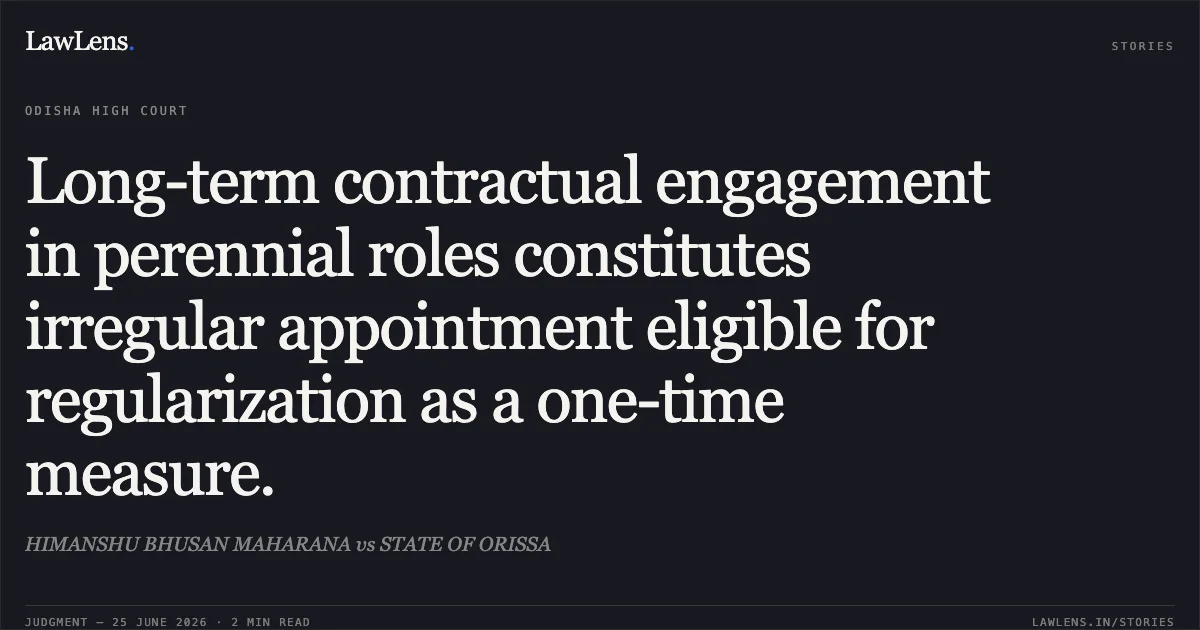
The Court answered the issues in the affirmative, holding that the petitioners’ services deserve to be regularized as a one-time measure following the merger of DRDAs with Zilla Parishads.
The Court directed Opposite Party No. 1 to undertake the necessary exercise to ensure the regularization of the petitioners within four months.
Source reference: p. 23The writ petition was disposed of with these directions.
Source reference: p. 23Original Court PDF
HIMANSHU BHUSAN MAHARANAvsSTATE OF ORISSA
Click to open original judgment
Original judgment, available to read, download and summarize on LawLens.in