Facts
The appellant was engaged on 13.01.2002 by Gram Panchayat Bamori as a Computer Operator/Assistant Grade-III on daily-wage basis, against Collector-rate remuneration. He claimed uninterrupted service, requisite qualifications, and experience from 2002 until termination.
Source reference: para. 4–5Following the Supreme Court’s decision in Secretary, State of Karnataka v. Uma Devi, the State issued regularisation policies dated 16.05.2007 and 29.09.2014. The appellant applied for regularisation on 06.04.2015, but the Chief Executive Officer, Janpad Panchayat Bamori, terminated his engagement on 29.06.2015, citing the establishment’s financial condition and non-requirement of his services.
Source reference: para. 6–7The appellant challenged the termination in W.P. No. 4693/2015, contending that his claim for regularisation had not been considered, that vacant posts of Assistant Grade-III were available, and that the termination was punitive, arbitrary, and passed without notice or hearing.
Source reference: para. 8–16The learned Single Judge dismissed the writ petition on 20.12.2018. The present intra-court writ appeal was filed under Section 2 of the Madhya Pradesh Uchcha Nyalaya Ki Khand Peeth Ko Appeal Adhiniyam, 2005. The delay in filing the appeal was condoned under Section 5 of the Limitation Act.
Source reference: para. 1–3Issues
Whether the appellant’s long and continuous daily-wage service, qualifications, experience, and the alleged availability of sanctioned posts created an enforceable right to regularisation or continuation in service under the State’s regularisation policies?
Source reference: para. 23–24Whether the appellant’s engagement could be discontinued without prior notice or hearing, or whether the termination was punitive or stigmatic in substance and therefore required compliance with principles of natural justice?
Source reference: para. 25–26Whether the learned Single Judge erred in dismissing the appellant’s writ petition and whether the Division Bench should interfere in intra-court appellate jurisdiction?
Source reference: para. 29–30Law Applied
The Court applied the Constitution Bench decision in Secretary, State of Karnataka v. Uma Devi, (2006) 4 SCC 1, holding that long service as a temporary, contractual, or daily-wage employee does not create a substantive right to regular appointment where the initial engagement was not made through the prescribed recruitment process against a sanctioned post.
Source reference: para. 23The State’s regularisation policies dated 16.05.2007 and 29.09.2014 could require consideration of an eligible employee’s case according to their terms, but could not be construed as conferring automatic regularisation dehors the statutory recruitment rules.
Source reference: para. 23–24The Court also applied the distinction between punitive termination and termination simpliciter: an order based on administrative reasons such as financial constraints or non-requirement of services is not punitive absent misconduct or stigma forming its foundation.
Source reference: para. 25–26The principles in Jarnail Singh v. State of Punjab, AIR 1986 SC 1626, S.P. Vasudev v. State of Haryana, AIR 1975 SC 2292, Manager, Government Branch Press v. D.B. Belliappa, 1979 SC 429, Babulal v. State of Haryana, AIR 1991 SC 1310, and G.B. Pant Agricultural & Technical University v. Keshoram, AIR 1995 SC 718, were recognised as applicable where the true foundation of an ostensibly innocuous termination is punitive.
Source reference: para. 14–15, 26The Court distinguished Dharam Singh v. State of U.P., 2025 SCC OnLine SC 1735, as a decision founded on materially different and exceptional facts.
Source reference: para. 27Reasoning
The Court held that the appellant’s initial engagement was admittedly on a daily-wage basis and was not pursuant to regular selection against a sanctioned post under the statutory recruitment procedure.
Source reference: para. 23Consequently, his prolonged service, qualifications, and experience could not, by themselves, confer a right to regular appointment.
Source reference: para. 23Similarly, the alleged availability of Assistant Grade-III posts did not dispense with the prescribed recruitment procedure or establish a vested right to regularisation, unless the applicable policy expressly authorised such treatment.
Source reference: para. 24The Court further found that the termination order recorded administrative reasons—financial constraints and non-requirement of services—and contained no allegation of misconduct or adverse imputation against the appellant. Its consequences therefore did not make it punitive or stigmatic, and no prior hearing or departmental enquiry was required.
Source reference: para. 25–26The reliance on Dharam Singh was rejected because that case involved a distinctive factual matrix, including long-term institutional utilisation, proposals for creation of posts, and repeated administrative requests for sanction, which were not shown to exist in the present case.
Source reference: para. 27Since no enforceable statutory or constitutional right was established and no perversity, jurisdictional error, or patent illegality was found in the Single Judge’s decision, appellate interference was unwarranted.
Source reference: para. 28–29Holding
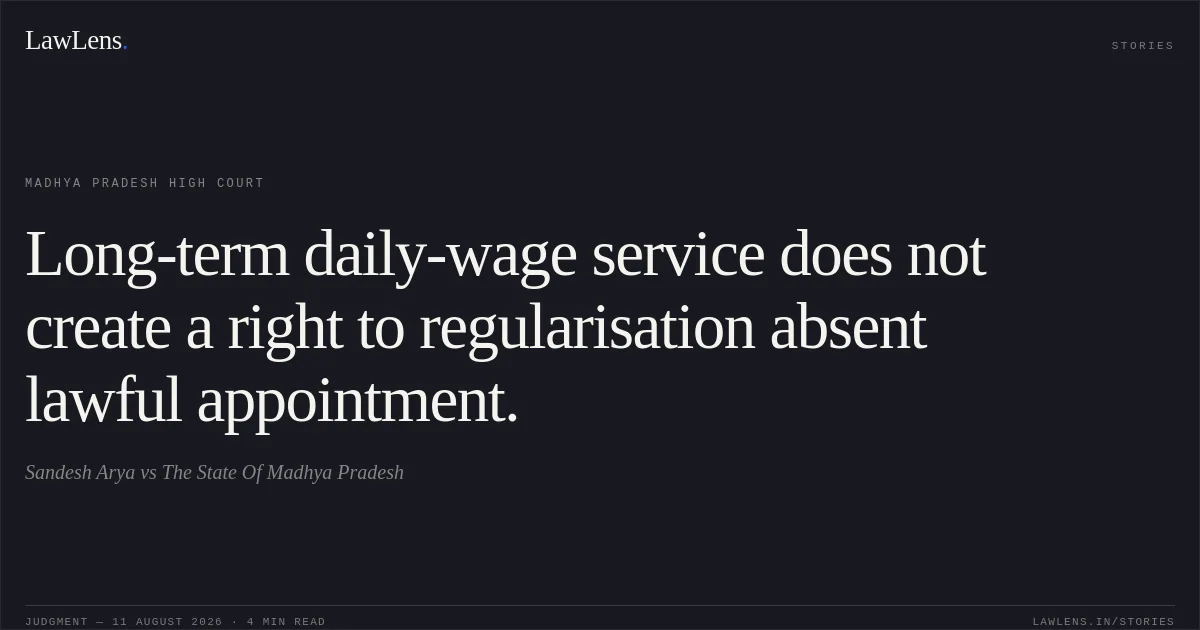
The Division Bench answered the issues against the appellant. It held that long-term daily-wage service, qualifications, experience, and alleged vacancy of sanctioned posts did not confer an automatic or enforceable right to regularisation or continuation in service.
The termination dated 29.06.2015 was held to be an administrative discontinuance, not a punitive or stigmatic termination requiring prior notice or hearing.
Source reference: para. 30The writ appeal was accordingly dismissed, and the learned Single Judge’s order dated 20.12.2018 in W.P. No. 4693/2015 was affirmed.
Source reference: para. 31The delay in filing the appeal had earlier been condoned.
Source reference: para. 1–2Acts & Sections Cited
1 provisions across 1 statute referred to in this judgment. Each provision opens on LawLens.
Limitation Act, 19631
Original Court PDF
Sandesh AryavsThe State Of Madhya Pradesh
Click to open original judgment
Original judgment, available to read, download and summarize on LawLens.in