Facts
The three applicants were engaged as High Skilled Labours in the Indian Institute of Chemical Biology (IICB), a unit of CSIR, starting between 1989 and 1991
Source reference: p. 1-2They sought temporary status under the Office Memorandum (OM) dated 01.09.1993, which required 240 days of continuous service in a year
Source reference: para. 3aFollowing a direction from the Tribunal in O.A. 60/2007, the respondents granted the applicants temporary status effective 03.08.2007
Source reference: para. 3b, 11Their pay was subsequently fixed and revised as per the VIth Central Pay Commission, and they successfully completed a Multi-Skilled Training Programme in 2012 for consideration against permanent posts
Source reference: para. 3bDespite serving for over 30 years, their services were not regularized.
Source reference: para. 5The respondents contended that regularization was a one-time measure under the "Casual Workers’ Absorption Scheme of CSIR, 1995" and that the applicants had no vested right after the cancellation of a specific recruitment process for Laboratory Attendants
Source reference: para. 5The matter was remanded to the Tribunal by the Hon’ble High Court via WPCT No. 241 of 2025 to be decided afresh
Source reference: para. 1Issues
1. Whether the applicants are entitled to regularization of their services based on their long-term continuous service and the perennial nature of their duties
Source reference: para. 7-82. Whether the respondents can use the "temporary" label to deny benefits and regularization to employees serving for decades
Source reference: para. 12-13Law Applied
The court primarily applied the principles of regularization established in Secretary, State of Karnataka v. Uma Devi (2006), while qualifying its application through recent precedents including Shripal & Another v. Nagar Nigam Ghaziabad (2025) and Jaggo v. Union of India & Others (2024), which hold that long-term continuous service indicates a perennial nature of work and that the Uma Devi judgment cannot be used as a "shield" to justify exploitative temporary engagements
Source reference: para. 8-10, 13It further relied on the Casual Workers’ Absorption Scheme of CSIR, 1995 and the DoPT Office Memorandum dated 01.09.1993 regarding temporary status
Source reference: para. 3, 5Reasoning
The Tribunal observed that the applicants had been working for approximately 36 years, holding temporary status for 18 of those years
Source reference: para. 14The court found that the respondents’ actions—fixing pay scales, revising pay under the Pay Commission, and conducting Multi-Skilled Training—demonstrated that the applicants were performing duties of a perennial nature against sanctioned posts
Source reference: para. 10The Tribunal rejected the respondents' argument that the claim was tied to a failed recruitment for Lab Attendants, noting that the applicants sought general regularization of their long-standing service
Source reference: para. 7Citing Shripal (supra) and Jaggo (supra), the Tribunal reasoned that misclassifying essential, recurring work as "temporary" for decades is a systemic misuse of employment contracts that deprives workers of dignity and benefits
Source reference: para. 9, 12The court noted that "de-facto approval" for empanelment had already been recognized by the department in internal communications dating back to 1999
Source reference: para. 11, 14Holding
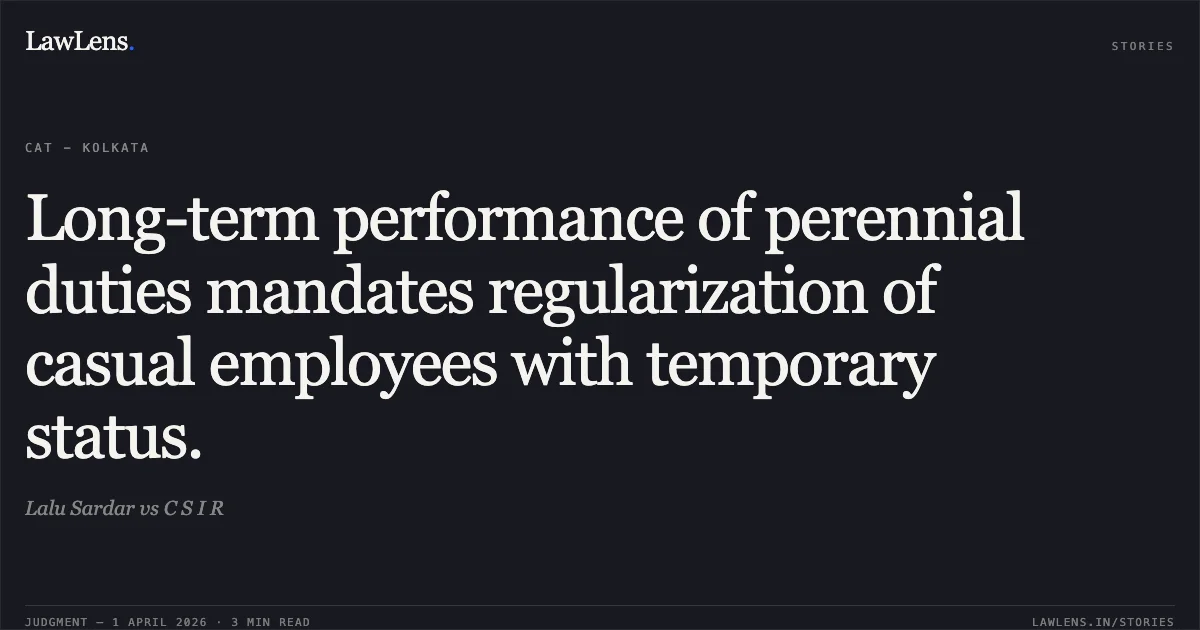
The Tribunal allowed the O.A., holding that denying regularization after 36 years of service would be a "travesty of justice"
The court directed the respondents to regularize the services of the applicants with effect from 27.12.1999 (the date of de-facto approval for empanelment)
Source reference: para. 14The respondents were ordered to implement this regularization, considering the perennial nature of the duties performed and the successful completion of training, within three months from the receipt of the order
Source reference: para. 14No order was made as to costs
Source reference: para. 15Acts & Sections Cited
1 provisions across 1 statute referred to in this judgment. Each provision opens on LawLens.
Administrative Tribunals Act, 19851
Original Court PDF
Lalu SardarvsC S I R
Click to open original judgment
Original judgment, available to read, download and summarize on LawLens.in