Facts
The Plaintiff (Kanchan Rohira) entered into a registered agreement for sale dated January 9, 1977, with Defendant No. 1 (Nirman Constructions) to purchase a flat for Rs. 26,000, paying an advance of Rs. 10,500
Source reference: para 2, 6.iiPossession was due by May 30, 1977, but was delayed due to internal management disputes within Defendant No. 1
Source reference: para 6.iii, 6.vOn September 30, 1981, Defendant No. 1 terminated the agreement alleging non-payment
Source reference: para 6.viiDefendant No. 1 subsequently sold the flat to Defendant No. 3 in 1981, who then sold it to Defendant No. 4 (Suresh Dhoot) on May 12, 1986, for Rs. 1,40,000
Source reference: para 2, 10The Trial Court held that the Plaintiff was ready and willing, the termination was illegal, and Defendant No. 4 was not a bonafide purchaser as he had constructive notice of the registered agreement
Source reference: para 4, 21-24However, the Trial Court denied specific performance under Section 20 of the Specific Relief Act due to Defendant No. 4’s long-standing possession since 1986, instead awarding the Plaintiff damages of Rs. 1,52,250 and a refund of the advance
Source reference: para 3, 26-27Both the Plaintiff and Defendant No. 4 appealed
Source reference: para 4Issues
1. Whether the Plaintiff proved readiness and willingness to perform her contractual obligations
Source reference: para 49.i2. Whether the notice of termination dated September 30, 1981, was illegal and bad in law
Source reference: para 49.ii3. Whether Defendant No. 4 was a transferee for value in good faith without notice of the original contract under Section 19(b) of the Specific Relief Act
Source reference: para 49.iii4. Whether a respondent can challenge adverse findings without filing a formal memorandum of cross-objection
Source reference: para 49.iii5. Whether the court properly exercised its discretion under Section 20 of the Specific Relief Act to deny specific performance while granting damages
Source reference: para 49.ivLaw Applied
The Court applied Section 16(c) of the Specific Relief Act, 1963, regarding readiness and willingness
Source reference: para 51Section 19(b) concerning relief against subsequent purchasers with notice
Source reference: para 54It relied on Section 3 of the Transfer of Property Act, 1882, specifically the proviso to Explanation I, which stipulates that constructive notice via registration requires proof that the instrument was duly entered in books under Section 51 and indexed under Section 55 of the Registration Act
Source reference: para 61-65The Court followed Ravinder Kumar Sharma v. State of Assam, establishing that a respondent may attack adverse findings to sustain a decree without filing cross-objections
Source reference: para 57Finally, it applied the discretionary principles under Section 20 of the Specific Relief Act (pre-2018 amendment), as elucidated in Sardar Singh v. Krishna Devi, holding that the court is not bound to grant specific performance merely because it is lawful
Source reference: para 70-71Reasoning
The Court affirmed that the Plaintiff was ready and willing, noting that the delay in payment was excusable as the construction was incomplete and the vendor was embroiled in internal litigation
Source reference: para 52-53Regarding the "bonafide purchaser" status, the Court set aside the Trial Judge’s finding of constructive notice. It reasoned that under the proviso to Section 3 of the Transfer of Property Act, mere registration does not constitute notice unless the Plaintiff proves that the document was correctly entered in the specific registers and indexes maintained under Sections 51 and 55 of the Registration Act; as the Plaintiff failed to lead such evidence, Defendant No. 4 could not be imputed with constructive notice
Source reference: para 64-66The Court also held that Defendant No. 4, having paid valuable consideration and occupied the flat since 1986, was a protected transferee
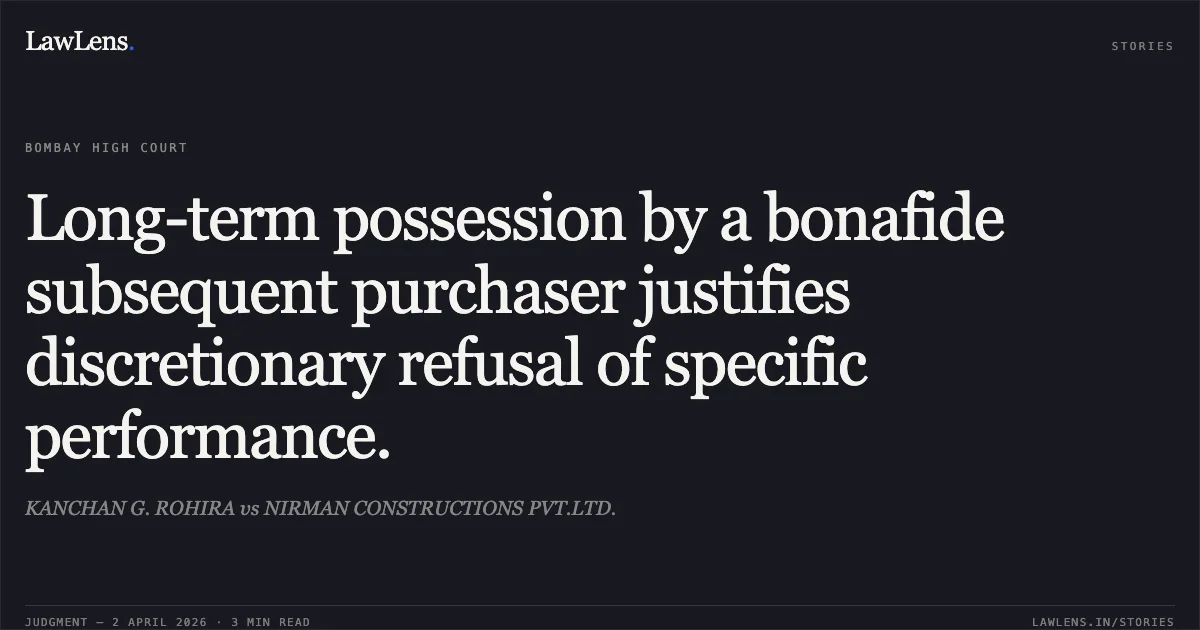
Source reference: para 67On the issue of discretion, the Court held that while the Plaintiff succeeded on the legality of the contract, the lapse of 40 years and the continuous possession of Defendant No. 4 made the grant of specific performance inequitable
Source reference: para 72-74The Court clarified that Section 20(1) grants broad discretionary powers not limited to the specific illustrations of hardship in Section 20(2)
Source reference: para 69, 71Holding
The High Court dismissed the Plaintiff’s appeal and confirmed the Trial Court’s decree
(i) the Plaintiff was ready and willing; (ii) the termination was illegal; (iii) Defendant No. 4 was a bonafide purchaser for value without notice because the technical requirements for constructive notice were not met; and (iv) the denial of specific performance in favor of damages was a proper exercise of judicial discretion given the equities of long-term possession
Source reference: para 76.i-vThe Plaintiff is entitled to the awarded damages of Rs. 1,52,250 plus a refund of Rs. 10,500 with interest
Source reference: para 3, 77Acts & Sections Cited
18 provisions across 4 statutes referred to in this judgment. Each provision opens on LawLens.
Registration Act, 1908
Specific Relief Act, 19632
Transfer of Property Act, 18821
Code of Civil Procedure, 19082
Original Court PDF
KANCHAN G. ROHIRAvsNIRMAN CONSTRUCTIONS PVT.LTD.
Click to open original judgment
Original judgment, available to read, download and summarize on LawLens.in