01Facts
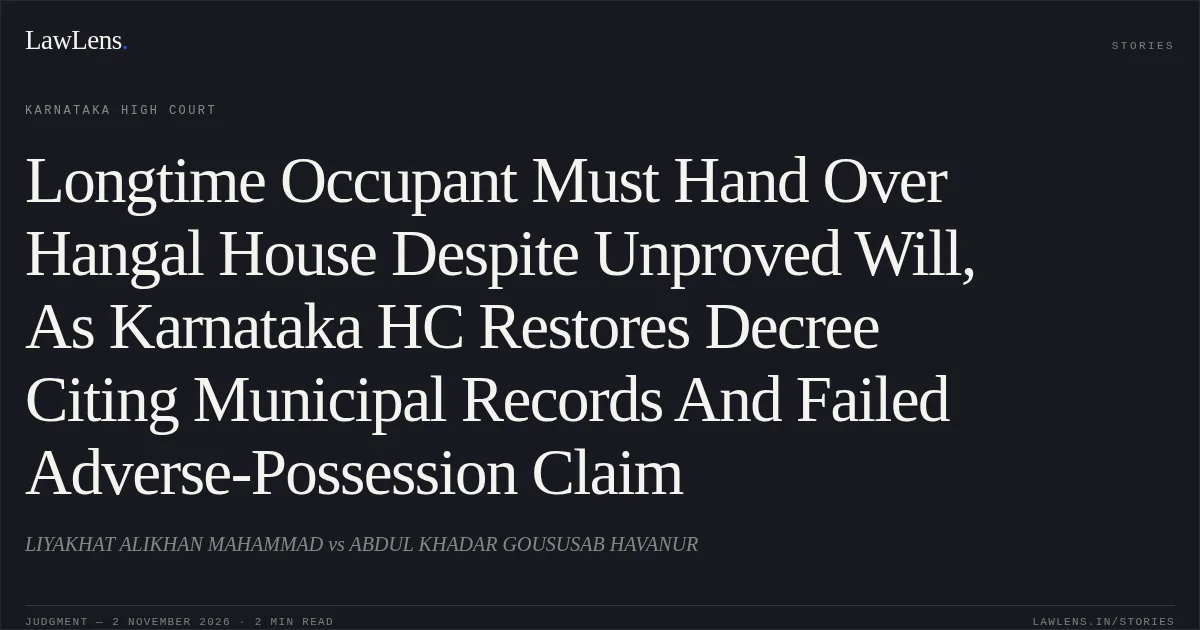
The plaintiffs sued for possession of a house and adjoining open space, asserting ownership under a registered Will dated 21 July 1984 and alleging that the defendant occupied the property as a tenant.
pp. 4–10The defendant denied the plaintiffs’ title and tenancy, claiming permissive possession and adverse possession.
pp. 4–10The trial court decreed the suit; the first appellate court reversed, principally finding that the Will had not been proved.
pp. 14–16The plaintiffs appealed under Section 100 CPC.
pp. 14–16The defendant’s plea of adverse possession had been rejected by the first appellate court, and that finding was not challenged.
pp. 23–2502Issues
i.1. Whether the first appellate court committed a serious error of law by reversing the trial court’s decree despite the evidence relied on by the plaintiffs, including the municipal assessment records.
p. 12, 16ii.2. Whether the plaintiffs established title to the suit property notwithstanding their failure to produce and prove the alleged Will.
pp. 16–18, 22–2703Law Applied
The appeal was considered under Section 100 CPC, which confines a second appeal to a substantial question of law.
The court relied on the principle that a tenant cannot ordinarily dispute the landlord’s title or challenge the Will under which the landlord claims, referring to Ghanshyam Dass v. Shakuntla Bakshi, Pandi Bandu v. Sapadu Krishna, Kamaljit Singh v. Sarabjit Singh and Asharfi Devi v. Shankar.
pp. 24–25It also referred to Metapalli Lasum Bai v. Metapalli Muthaiah concerning a registered Will.
p. 25The judgment did not identify a specific statutory provision governing proof of the Will or title.
Provisions in the judgment · 1 · Linked ones open on LawLens
Code of Civil Procedure, 1908 Section 100
04Reasoning
The court noted that the defendant had not established adverse possession and had not challenged the appellate court’s finding rejecting that plea.
pp. 23–24It considered the municipal assessment extracts, which recorded the plaintiffs as owners and the defendant as occupier of the house, and treated those records as supporting the plaintiffs’ title.
pp. 17–18, 25–26It also relied on the principle that a tenant could not challenge the Will through which the plaintiffs claimed ownership.
pp. 24–25On that basis, the court concluded that the first appellate court had erred in dismissing the suit, although the alleged Will itself had not been produced.
pp. 14–15, 25–2705Holding
The High Court answered the substantial question of law in favour of the plaintiffs.
pp. 26–27The High Court allowed the second appeal and set aside the first appellate court’s judgment.
pp. 26–27It restored and confirmed the trial court’s decree directing the defendant to deliver possession of the suit property to the plaintiffs.
pp. 26–27Original Court PDF
LIYAKHAT ALIKHAN MAHAMMADvsABDUL KHADAR GOUSUSAB HAVANUR
Click to open original judgment
Original judgment, available to read, download and summarize on LawLens.in