Facts
The Applicant, while serving as a Gramin Dak Sevak Branch Postmaster (GDS BPM) at Kodangipatti, was charge-sheeted on December 16, 2011, under Rule 10 of the GDS (Conduct Engagement) Rules
Source reference: para. 2She was accused of misappropriating deposit amounts of ₹150 and ₹555 by making entries in depositors' passbooks but failing to credit the sums to the Post Office accounts
Source reference: para. 11An inquiry concluded on April 4, 2014, finding the charges "proved beyond doubt"
Source reference: para. 12On June 30, 2014, the Disciplinary Authority (DA) imposed a lenient penalty of ‘Censure’
Source reference: para. 8Subsequently, the Reviewing Authority issued a show-cause notice (SCN) on December 27, 2014, proposing to enhance the penalty
Source reference: para. 2On August 4, 2015, the Reviewing Authority passed a final order enhancing the punishment to "Removal from Engagement"
Source reference: para. 9The Applicant challenged this order, alleging it was time-barred (issued beyond six months) and that the SCN reflected a predetermined mind
Source reference: para. 2-5Issues
1. Whether the Reviewing Authority exercised its powers of revision within the prescribed limitation period from the date of the original punishment order
Source reference: para. 2-32. Whether the enhanced penalty of removal from engagement was disproportionate to the gravity of the misconduct involving misappropriation of small amounts
Source reference: para. 14Law Applied
Rule 10 and Rule 21 of the Department of Posts, Gramin Dak Sevaks (Conduct Engagement) Rules, 2001/2011
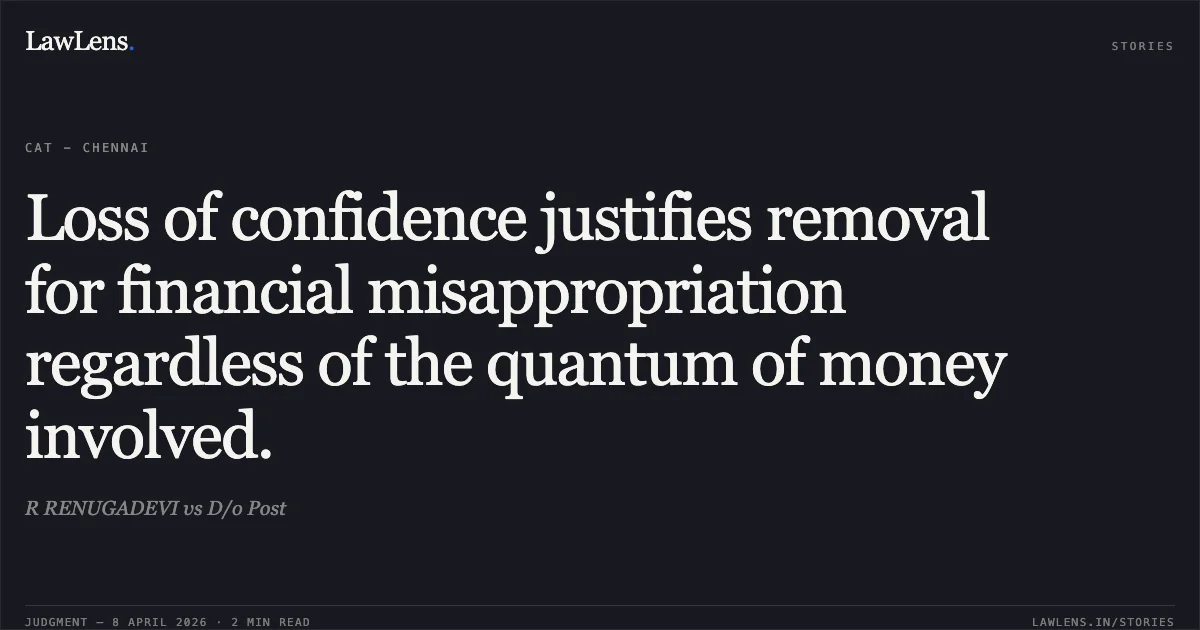
Source reference: para. 2, 11The principle established in Divisional Controller, KSRTC (NWKRTC) v. A.T. Mane, which mandates that in cases of misappropriation, the "loss of confidence" is the primary factor for punishment, regardless of the amount involved
Source reference: para. 14Divisional Controller, NEKRTC v. H. Amaresh, holding that sympathy or generosity is impermissible in cases of pilferage
Source reference: para. 14Supreme Court’s ruling in Union of India v. Indraj (2025), which upheld the dismissal of a GDS for embezzlement of post office deposits
Source reference: para. 15Reasoning
The Tribunal rejected the Applicant's contention regarding the limitation period, noting the SCN was issued within six months of the DA's order dated June 30, 2014
Source reference: para. 8On the merits of the misconduct, the Tribunal observed that the inquiry had clearly established that the Applicant stamped passbooks but did not credit the funds to official books
Source reference: para. 11Linking these facts to the 'Rule of Law', the Tribunal reasoned that any misappropriation—even of small sums—constitutes a breach of mutual trust between the banker and the customer
Source reference: para. 15The court noted that leniency in financial irregularities would foster an expectation of sympathetic treatment and undermine the integrity of the Department
Source reference: para. 16Consequently, the Tribunal found that the Reviewing Authority correctly determined that ‘Censure’ was not commensurate with the gravity of the offence and acted within its jurisdiction to enhance the penalty
Source reference: para. 13, 17Holding
The Tribunal dismissed the Original Application, holding that there was no procedural impropriety or illegality in the Reviewing Authority’s order
It held that the penalty of "Removal from Engagement" was well-reasoned, proportionate, and justified given the nature of the financial misconduct
Source reference: para. 17No order as to costs was made
Source reference: para. 18Original Court PDF
R RENUGADEVIvsD/o Post
Click to open original judgment
Original judgment, available to read, download and summarize on LawLens.in