Facts
The appellant was injured when his car collided with a lorry whose driver had allegedly braked suddenly.
Source reference: pp. 3–7The Tribunal found the lorry driver negligent and awarded the appellant ₹3,19,857 in compensation, holding the lorry’s insurer liable.
Source reference: pp. 3–7The appellant appealed under Section 173(1) of the Motor Vehicles Act, 1988, seeking enhancement.
Source reference: pp. 3–7He challenged, among other things, the income and disability assessment and the amounts awarded for pain and suffering and loss of amenities.
Source reference: pp. 3–7The High Court considered the appeal as one concerning the adequacy of compensation.
Source reference: p. 6Issues
1. Whether the appellant was entitled to enhancement of compensation, including for future loss of earning capacity and other heads.
Source reference: pp. 6–72. Whether the insurer of the lorry was liable to pay the enhanced compensation.
Source reference: pp. 5, 9Law Applied
The appeal was brought under Section 173(1) of the Motor Vehicles Act, 1988.
Source reference: p. 2In reassessing compensation, the Court applied the principles reflected in its calculation: determining loss of future earnings using monthly income, percentage of loss of earning capacity, and the applicable multiplier; and assessing compensation under distinct heads including pain and suffering, medical expenses, treatment-period income loss, and loss of amenities.
Source reference: pp. 7–9Reasoning
Although the appellant claimed monthly earnings exceeding ₹6,000, he produced no specific proof of income. The Court therefore adopted a notional income of ₹6,500 per month, rather than the Tribunal’s ₹5,000.
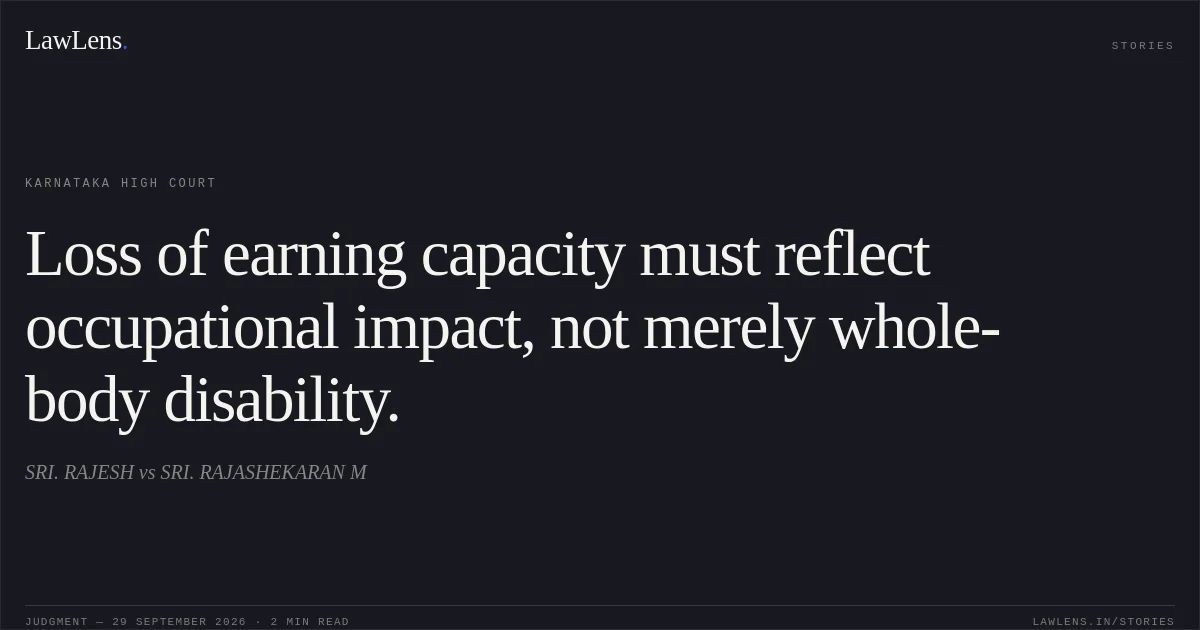
Source reference: p. 6Considering the appellant’s age (22), the multiplier of 18, the elbow-movement restriction, and its particular effect on his work as a driver, the Court assessed loss of earning capacity at 10% and awarded ₹1,40,400 for future loss of income.
Source reference: pp. 7–8It increased compensation for pain and suffering from ₹25,000 to ₹50,000, for loss of income during treatment to ₹19,500, and for loss of amenities, disfigurement, and marriage prospects from ₹25,000 to ₹50,000. It retained the medical expenses and the amounts awarded for food and nourishment, conveyance, and attendant charges.
Source reference: pp. 8–9Holding
The appeal was allowed in part.
Compensation was enhanced from ₹3,19,857 to ₹4,49,957, rounded to ₹4,50,000, with interest at 6% per annum from the date of the claim petition until deposit, excluding the 235-day delay in filing the appeal.
Source reference: p. 9Respondent No. 2, the lorry’s insurer, was directed to deposit the enhanced compensation with the Tribunal within six weeks; upon deposit, the enhanced compensation and interest were ordered released to the appellant electronically.
Source reference: p. 9Acts & Sections Cited
1 provisions across 1 statute referred to in this judgment. Each provision opens on LawLens.
Motor Vehicles Act, 19881
Original Court PDF
SRI. RAJESHvsSRI. RAJASHEKARAN M
Click to open original judgment
Original judgment, available to read, download and summarize on LawLens.in