Facts
The petitioner, an Upper Division Clerk at the Passport Office, Ghaziabad, was convicted by the Sessions Court on 28.03.2026 for offenses under Sections 467/468 of the IPC and Section 12(1)(b) of the Passport Act, 1967
Source reference: p. 1-2The Appellate Court found that the petitioner forged two passports—issuing them in fictitious names—originally intended for legitimate applicants
Source reference: p. 2While the Trial Court had initially acquitted him on 11.03.2025, the Sessions Court reversed this on appeal
Source reference: p. 2The High Court suspended the petitioner’s sentence on 07.05.2026
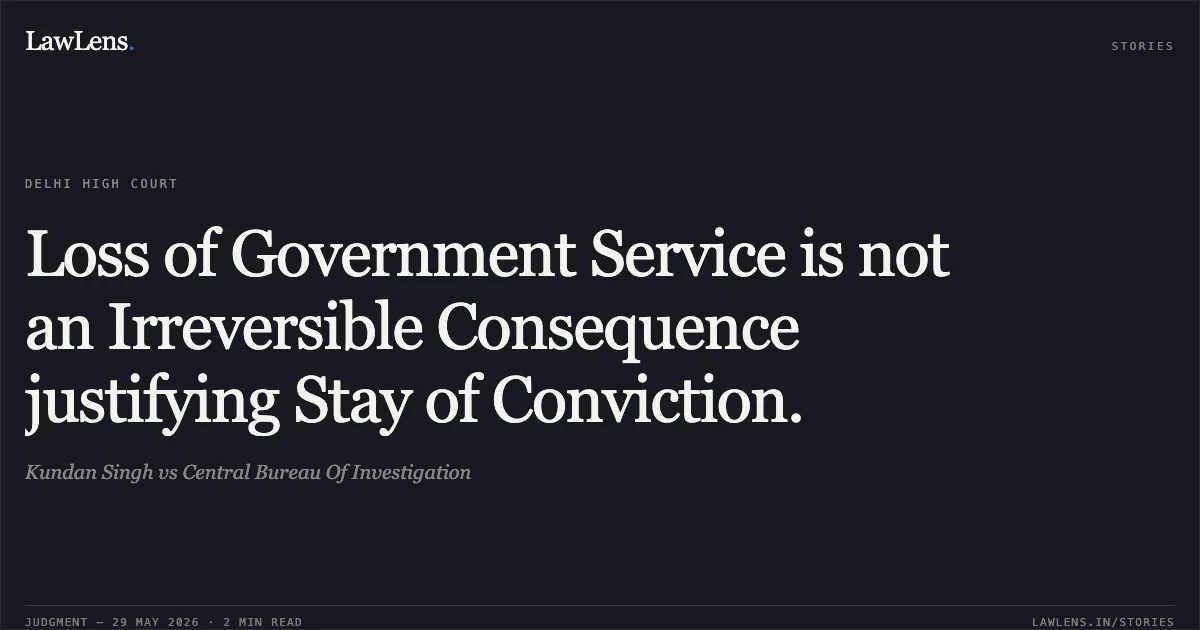
Source reference: p. 2The petitioner subsequently filed CRL.M.A. 11958/2026 seeking a stay of the conviction itself to prevent dismissal from government service before his 2027 superannuation
Source reference: p. 3Issues
1. Whether the petitioner established "exceptional circumstances" or "irreversible consequences" necessary to warrant the rare relief of a stay of conviction
Source reference: p. 4-62. Whether the potential loss of government service and retirement benefits constitutes a sufficient ground to stay a conviction involving misuse of public office
Source reference: p. 7-10Law Applied
The court primarily applied Section 389(1) of the CrPC regarding the suspension of conviction
Source reference: p. 5It relied on the principle from Rama Narang v. Ramesh Narang that while courts have the power to stay conviction, it is an exception to be resorted to in rare cases
Source reference: p. 4-5It further applied the doctrine from K.C. Sareen v. CBI and State of Maharashtra v. Balakrishna Dattatrya Kumbhar, which establishes that corruption or misconduct by a public servant should not typically be stayed as it would be against public policy
Source reference: p. 5-8Finally, it distinguished Navjot Singh Sidhu v. State of Punjab and Afjal Ansari v. State of U.P., noting that consequences for elected representatives (disqualification from representing a constituency) differ from those for salaried government employees
Source reference: p. 9Reasoning
The Court reasoned that a stay of conviction is not a rule but an exception requiring a showing of "irreversible consequences"
Source reference: p. 5The Court held that loss of employment is not legally "irreversible" because if the petitioner eventually succeeds in his revision, he can be granted financial recompense and consequential benefits retrospectively
Source reference: p. 8-10The Court emphasized the gravity of the offense—forgery of passports by a public official—noting such acts have serious implications for national security and the administration of justice
Source reference: p. 4, 10It rejected the plea that the absence of a charge under the Prevention of Corruption Act made the offense less severe, concluding that the misuse of entrusted passport booklets warrants the same "sublime public policy" of keeping a convicted official under disability during appeal
Source reference: p. 10Holding
The Court answered the issues in the negative and dismissed CRL.M.A. 11958/2026, refusing to stay the conviction
The Court held that potential loss of service is not a determinative factor for staying a conviction of a public servant involving serious allegations of forgery and misuse of office
Source reference: p. 10The main revision petition was scheduled for further hearing on 02.09.2026
Source reference: p. 10Acts & Sections Cited
10 provisions across 4 statutes referred to in this judgment. Each provision opens on LawLens.
Indian Penal Code, 18606
Passports Act, 19671
Code of Criminal Procedure, 19731
Prevention of Corruption Act, 19882
Original Court PDF
Kundan SinghvsCentral Bureau Of Investigation
Click to open original judgment
Original judgment, available to read, download and summarize on LawLens.in