01Facts
On 01.01.2024, the appellant-claimant (aged 44) was injured in a road traffic accident allegedly caused by the rash and negligent driving of Tata Nexon car KA-43/N-3664, owned by Respondent No.1 and insured with Respondent No.2 (Liberty General Insurance).
¶ 3He sustained (i) open right comminuted fracture of the distal femur with bone loss, and (ii) closed right tibia and fibula fracture.
¶ 7The Tribunal (MVC No. 1324/2024) awarded ₹7,48,700 under seven heads, with 6% interest from the date of petition, and directed the insurer to deposit the award.
¶ 3–4The Tribunal assessed the notional income at ₹16,500/month, applied a multiplier of 14, and took whole-body disability at 15%.
¶ 6, 8The claimant appealed under Section 173(1) of the Motor Vehicles Act seeking enhancement.
¶ 2The appeal was taken up for final disposal with the consent of counsel for the appellant and Respondent No.2.
¶ 2The doctor testified to 60% disability of the right lower limb.
¶ 802Issues
i.1. Whether the Tribunal's notional monthly income of ₹16,500 required upward revision to ₹17,000 for the year 2024.
¶ 6ii.2. Whether the multiplier of 14 applied by the Tribunal, based on the claimant's age of 44, was correct.
¶ 6iii.3. Whether the Tribunal's award under Pain and Suffering (₹30,000), Loss of Amenities (₹30,000), and Loss of Income during Laid-up Period (₹33,000) was inadequate in light of the injuries and treatment period.
¶ 7iv.4. Whether the whole-body disability assessed at 15% was erroneous, given 60% disability of the lower limb, requiring recalculation of loss of future income.
¶ 803Law Applied
The court applied Section 173(1) of the Motor Vehicles Act, 1988 as the statutory basis for appellate review of the Tribunal's award.
¶ 1Compensation under the head of loss of future earning capacity is computed as annual income × multiplier × percentage of disability, and the multiplier is fixed by the claimant's age, here 14 for an age of 44.
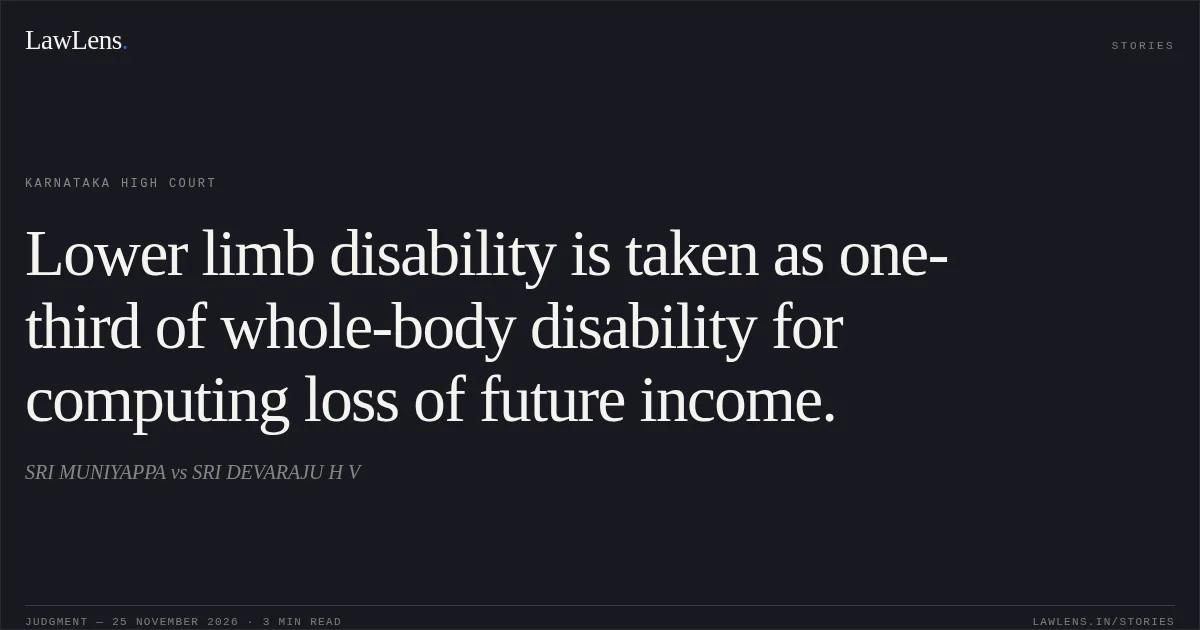
¶ 6Disability to a lower limb is converted to whole-body disability by taking one-third of the lower-limb percentage.
¶ 8Compensation for pain, suffering, and loss of amenities must reflect the nature and severity of the fractures.
¶ 7No judicial precedent is cited in the judgment.
Provisions in the judgment · 1 · Linked ones open on LawLens
Motor Vehicles Act, 1988 Section 173
04Reasoning
The court accepted the Tribunal's multiplier of 14 as correct for the claimant's age of 44.
¶ 6The court revised the notional income from ₹16,500 to ₹17,000 per month for 2024.
¶ 6Considering the open comminuted femur fracture with bone loss and the closed tibia-fibula fracture, the court enhanced pain and suffering from ₹30,000 to ₹90,000 and loss of amenities from ₹30,000 to ₹80,000.
¶ 7The court upheld the Tribunal's ₹30,000 for attendant, conveyance, and nourishment charges, and its ₹1,79,900 for medical expenses, because the claimant was hospitalised.
¶ 7The court fixed three months of rest as reasonable and enhanced laid-up income loss to ₹51,000 (₹17,000 × 3).
¶ 7Converting the 60% lower-limb disability to 20% whole-body disability, the court computed loss of future income as ₹17,000 × 12 × 14 × 20% = ₹5,71,200, replacing the Tribunal's ₹4,15,800.
¶ 8The court upheld the ₹30,000 future medical expenses for implant removal.
¶ 805Holding
The claimant is entitled to total compensation of ₹10,32,100, against ₹7,48,700 awarded by the Tribunal, resulting in enhancement of ₹2,83,400.
¶ 9–10The appeal is allowed in part. Respondent No.2 (insurer) is directed to deposit the enhanced compensation of ₹2,83,400, with 6% interest per annum from the date of petition until realisation, before the Tribunal within six weeks, and the claimant is entitled to release of the entire enhanced amount.
¶ 10(ii)–(iv)Original Court PDF
SRI MUNIYAPPAvsSRI DEVARAJU H V
Click to open original judgment
Original judgment, available to read, download and summarize on LawLens.in