01Facts
The claimant, aged 19 on the date of the accident, was injured in a road traffic accident on 01.07.2023 involving Car bearing Regn. No. KA-09/C-5097.
¶ 3He alleged rash and negligent driving by the car driver and filed MVC No. 1376/2023 before the Principal Judge, Court of Small Causes and MACT, Mysuru.
¶ 3 · ¶ 6The claimant sustained a compound Type I fracture of both bones of the right leg.
¶ 7The Tribunal awarded ₹4,75,600 under seven heads, with 6% interest from the date of petition, and directed the insurer (R-2) to deposit the award.
¶ 3 · ¶ 4The Tribunal assessed whole-body disability at 5%, although PW-2 (treating doctor) deposed to 18% disability of the lower limb.
¶ 10PW-2 also stated that surgery would be required to remove the implant.
¶ 11The claimant appealed under Section 173(1) of the Motor Vehicles Act, 1988, seeking enhancement.
¶ 1 · p. 2The insurer contested the appeal; the appeal was taken up for disposal with the consent of both sides.
¶ 2 · ¶ 502Issues
i.1. Whether the Tribunal correctly applied the multiplier and notional income in computing loss of future income.
¶ 6ii.2. Whether the Tribunal erred in assessing permanent disability at 5% of the whole body where the doctor assessed 18% disability of the lower limb, and whether the loss of future earning capacity required recomputation.
¶ 10iii.3. Whether the awards under pain and suffering, loss of amenities, loss of income during laid-up period, attendant/conveyance/food charges, and future medical expenses were adequate in light of the injuries and evidence.
¶ 7, 8, 9, 1103Law Applied
The appeal rests on Section 173(1) of the Motor Vehicles Act, 1988, which provides the statutory forum for challenging an award of the Claims Tribunal.
p. 2The Court applied the multiplier method for future loss of earnings, adopting multiplier '18' for a claimant aged 19 at the time of the accident.
¶ 6It applied the notional income for the year 2023 as fixed by the authorities, taking ₹16,250 per month.
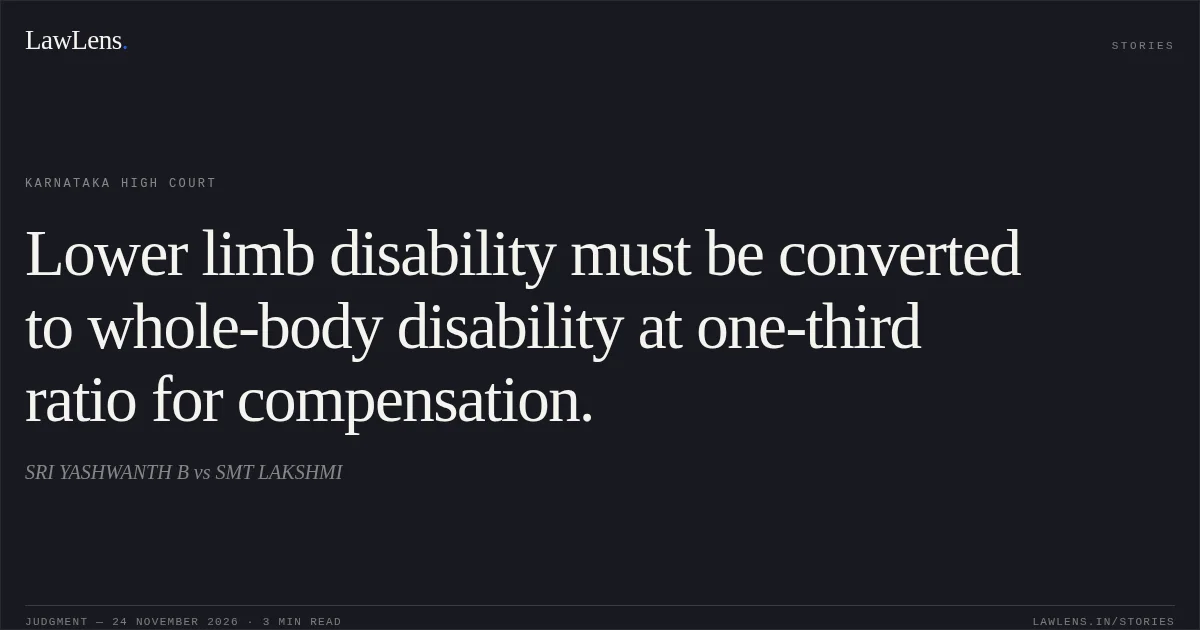
¶ 6It applied the principle that disability to the lower limb must be converted to whole-body disability by taking one-third of the lower-limb percentage.
¶ 10The Court made awards on the evidence of PW-2 for future medical expenses and for the cost of surgical removal of implant.
¶ 11No specific precedent is cited in the judgment; the Court's reasoning is based on the statutory framework and the evidence on record.
Provisions in the judgment · 1 · Linked ones open on LawLens
Motor Vehicles Act, 1988 Section 173
04Reasoning
The Court found the Tribunal's multiplier of 18 correct for a 19-year-old claimant.
¶ 6It adjusted the notional income from ₹16,000 to ₹16,250 per month and used the higher figure for all income-based heads.
¶ 6 · ¶ 8Relying on PW-2's evidence of 18% lower-limb disability, the Court converted it to 6% whole-body disability and recalculated future loss of income as ₹16,250 × 12 × 18 × 6% = ₹2,10,600.
¶ 10Given the compound Type I fracture, the Court enhanced pain and suffering from ₹40,000 to ₹80,000 and loss of amenities from ₹15,000 to ₹60,000.
¶ 7Loss of income during the three-month laid-up period was recomputed at ₹48,750.
¶ 8The attendant, conveyance, food and nourishment head was reduced from ₹35,000 to ₹6,000 (₹1,000 × 6 days of hospitalisation), since the record supported only six days of admission.
¶ 9Future medical expenses were enhanced to ₹30,000 for the planned implant-removal surgery.
¶ 11The Tribunal's award of ₹1,44,800 for past medical expenses was left undisturbed.
¶ 1205Holding
The Court held that the claimant is entitled to total compensation of ₹5,80,150, which is ₹1,04,550 more than the Tribunal's award of ₹4,75,600, together with 6% interest per annum from the date of the petition until realisation.
¶ 13 · ¶ 14(ii)The appeal is allowed in part.
¶ 14(i)The insurer (R-2) is directed to deposit the enhanced compensation with interest before the Tribunal within six weeks, and the appellant is entitled to release of the entire enhanced amount.
¶ 14(iii)–(iv)Original Court PDF
SRI YASHWANTH BvsSMT LAKSHMI
Click to open original judgment
Original judgment, available to read, download and summarize on LawLens.in