Facts
The parties were married on April 30, 2021
Source reference: para. 55In 2023, the respondent-husband filed for divorce under Section 13(1)(i-a) and (i-b) of the Hindu Marriage Act, 1955, alleging cruelty and desertion
Source reference: para. 2The Family Court, Dhanbad, proceeded ex parte and granted the decree of divorce on January 4, 2024
Source reference: para. 1, 4During the pendency of the appeal, the parties attempted mediation, which partially succeeded regarding the return of gifted articles but failed on the quantum of permanent alimony
Source reference: para. 15, 31The appellant sought ₹30,00,000, asserting the husband had remarried, while the husband, a civil court employee earning approximately ₹57,634 per month, offered ₹10,00,000
Source reference: para. 18, 20, 30, 60Issues
1. Whether the marriage is to be dissolved on the ground of cruelty and desertion?
Source reference: para. 62. What would be the just and fair quantum of permanent alimony to meet the needs of the appellant-wife based on the husband's income and social status?
Source reference: para. 32Law Applied
Section 25 of the Hindu Marriage Act, 1955, which empowers courts to grant permanent alimony based on the respondent's income, property, and the conduct of the parties
Source reference: para. 33Vinny Parmvir Parmar v. Parmvir Parmar, establishing that alimony should enable the wife to live in reasonable comfort commensurate with her matrimonial status
Source reference: para. 39Rajnesh v. Neha, which dictates that maintenance should prevent destitution without becoming oppressive for the husband
Source reference: para. 41Kalyan Dey Chowdhury v. Rita Dey Chowdhury, noting that 25% of the husband's net salary is a reasonable benchmark for alimony
Source reference: para. 37, 74Reasoning
The Court noted that since the husband had allegedly remarried and the wife agreed to the dissolution subject to alimony, the primary focus shifted to the quantum of settlement under Section 25
Source reference: para. 27, 31The Court assessed the husband's financial capacity, noting his stable career as a civil court employee with a monthly salary of ₹57,634
Source reference: para. 60The 23-year-old appellant has no independent source of income and a life expectancy of approximately 47 more years
Source reference: para. 70Applying a pragmatic calculation, the Court observed that even a modest monthly requirement of ₹4,500 over her remaining life expectancy would total approximately ₹25,00,000
Source reference: para. 70The Court reasoned that alimony must account for future inflation and the high cost of living while ensuring the wife is not reduced to penury, balancing the husband's "free income" against the wife’s total lack of sustenance
Source reference: para. 61, 71-75Holding
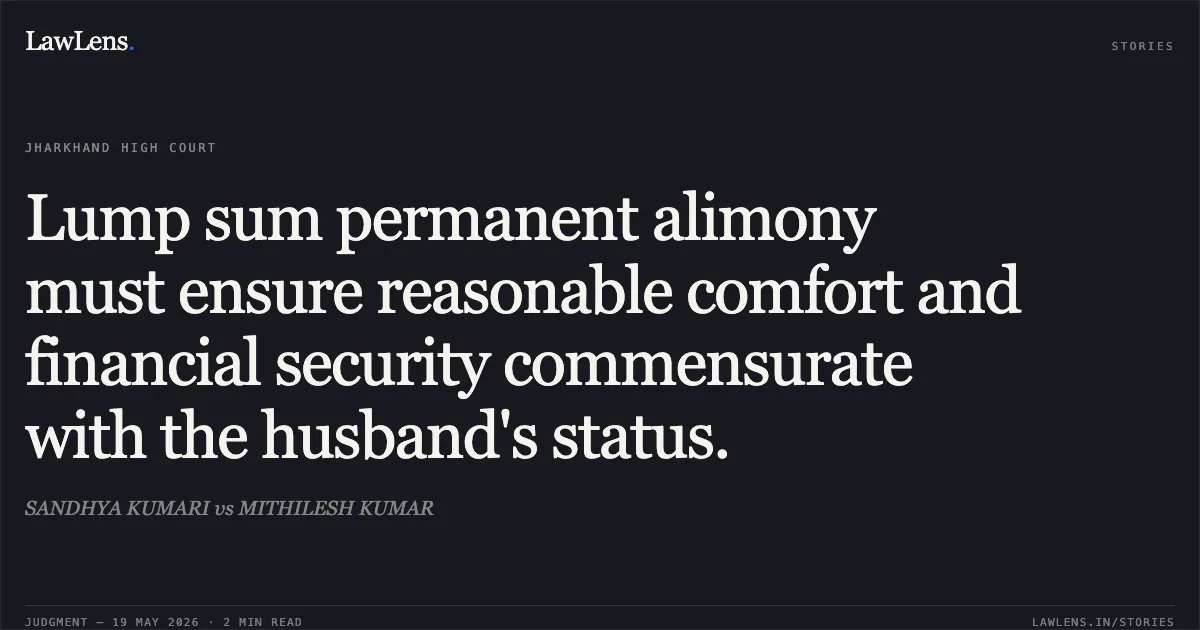
The High Court affirmed the decree of divorce but modified the terms of the settlement, ordering the respondent-husband to pay a lump sum of ₹25,00,000 (Rupees Twenty-Five Lakhs) as permanent alimony
This amount is to be paid in four equal installments over 12 months, with the first installment due within two months of the order; the appeal was disposed of with liberty to the wife to approach the court if payments are not credited
Source reference: para. 76, 77, 80Acts & Sections Cited
6 provisions across 4 statutes referred to in this judgment. Each provision opens on LawLens.
Family Courts Act, 19841
Hindu Marriage Act, 19553
Special Marriage Act, 19541
Code of Criminal Procedure, 19731
Original Court PDF
SANDHYA KUMARIvsMITHILESH KUMAR
Click to open original judgment
Original judgment, available to read, download and summarize on LawLens.in