Facts
M.K. Stalin contested the 2026 Tamil Nadu Legislative Assembly election from No.13, Kolathur Assembly Constituency as the Dravida Munnetra Kazhagam candidate.
Source reference: p.8; paras 2.1–2.2Polling was held on 23.04.2026 and counting on 04.05.2026, when the fourth respondent was declared elected and the petitioner stood second.
Source reference: p.8; paras 2.1–2.2Relying on the post-result EVM verification mechanism directed by the Supreme Court in Association for Democratic Reforms v. Election Commission of India, the petitioner applied on 07.05.2026 for checking and verification of the burnt memory of the Control Units, Ballot Units and VVPAT units used at fourteen polling stations, representing 5% of the 286 polling stations.
Source reference: p.9; paras 2.3–2.4The verification was conducted between 29.07.2026 and 05.08.2026, following which the District Election Officer certified that it had been successfully completed in accordance with the prescribed procedure.
Source reference: p.9; para 2.4The petitioner alleged several irregularities, including VVPAT malfunctions during mock polling, defective or irregular address tags and seals, mismatched ballot units, failure of a Control Unit to detect a Ballot Unit, non-response to technical queries, and failure to provide video recordings and technical failure reports.
Source reference: p.10; para 2.5He sought quashing of the certification order, 100% counting of VVPAT slips, verification of all 286 machines, preservation of election-related records, and declarations that the fourth respondent’s election was void and that the petitioner was duly elected.
Source reference: pp.6, 10–11; paras 2.6, 3The Election Commission raised a preliminary objection that the writ petition was barred by Article 329(b) of the Constitution read with the Representation of the People Act, 1951.
Source reference: pp.11–13; paras 3–5Issues
Whether the writ petition, notwithstanding its formal challenge to the post-result EVM/VVPAT verification process, in substance called in question the election and result of the returned candidate and was therefore barred by Article 329(b) of the Constitution read with the Representation of the People Act, 1951?
Source reference: p.20; para 7Whether the petitioner could seek 100% VVPAT counting and verification of all 286 machines in writ jurisdiction, or whether such relief had to be pursued through an election petition requiring proof and trial?
Source reference: pp.23–24; paras 12–13Whether the alleged EVM/VVPAT malfunctions, breaches of procedural rules and other irregularities were matters falling within the statutory grounds for declaring an election void under Section 100 of the Representation of the People Act, 1951?
Source reference: pp.22–23; para 12Law Applied
The Court applied Article 329(b) of the Constitution, which bars judicial interference with an election except through an election petition, and the statutory election-dispute mechanism under the Representation of the People Act, 1951, including Sections 80, 97 and 100.
Source reference: pp.11–16, 20–23The term “election” under Article 329(b) has a wide meaning covering the electoral process culminating in the declaration of the result; a proceeding that directly or indirectly seeks invalidation of the declared result cannot ordinarily be maintained under Article 226.
Source reference: p.20; para 8Section 97, concerning recrimination, safeguards proceedings in which a candidate seeks a declaration that he, rather than the returned candidate, was duly elected.
Source reference: p.22; para 11Section 100(1)(d)(iii) and (iv) provide grounds for declaring an election void where votes were improperly received or rejected, or where non-compliance with the Constitution, the Act or the Rules materially affected the result.
Source reference: pp.22–23; para 12The Court relied on N.P. Ponnuswami v. Returning Officer, Mohinder Singh Gill v. Chief Election Commissioner, and Election Commission of India v. Ashok Kumar for the restricted scope of judicial intervention in election matters.
Source reference: pp.16–18; para 5.6Association for Democratic Reforms v. Election Commission of India created an additional post-result verification safeguard, not an independent writ remedy bypassing the election-petition procedure.
Source reference: pp.24–26; para 15Reasoning
The Court examined the substance of the reliefs rather than the petitioner’s characterization of the proceedings.
Source reference: pp.20–22; paras 8–10Although the pleadings focused on alleged defects in the post-result verification, the prayers sought to invalidate the fourth respondent’s election and declare the petitioner elected in his place.
Source reference: pp.20–22; paras 8–10Those reliefs went directly to the validity and outcome of the election and therefore attracted Article 329(b).
Source reference: pp.20–22; paras 8–10The request for a declaration in favour of the petitioner also necessarily engaged Section 97’s recrimination procedure, which could not be undertaken in a writ proceeding because it required notice to affected candidates and a trial on oral and documentary evidence.
Source reference: p.22; para 11The alleged VVPAT malfunctions, defective seals and address tags, failure to detect a Ballot Unit and other procedural irregularities were matters capable of constituting grounds under Section 100(1)(d)(iii) or (iv), subject to proof that they materially affected the election result.
Source reference: pp.22–23; para 12Similarly, an order for 100% VVPAT counting or verification of all 286 machines would require a prima facie evidentiary foundation and could be directed, if warranted, by the Election Tribunal rather than on affidavits in writ jurisdiction.
Source reference: p.23; para 13The Court held that the Supreme Court’s verification mechanism was an evidentiary safeguard that could support an election petition, but did not displace the constitutional bar or create a separate Article 226 remedy.
Source reference: pp.24–26; para 15The expiry of the statutory limitation period during the administrative verification process could not enlarge the High Court’s jurisdiction; any limitation-related relief had to be considered by the competent election forum.
Source reference: pp.26–27; para 17Holding
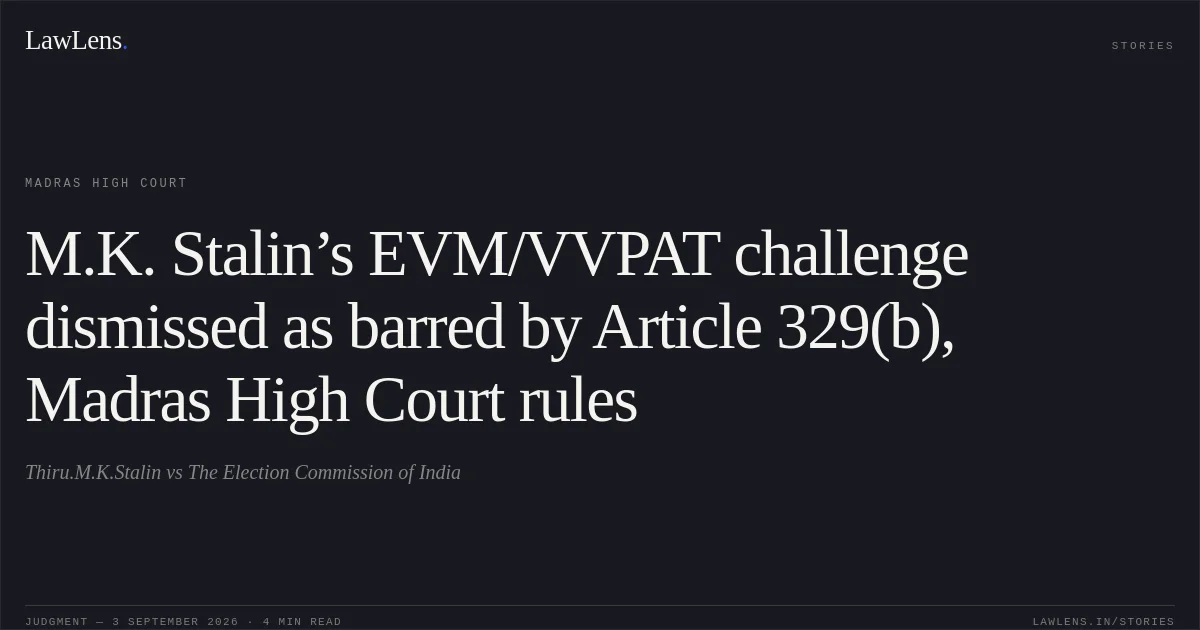
The Court held that the writ petition, in substance and effect, called in question the election of the fourth respondent and was barred by Article 329(b) of the Constitution read with the Representation of the People Act, 1951.
The petitioner’s grievances regarding the verification process, EVM/VVPAT irregularities, recount and the validity of the election were left open for adjudication in an appropriate election petition, subject to the statutory requirements, including proof of material effect on the result.
Source reference: pp.28–29; paras 18–19The writ petition was dismissed as not maintainable, with liberty to the petitioner to pursue any remedy available in law.
Source reference: p.29; para 19No order as to costs was made, and the connected miscellaneous petitions were closed.
Source reference: p.29; para 19Acts & Sections Cited
3 provisions across 1 statute referred to in this judgment. Each provision opens on LawLens.
Representation of the People Act, 19513
Original Court PDF
Thiru.M.K.StalinvsThe Election Commission of India
Click to open original judgment
Original judgment, available to read, download and summarize on LawLens.in