Facts
The Petitioner (Applicant No. 2 before the Tribunal) challenged the order of the Central Administrative Tribunal (CAT) dated 18 April 2023, which dismissed his plea for recruitment as Scientist-B.
Source reference: p. 1-2The recruitment required specific educational qualifications in fields like Electronics and Communication.
Source reference: para. 3The Petitioner held a Bachelor’s degree in Electronics and Telecommunications. The CAT held that this was not equivalent to the prescribed Bachelor's degree in Electronics and Communication.
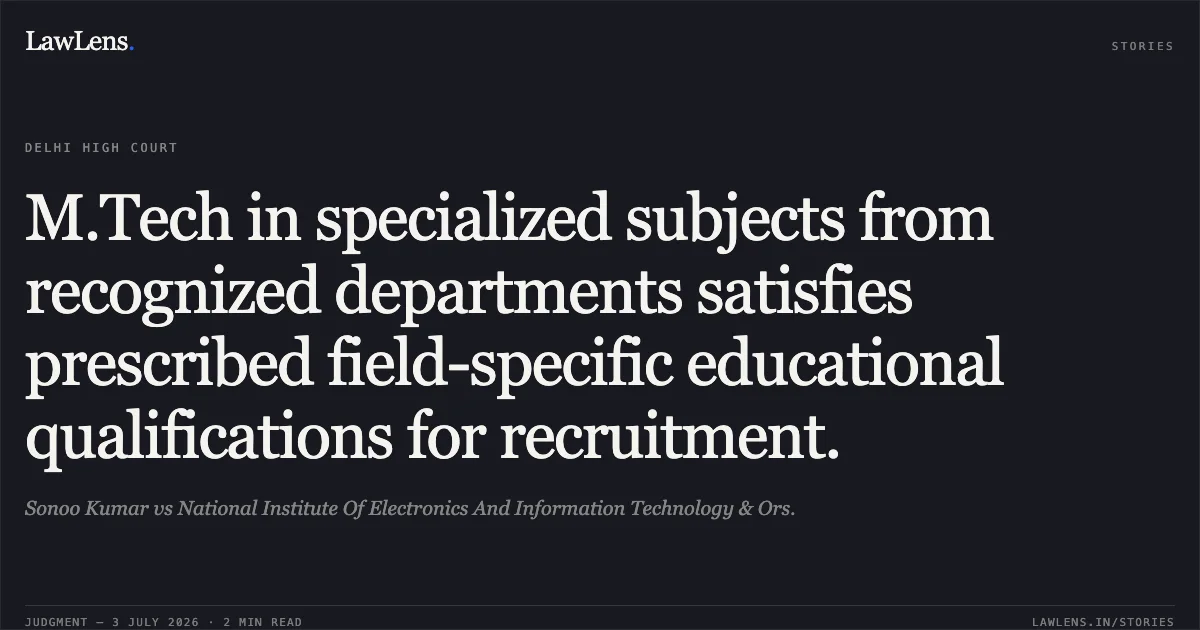
Source reference: para. 4In the present writ petition, the Petitioner contended that while his Bachelor's degree was questioned, he also possessed an M.Tech in "Signal Processing and Digital Design" from Delhi Technological University, obtained while being a student of the Electronics & Communication Engineering Department.
Source reference: para. 5-6He argued this M.Tech degree satisfies the essential qualifications, a plea he claimed was raised in para 4.13 of his original OA but not specifically addressed by the CAT.
Source reference: para. 7-8Issues
1. Whether a Bachelor’s degree in Electronics and Telecommunications can be treated as equivalent to a Bachelor’s degree in Electronics and Communication for the post of Scientist-B.
Source reference: para. 42. Whether the Petitioner’s M.Tech in Signal Processing and Digital Design from the Electronics & Communication Engineering Department fulfills the prescribed eligibility criteria.
Source reference: para. 6, 9Law Applied
The recruitment notification's prescribed educational qualifications required a Bachelor’s Degree (B.E./B.Tech) or Master’s Degree (M.Sc/MCA/ME/M.Tech) in specified fields, including Electronics and Communication.
Source reference: para. 3The court applied the principle of judicial restraint regarding the equivalence of educational qualifications, affirming that courts should not readily treat two distinct technical degrees as equivalent.
Source reference: para. 4The court acknowledged the right of a candidate for public service to have all pleaded qualifications duly considered by the adjudicating body.
Source reference: para. 9Reasoning
The High Court initially upheld the Tribunal's finding that a Bachelor’s degree in Electronics and Telecommunications is not the same as Electronics and Communication.
Source reference: para. 4The Court noted the Petitioner's secondary qualification—an M.Tech degree—and the argument that while specialized (Signal Processing), it falls under the umbrella of the Department of Electronics & Communication.
Source reference: para. 6The Court noted that this specific plea (para 4.13 of the OA) regarding the Master's degree was seemingly overlooked or not specifically argued during the Tribunal's proceedings.
Source reference: para. 8-9Given that the case involves the right to be considered for public service, the Court found it "appropriate" to allow the Petitioner to re-agitate this specific point before the Tribunal rather than deciding the technical equivalence itself.
Source reference: para. 9-11Holding
The High Court disposed of the writ petition by permitting the Petitioner to urge the specific ground regarding his M.Tech qualification before the CAT.
The Court directed the parties to appear before the Tribunal on 13 July 2026 for an expedited hearing, with the final entitlement to appointment subject to the Tribunal's fresh determination.
Source reference: para. 12-13Acts & Sections Cited
1 provisions across 1 statute referred to in this judgment. Each provision opens on LawLens.
Administrative Tribunals Act, 19851
Original Court PDF
Sonoo KumarvsNational Institute Of Electronics And Information Technology & Ors.
Click to open original judgment
Original judgment, available to read, download and summarize on LawLens.in