01Facts
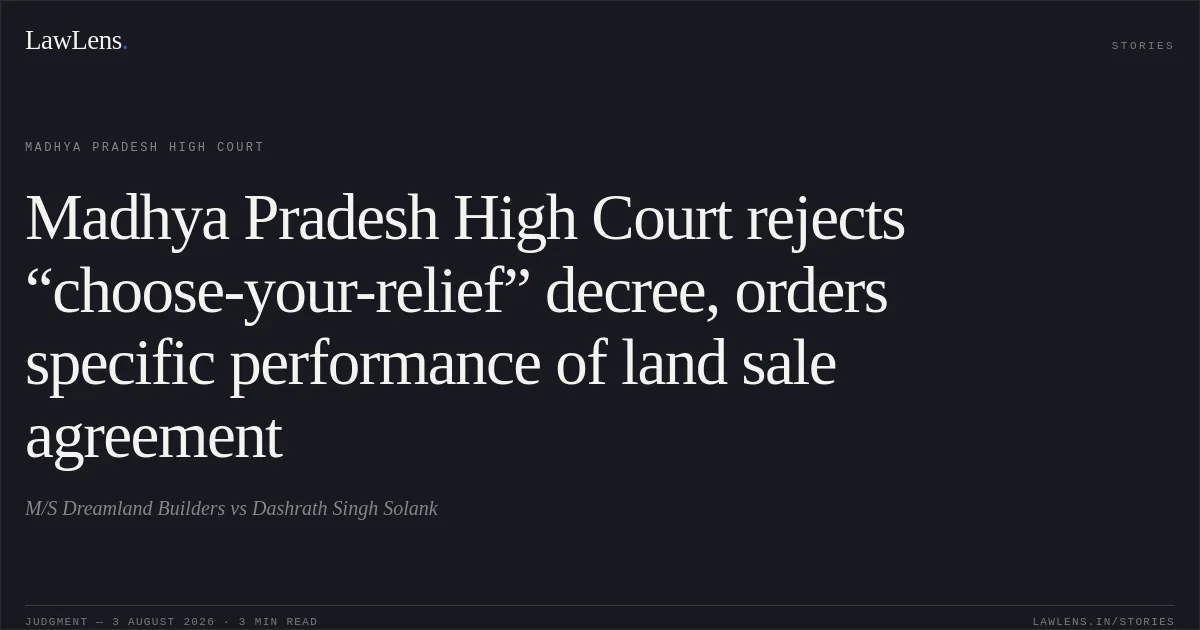
The appellant-plaintiff instituted a suit for specific performance concerning 1.142 hectares of land in Survey No. 402, Village Fanda Kalan, Bhopal, under an agreement to sell dated 20.02.2012 for ₹1,66,38,000.
[para. 4–5]The plaintiff asserted that ₹83,00,000 had been paid and that the balance ₹83,38,000 was payable upon execution of the sale deed.
[para. 4–5]Although the agreement and receipt of the amount were admitted, the defendant resisted the suit, alleging the plaintiff’s breach and contending that the property’s value had substantially increased.
[para. 4–5]The Trial Court found the agreement, payment, limitation, and the plaintiff’s readiness and willingness proved, but passed an unusual decree giving the defendant alternatives: execute the sale deed for the entire land, execute it for half the land, or refund ₹83,00,000 with interest.
[para. 6–7]The plaintiff challenged the ambiguity and ineffectiveness of this decree in the present appeal under Section 96 CPC.
[para. 8–9]02Issues
i.1. Whether a decree for specific performance may give the defendant the option either to execute the sale deed, execute a sale deed for part of the property, or refund the advance consideration.
[para. 9–14]ii.2. Whether the Trial Court could grant refund of the advance amount when specific performance had been decreed and no specific alternative prayer for refund had been made in the plaint.
[para. 15–17]iii.3. Whether the plaintiff was entitled to an unconditional decree for specific performance in view of the findings regarding execution of the agreement and his readiness and willingness.
[para. 16–21]03Law Applied
The Court applied Section 96 of the Code of Civil Procedure, 1908, governing first appeals, and the principles governing specific performance of contracts for sale of immovable property.
Under Section 22(1)(b) read with Section 22(2) of the Specific Relief Act, 1963, refund of earnest money or advance consideration is a separate relief that must be specifically claimed, particularly where specific performance is refused; it cannot ordinarily be granted suo motu.
[para. 15–17]A court must itself determine and grant a definite relief and cannot leave the operative choice between specific performance and refund to the defendant.
[para. 13–14]The Court relied on K.R. Suresh v. R. Poornima, 2025 SCC OnLine SC 1014, reaffirming that a specific prayer or amendment is necessary for grant of refund under Section 22.
[para. 17]It also applied the principle that subsequent appreciation in property prices is not, by itself, a valid ground for refusing specific performance of a proved agreement to sell.
[para. 18–19]Provisions in the judgment · 3 · Linked ones open on LawLens
Code of Civil Procedure, 1908 Section 96
Specific Relief Act, 1963 Section 22Section 21
04Reasoning
The Trial Court’s findings established that the agreement was genuine, ₹83,00,000 had been paid, and the plaintiff remained ready and willing to perform his obligations.
[para. 6, 16]Accordingly, the decree should have granted a clear and operative remedy for specific performance.
By permitting the defendant to choose between executing the sale deed, conveying half the land, or refunding the advance, the Trial Court effectively delegated its adjudicatory function to the defendant and created an uncertain decree.
[para. 13–14]The alternative refund direction was also legally unsustainable because specific performance had not been refused and the plaint contained no specific prayer for refund under Section 22.
[para. 15–17]The defendant’s objection that the land had appreciated in value did not justify non-performance, particularly when no circumstance disentitling the plaintiff from specific performance was established and the defendant had not filed any cross-appeal or cross-objection against the findings favourable to the plaintiff.
[para. 18–20]05Holding
The appeal was allowed and the Trial Court’s findings were affirmed, but its operative decree was modified.
The plaintiff was directed to pay or deposit the balance consideration of ₹83.38 lakhs within two months from the appellate judgment.
[para. 22(a)–(b)]Upon such payment or deposit, the defendant was directed to execute the sale deed in the plaintiff’s favour within 15 days.
[para. 22(c)]If the defendant failed to do so, the plaintiff could have the sale deed executed through the executing court and obtain possession.
[para. 22(c)]The defendant was not permitted to elect refund, partial conveyance, or non-performance.
Original Court PDF
M/S Dreamland BuildersvsDashrath Singh Solank
Click to open original judgment
Original judgment, available to read, download and summarize on LawLens.in