Facts
The applicant, arrayed as Respondent No. 13 in the Official Liquidator’s application, sought to vacate an interim injunction dated 9 August 2024 insofar as it applied to him.
Source reference: pp. 5–7He had worked for the company in liquidation from 1997 until his resignation in 2007, and contended that he had no statutory or financial decision-making authority and had not benefited from the alleged diversion of company funds.
Source reference: pp. 5–7He relied on the quashing of PMLA proceedings against him and the setting aside of provisional attachment of his properties under SAFEMA; an appeal against the order quashing the PMLA proceedings was pending before the Supreme Court.
Source reference: pp. 6, 10The Official Liquidator relied on the SFIO report, which alleged that the applicant performed CFO functions, participated in financial transactions and manipulations, and played a role in diverting company funds.
Source reference: pp. 8–12Issues
1. Whether the interim injunction against the applicant should be vacated in light of the outcomes of the PMLA and SAFEMA proceedings and his objections to the SFIO report.
Source reference: pp. 10–122. Whether the applicant could be permitted to operate his bank accounts while the Official Liquidator’s application remained pending.
Source reference: pp. 12–13Law Applied
The Court referred to Section 35 of the Companies Act, 2013, stating that persons who held relevant positions during a period in which there was a prima facie finding of fraud could be personally liable for resulting losses, and their properties could be proceeded against.
Source reference: p. 12The Court also treated the pending PMLA appeal and unresolved SFIO-related criminal proceedings as matters that had not attained finality; it did not regard the collateral proceedings as finally determining the applicant’s liability in the company proceedings.
Source reference: pp. 10–12The applicant’s reliance on Section 212(2) of the Companies Act, 2013 was recorded, but the Court did not decide that contention.
Source reference: p. 7Reasoning
The Court found that the PMLA proceedings had not reached finality because the appeal against their quashing remained pending, and that the SAFEMA Tribunal’s order setting aside provisional attachment did not finally resolve the issues in the company proceedings.
Source reference: p. 10It also considered the SFIO report and supporting material, including evidence that the applicant performed CFO functions, was authorised as a joint cheque signatory, and was associated with committees and transactions relevant to the alleged diversion of funds.
Source reference: pp. 11–12In the Court’s view, those matters disclosed a prima facie basis to preserve assets for the benefit of the company’s creditors, notwithstanding that the applicant’s alleged role and liability remained to be finally adjudicated.
Source reference: pp. 12–13However, because his bank accounts had been frozen, the Court considered a monitored permission to operate them appropriate.
Source reference: p. 13Holding
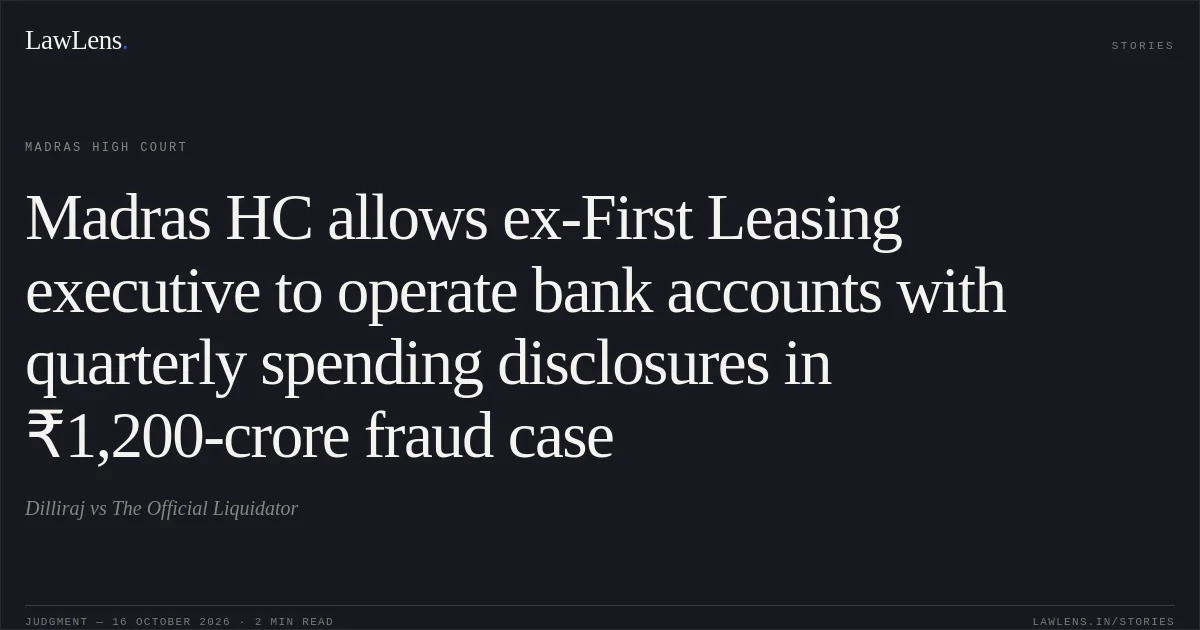
The Court declined to vacate the interim injunction but modified it to permit the applicant to operate his bank account, subject to filing quarterly statements of withdrawals and proof of the expenditure incurred from the withdrawn amounts until disposal of COMP.A. No. 276 of 2024.
All other terms of the interim order dated 9 August 2024 remained unchanged; there was no order as to costs.
Source reference: p. 14Acts & Sections Cited
2 provisions across 1 statute referred to in this judgment. Each provision opens on LawLens.
Companies Act, 20132
Original Court PDF
DillirajvsThe Official Liquidator
Click to open original judgment
Original judgment, available to read, download and summarize on LawLens.in