01Facts
The petitioner, the trustee-administered Arulmighu Sri Devi Gangaiamman Thirukoil, is a non-listed public temple under the Hindu Religious and Charitable Endowments Department (HR&CE).
¶ 2 / p.3Its Board of Trustees was appointed on 30.12.2024.
¶ 2 / p.3After prior permission from the second respondent (03.05.2025), Balalayam was performed on 05.06.2025, and all sanctioned Thiruppani and renovation works were completed.
¶ 2 / p.3The Board passed a resolution on 22.10.2026 and applied on 24.10.2026 to the second and third respondents for permission to conduct Kumbhabhishekam on 22.11.2026.
¶ 2 / p.3–4The application also sought police protection against anticipated interference by the seventh respondent, an individual.
¶ 2 / p.3–4No order had been passed, so the petitioner approached the Court under Article 226.
¶ 2 / p.4The learned Special Government Pleader stated that the application was under consideration and that orders would be passed within the time fixed by the Court.
¶ 3 / p.4The Court dispensed with notice to the seventh respondent because no order prejudicial to him was to be passed.
¶ 5 / p.402Issues
i.1. Whether the Court should direct the respondents to grant or refuse permission for the scheduled Kumbhabhishekam, or instead direct consideration of the pending application within a fixed time.
¶ 1 / p.3 · ¶ 6 / p.4ii.2. Whether notice to the seventh respondent was required before disposing of a writ petition seeking police protection against his alleged interference.
¶ 5 / p.4iii.3. Whether, given the urgency of the 22.11.2026 date, a time-bound direction for consideration of the representation dated 24.10.2026 was warranted.
¶ 6 / p.403Law Applied
The Court's power to issue a writ of mandamus under Article 226 of the Constitution was invoked, as stated in the prayer.
¶ 1 / p.3A public authority must consider a pending representation and pass a reasoned order on its merits in accordance with law, which the Court directed respondents to do.
¶ 6 / p.4The principle of audi alteram partem, which governs notice to affected persons, was applied in its narrow form: notice is required only where a prejudicial order is to be passed against a party.
¶ 5 / p.4The order does not cite any statute, such as the Tamil Nadu Hindu Religious and Charitable Endowments Act, 1959, and no precedent is relied upon.
04Reasoning
The Court did not examine the merits of the Kumbhabhishekam proposal. It treated the petition as one for a time-bound direction to decide a pending application, given that the function was fixed for 22.11.2026.
¶ 6 / p.4The Government Pleader's statement that the application was under consideration supported this course.
¶ 3 / p.4Because the Court proposed no order adverse to the seventh respondent, it dispensed with notice to him and disposed of the petition at the admission stage.
¶ 5 / p.4The order leaves the question of police protection against the seventh respondent unaddressed, since it directs no protection and records no finding on anticipated interference.
¶ 6–7 / p.4–5The direction is framed as "either way," so the respondents remain free to grant or refuse permission, provided the decision is reasoned, on merits, and in accordance with law.
¶ 6 / p.405Holding
The Court did not decide whether permission should be granted.
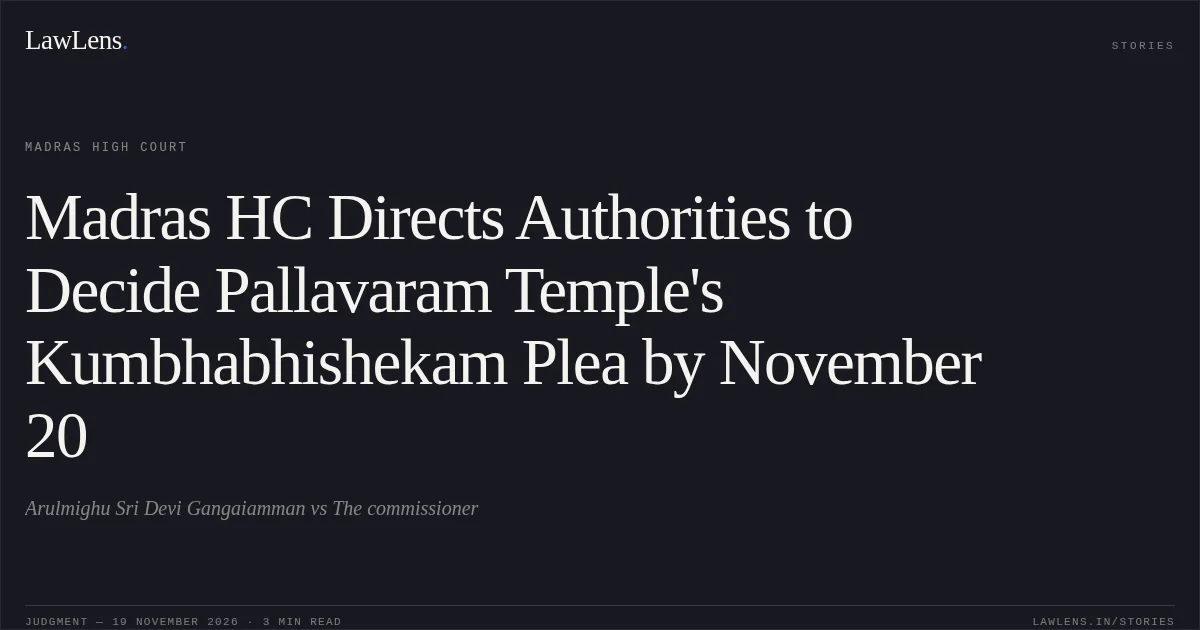
¶ 6 / p.4The respondents must consider the petitioner's application and representation dated 24.10.2026 and pass appropriate orders, either way, on their own merits and in accordance with law, on or before 20.11.2026.
¶ 6 / p.4Notice to the seventh respondent was dispensed with because no prejudicial order was to be passed.
¶ 5 / p.4The writ petition was disposed of with no costs, and the connected miscellaneous petition was closed.
¶ 7 / p.5The order grants no relief on the prayer for police protection under the cited paragraphs.
¶ 6–7 / p.4–5Original Court PDF
Arulmighu Sri Devi GangaiammanvsThe commissioner
Click to open original judgment
Original judgment, available to read, download and summarize on LawLens.in