Facts
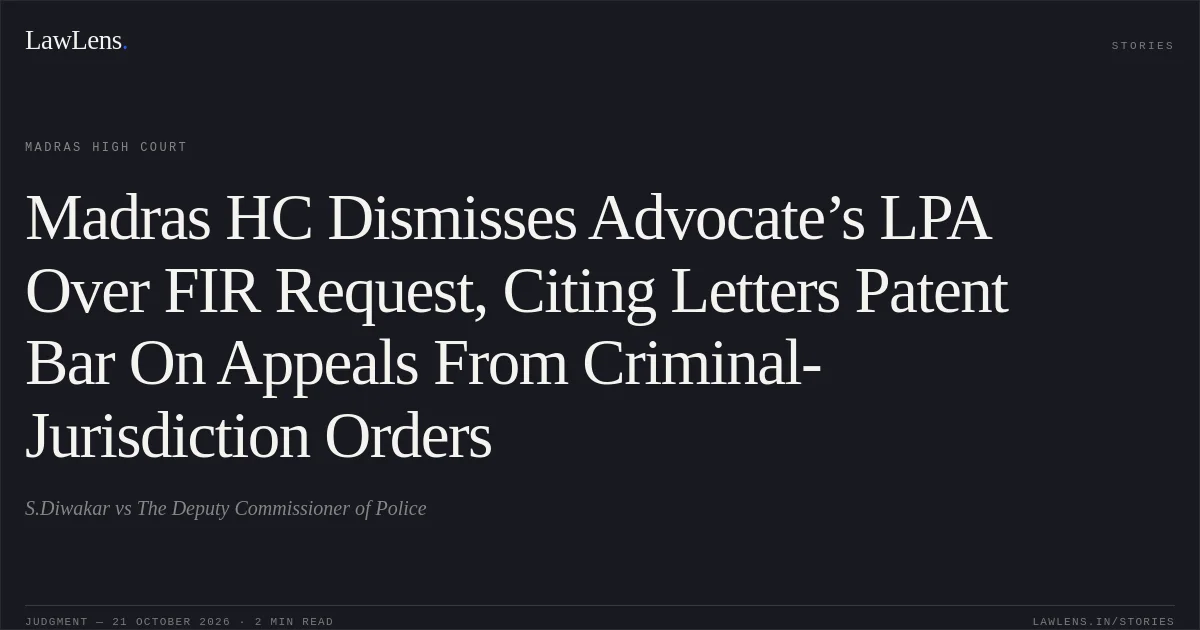
The appellant, a practising advocate appearing in person, had earlier sought police action on his complaints through a writ petition. The writ petition was dismissed, and the Division Bench later dismissed his writ appeal, noting that he had not exhausted the remedies available under the Code of Criminal Procedure.
Source reference: pp. 3–8, paras. 4–6In 2026, he filed a petition under Section 482 CrPC seeking a direction to register a complaint. The Single Judge disposed of the petition, leaving him at liberty to approach the competent court by way of a private complaint.
Source reference: pp. 8–10, paras. 7–9The appellant then filed this Letters Patent Appeal challenging that order.
Source reference: p. 10, para. 10Issues
1. Whether an appeal under Clause 15 of the Letters Patent lies against a Single Judge’s order passed in a Criminal Original Petition under Section 482 CrPC.
Source reference: pp. 10–12, paras. 10–132. Whether the present appeal was maintainable where the petition before the Single Judge sought to set the criminal law in motion by seeking registration of an FIR.
Source reference: p. 12, para. 13Law Applied
Clause 15 of the Letters Patent excludes an appeal against a judgment or order passed by a Single Judge in the exercise of criminal jurisdiction.
Source reference: pp. 10–11, para. 11In Ram Kishan Fauji v. State of Haryana, (2017) 5 SCC 533, the Supreme Court held that no Letters Patent Appeal lies against an order passed by a Single Judge exercising criminal jurisdiction.
Source reference: p. 11, para. 12The Court also stated that an order under Section 482 CrPC in a criminal original petition is not appealable under Clause 15 and that an appeal against such an order lies only before the Supreme Court.
Source reference: p. 12, para. 13Reasoning
The appellant’s Section 482 petition sought registration of an FIR and therefore invoked the Single Judge’s criminal jurisdiction.
Source reference: pp. 11–12, paras. 12–13Applying Clause 15 and Ram Kishan Fauji, the Court held that the character of the jurisdiction exercised—not the form of the challenged order—precluded a Letters Patent Appeal.
Source reference: pp. 11–12, paras. 12–13The Court accordingly treated the appeal as not maintainable and did not reconsider the merits of the underlying complaint or the Single Judge’s disposal of the petition.
Source reference: pp. 11–12, paras. 12–13Holding
The Court held that the Letters Patent Appeal was not maintainable because it challenged an order passed in the exercise of criminal jurisdiction under Section 482 CrPC.
The appeal was dismissed; no costs were awarded.
Source reference: p. 12, para. 14Acts & Sections Cited
6 provisions across 2 statutes referred to in this judgment. Each provision opens on LawLens.
Patents Act, 19701
Code of Criminal Procedure, 19735
Original Court PDF
S.DiwakarvsThe Deputy Commissioner of Police
Click to open original judgment
Original judgment, available to read, download and summarize on LawLens.in