01Facts
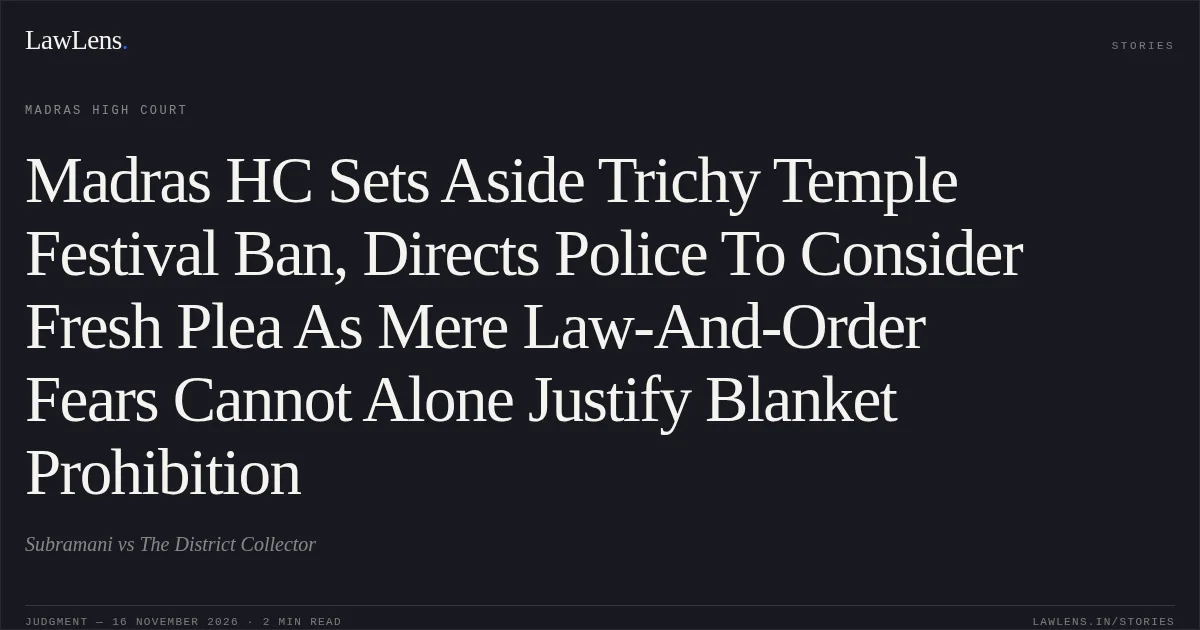
The petitioner, a devotee and representative of devotees of Arulmigu Mariamman Thirukoil, challenged the Executive Officer’s order dated 22 October 2026 refusing permission to hold the temple’s chariot festival on 30 October 2026.
¶ 2–5 · pp. 2–5The refusal relied on the asserted custom of holding the festival in the Tamil month of Aadi, rather than Aippasi.
¶ 2–5 · pp. 2–5The petitioner had sought permission following village consultations and earlier proceedings directing consideration of his representations.
¶ 2–5 · pp. 2–5By the time the writ petition was heard, the proposed festival date had passed.
¶ 2–5 · pp. 2–5The respondents submitted that the Joint Commissioner was the competent authority to decide questions of custom and usage under Section 63(e) of the Tamil Nadu HR&CE Act, 1959, and that the petitioner could approach that authority.
¶ 2–5 · pp. 2–502Issues
i.Whether the petitioner should be permitted to challenge the Executive Officer’s rejection of the proposed festival before the Joint Commissioner, as the authority competent to determine questions of custom and usage.
¶ 3, 5–6 · pp. 4–5ii.Whether, given that the proposed festival date had passed, the petitioner could seek permission from the Joint Commissioner to conduct the festival on a proximate auspicious date.
¶ 5–7 · pp. 5–603Law Applied
Section 63(e) of the Tamil Nadu Hindu Religious and Charitable Endowments Act, 1959 empowers the competent statutory authority to determine questions concerning the established usage and custom of a religious institution.
¶ 3, 5–7 · pp. 4–6The Court proceeded on the respondents’ submission that the Joint Commissioner was that competent authority and that the petitioner could seek statutory redress there; it did not itself determine the temple’s custom or the merits of the refusal.
¶ 3, 5–7 · pp. 4–6Provisions in the judgment · 1 · Linked ones open on LawLens
TAMIL NADU HINDU RELIGIOUS AND CHARITABLE ENDOWMENTS ACT, 1959 Section 63
04Reasoning
The Court noted that the proposed date of 30 October 2026 had elapsed and that the Joint Commissioner, rather than the High Court in the present proceedings, was the appropriate authority to adjudicate the dispute about custom and usage.
¶ 5–7 · pp. 5–6It therefore left the merits open and granted the petitioner liberty to challenge the rejection and seek permission for a festival on a proximate auspicious date.
¶ 5–7 · pp. 5–6To ensure consideration on the merits, it directed the Joint Commissioner to entertain the filing without insisting on limitation, hear the relevant parties, and decide the matter uninfluenced by the Executive Officer’s observations.
¶ 5–7 · pp. 5–605Holding
The writ petition was disposed of without quashing the rejection order or deciding whether the festival could be conducted.
¶ 6–8 · pp. 5–6The petitioner was granted two weeks from receipt of the order to file an appeal or statutory petition before the Joint Commissioner.
¶ 6–8 · pp. 5–6The Joint Commissioner was directed to issue notice to the petitioner, the Executive Officer, the hereditary Poosaris, and other interested parties; provide a reasonable opportunity of personal hearing; and pass orders on the merits and in accordance with law within four weeks thereafter, without insisting on limitation.
¶ 6–8 · pp. 5–6Original Court PDF
A.ManivannanvsThe Commissioner
Click to open original judgment
Original judgment, available to read, download and summarize on LawLens.in