01Facts
A partition suit resulted in a preliminary decree dated 23 February 2012, which was affirmed by the High Court in S.A. No. 386 of 2013 on 4 October 2013.
Final-decree proceedings were initiated in I.A. No. 589 of 2013.
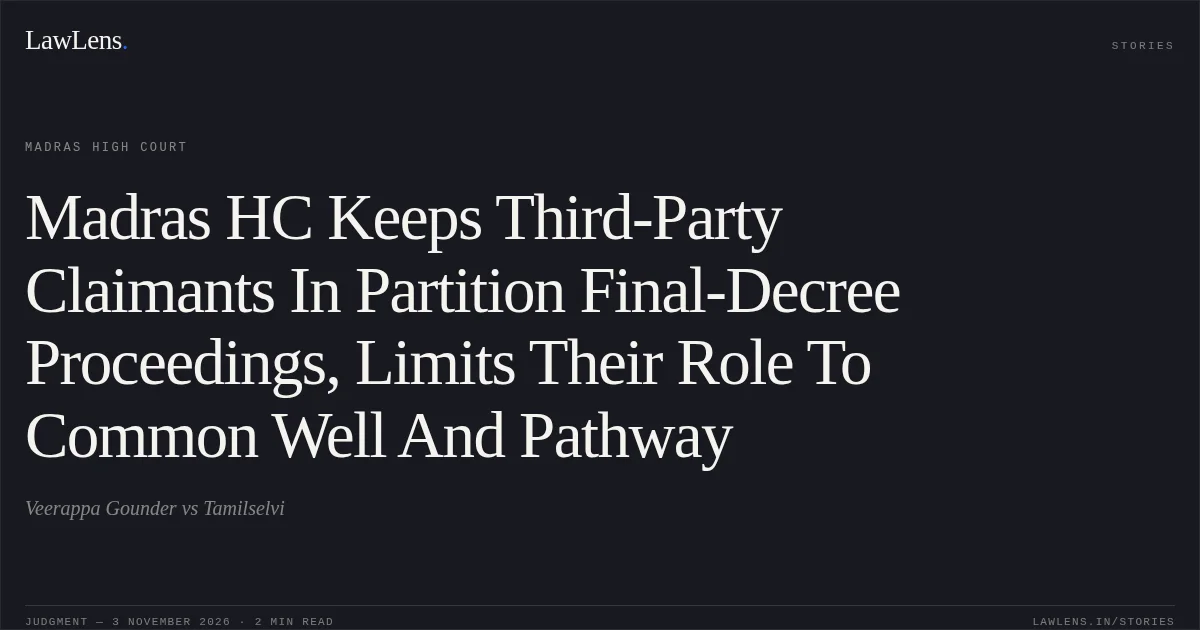
The respective first respondents, third parties to the suit, applied to be impleaded, asserting rights in a common well and pathway that they said could be affected by the final-decree process.
pp. 4–5The Second Additional Subordinate Court, Erode, allowed their applications.
p. 3 · pp. 5–6The first defendant challenged those orders under Article 227 of the Constitution.
p. 3 · pp. 5–602Issues
i.1. Whether third parties claiming rights in the common well and pathway could be impleaded in the final-decree proceedings, although the court’s task was to divide the suit properties among the decree-holders.
pp. 5–7ii.2. Whether the impleadment should be limited to consideration of the claimed rights in the common well and pathway.
p. 703Law Applied
The Court exercised its supervisory jurisdiction under Article 227 of the Constitution of India.
p. 3It applied the procedural principle that persons claiming an interest in matters forming part of final-decree proceedings may be joined where their participation can help avoid subsequent litigation; their participation may, however, be confined to the subject matter relevant to their asserted interest.
pp. 6–704Reasoning
The Court accepted that the final-decree court was not determining the third parties’ rights generally, but was dividing the suit properties by metes and bounds.
p. 6Because the common well and pathway formed part of the proceedings, excluding the claimants could lead to further litigation after the final decree. Their participation could allow the court to consider any established rights in those common areas when balancing the parties’ equities, without expanding the proceedings beyond that limited purpose.
pp. 6–705Holding
The Court disposed of both revisions in the above terms, leaving the impleadment in place but limiting its scope to the common well and pathway.
pp. 7–8It directed the trial court to refer the parties to mediation at the District Court, Erode Mediation Centre for six weeks. If mediation failed, the trial court was to continue the final-decree proceedings in accordance with law and complete them within three months thereafter.
pp. 7–8No costs were awarded, and the connected miscellaneous petitions were closed.
p. 8Original Court PDF
Veerappa GoundervsTamilselvi
Click to open original judgment
Original judgment, available to read, download and summarize on LawLens.in