01Facts
On 6 July 2016, the appellant was injured when the TNSTC bus in which he was travelling collided with a stationary bus.
pp. 2–3He sustained, among other injuries, a segmental fracture of the left leg and a crush laceration to the right ankle; the Medical Board assessed his permanent disability at 30%.
pp. 2–3, 7The Motor Accident Claims Tribunal found the bus driver negligent and awarded ₹5,10,120, including ₹1,50,000 for permanent disability using the percentage method.
p. 3The claimant appealed under Section 173 of the Motor Vehicles Act seeking enhanced compensation, including on the basis of his claimed earnings and the effect of his injuries.
p. 1, 402Issues
i.1. Whether, absent evidence of functional disability or loss of earning capacity, the Tribunal was justified in assessing permanent-disability compensation by the percentage method rather than the multiplier method.
pp. 5–6ii.2. Whether the claimant’s monthly income and compensation for loss of income, pain and suffering, and extra nourishment required enhancement.
pp. 6–803Law Applied
A claim for compensation for bodily injury is brought under Section 166 of the Motor Vehicles Act, with an appeal from the Tribunal’s award under Section 173. Where the medical assessment does not establish functional disability or loss of earning capacity, and there is no other evidence proving that loss, compensation for disability may be assessed by the percentage method rather than by applying a multiplier; the Court relied on Reliance General Insurance Company Limited v. M. Manoharan, 2023 (1) TN MAC 348 (DB).
p. 6The Tribunal had also relied on M. Chinnathambi v. Deepa, 2020 (1) TN MAC 617, applying ₹5,000 per percentage of disability.
p. 3Provisions in the judgment · 2 · Linked ones open on LawLens
Motor Vehicles Act, 1988 Section 173Section 166
04Reasoning
The Medical Board assessed 30% disability but did not link it to functional disability or reduced earning capacity, and the claimant produced no other evidence establishing such a link. The Court therefore upheld the percentage method and the Tribunal’s disability award.
pp. 5–6The claimant’s employment documents showed inconsistent salary figures, and one was issued after the accident; nevertheless, the Tribunal’s ₹10,000 monthly income assessment was considered too low for a 2016 accident, so the Court fixed income at ₹15,000 per month.
pp. 6–7Given the injuries and eight-day hospitalisation, it allowed six months’ loss of income and enhanced compensation for pain and suffering and extra nourishment.
pp. 7–805Holding
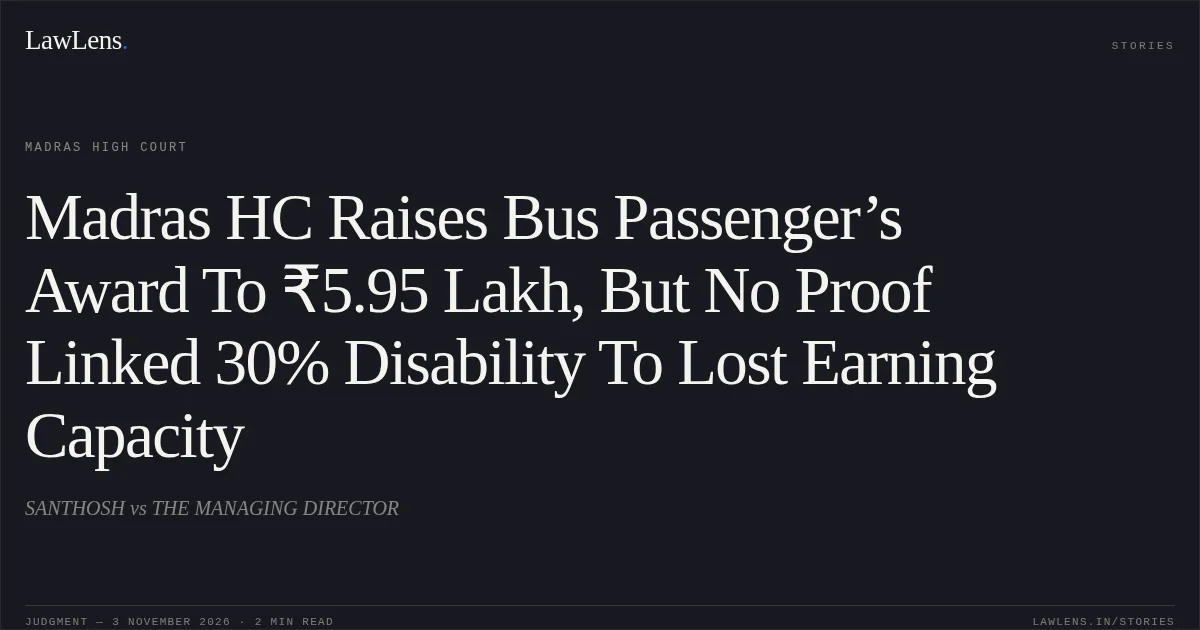
The appeal was partly allowed.
pp. 8–9The total compensation was enhanced from ₹5,10,120 to ₹5,95,000, with interest at 7.5% per annum from the date of the claim petition until deposit, excluding any period of default.
pp. 8–9The Court directed deposit of the enhanced award, less any amount already deposited, within six weeks, and permitted the claimant to withdraw the amount in accordance with the Tribunal’s directions.
p. 9Original Court PDF
SANTHOSHvsTHE MANAGING DIRECTOR
Click to open original judgment
Original judgment, available to read, download and summarize on LawLens.in