01Facts
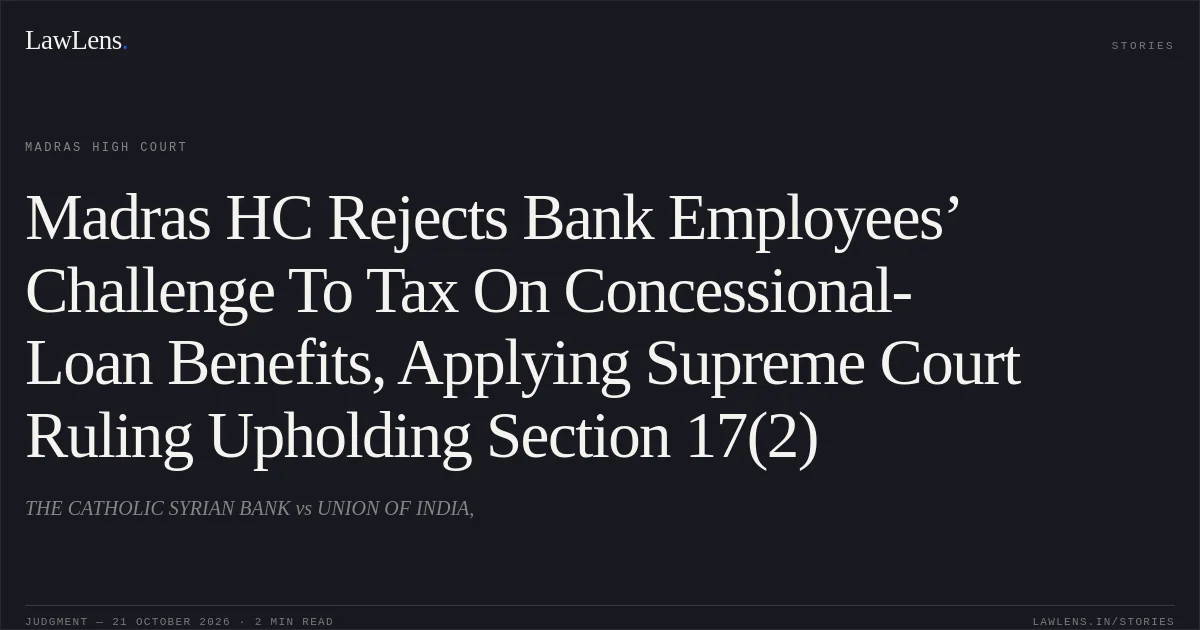
The petitioner, the Catholic Syrian Bank Executive Forum, sought a declaration that Rule 3(7)(i) of the Income Tax Rules, 1962, and Sub-para A of paragraph 4 of the bank’s circular dated 2 January 2008 were unconstitutional and ultra vires the Income Tax Act
p. 2The Court noted that a Division Bench had previously upheld the validity of Section 17(2)(viii) of the Act and Rule 3(7)(i), and that the Supreme Court had upheld that decision
pp. 3–502Issues
i.1. Whether Rule 3(7)(i) of the Income Tax Rules was unconstitutional or ultra vires the Income Tax Act
p. 2ii.2. Whether Sub-para A of paragraph 4 of the bank’s circular dated 2 January 2008 was unconstitutional or ultra vires the Income Tax Act
p. 203Law Applied
Section 17(2)(viii) of the Income Tax Act authorises rules treating specified benefits or perquisites as taxable; Rule 3(7)(i) is within that rule-making power and does not amount to excessive delegation.
p. 3In All India Union Bank Officers v. Union of India (Madras High Court, 20 April 2016), the Court upheld the provision and rule. In All India Bank Officers’ Confederation v. Regional Manager, Central Bank of India, 2024 INSC 389, (2024) 464 ITR 286, the Supreme Court affirmed their validity, holding that use of SBI’s rate as a uniform benchmark for valuing the benefit of interest-free or concessional loans was neither arbitrary nor violative of Article 14
pp. 3–5Provisions in the judgment · 2
Income Tax Act, 1961 Section 17
Circular dated 02.01.2008 Section 4
04Reasoning
The Court treated the challenge to Rule 3(7)(i) as squarely covered by the earlier Madras High Court decision and the Supreme Court’s affirmance of it
p. 6Since those decisions had upheld the rule’s validity, the Court concluded that the issue raised in the petition could not be reconsidered in the petitioner’s favour. The Court did not separately analyse the challenge to the bank circular
p. 2, 605Holding
The Court dismissed the writ petition, holding that the challenge was covered by the prior decisions upholding Rule 3(7)(i)
p. 6It made no order as to costs and closed the interim application
p. 6Original Court PDF
THE CATHOLIC SYRIAN BANKvsUNION OF INDIA,
Click to open original judgment
Original judgment, available to read, download and summarize on LawLens.in