01Facts
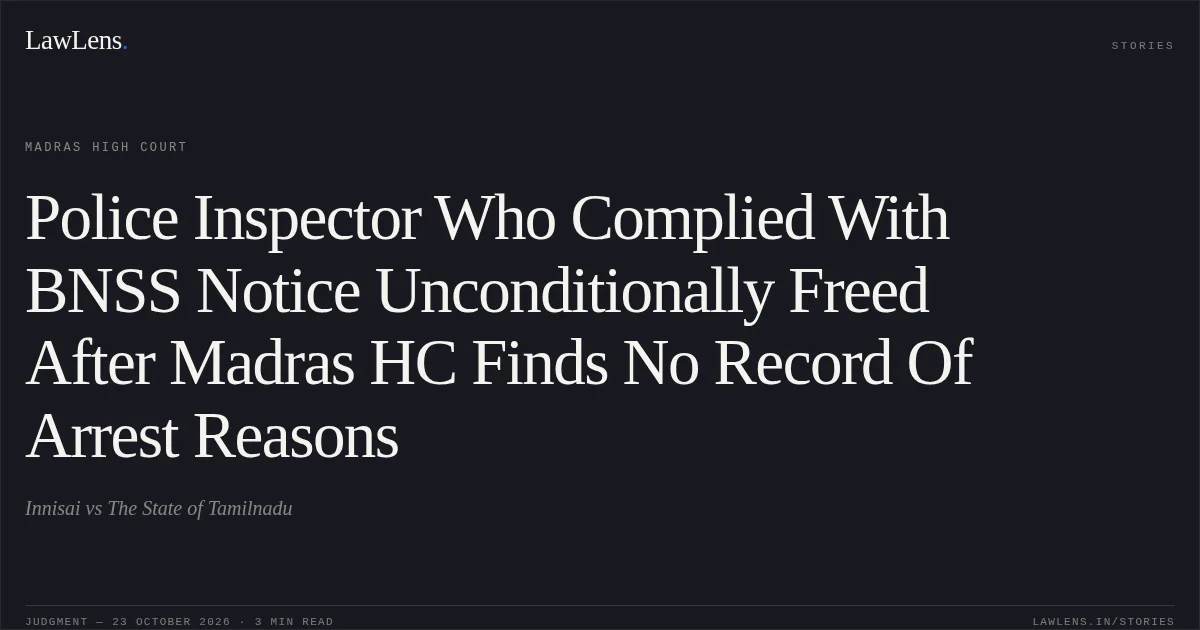
The petitioner, Innisai, sought habeas corpus relief for her husband, Sugumaran, an Inspector of Police.
pp. 2–4, 8–10After a complaint concerning a partnership dispute was transferred to the CB-CID, the investigation was altered to include allegations against Sugumaran, who was arrested on 9 October 2026 and remanded to custody.
pp. 2–4, 8–10He had appeared in response to a notice issued under Section 35(3) of the Bharatiya Nagarik Suraksha Sanhita, 2023 (BNSS).
pp. 2–4, 8–10The petitioner alleged that the arrest was made without the reasons required by Section 35(5) BNSS and that the grounds of arrest had not been served on Sugumaran.
pp. 2–4, 8–10The Magistrate dismissed his bail application; the petitioner then filed this habeas corpus petition.
pp. 2–4, 8–1002Issues
i.1. Whether a habeas corpus petition was maintainable to challenge Sugumaran’s arrest and remand as illegal.
pp. 4–5ii.2. Whether the arrest was unlawful because Sugumaran had complied with a Section 35(3) BNSS notice and the required reasons for arrest were not shown to have been recorded.
pp. 5–8iii.3. Whether the arrest and remand violated Article 22(1) of the Constitution because the grounds of arrest were not served on Sugumaran.
pp. 8–1003Law Applied
Under Gautam Navlakha v. National Investigation Agency, a habeas corpus petition lies where remand is absolutely illegal, without jurisdiction, or passed mechanically; V. Senthil Balaji v. State recognises the remedy where detention violates a statutory mandate.
p. 4Section 35(5) BNSS provides that a person who complies and continues to comply with a notice under Section 35(3) shall not be arrested for the relevant offence unless the police officer forms and records reasons for arrest.
pp. 5–7Section 35(1)(b) BNSS requires the statutory conditions for arrest in qualifying cognizable offences to be met, with reasons recorded in writing; the Court referred to Arnesh Kumar v. State of Bihar on scrutiny of those conditions.
pp. 6–7Article 22(1) requires that an arrested person be informed of the grounds of arrest; relying on Mihir Rajesh Shah v. State of Maharashtra and Vihaan Kumar v. State of Haryana, the Court held that failure to comply renders the arrest and remand, and subsequent proceedings, illegal.
pp. 9–10Provisions in the judgment · 5 · Linked ones open on LawLens
Bharatiya Nagarik Suraksha Sanhita, 2023 Section 35
Bharatiya Nyaya Sanhita, 2023 Section 61Section 198Section 308
Code of Criminal Procedure, 1973 Section 41
04Reasoning
Sugumaran had appeared in response to the Section 35(3) notice, bringing his arrest within the protection of Section 35(5).
pp. 7–8The respondents produced no material showing that the investigating officer had recorded the reasons required to justify arrest despite that compliance; the Court considered this sufficient to invalidate the arrest and remand.
pp. 7–8The Court also found no evidence that the grounds of arrest had been served.
pp. 8–10It rejected the Magistrate’s reasoning that service could be dispensed with because Sugumaran was a police officer and his wife was a lawyer, holding that constitutional protections cannot be waived on that basis.
pp. 8–10The Court expressly confined its decision to the legality of the arrest and remand and did not determine the merits of the allegations or whether the FIR should be quashed.
pp. 12–1305Holding
The Court held that the arrest, detention and remand were illegal, both because compliance with Section 35(5) BNSS was not shown and because the constitutional requirement to inform Sugumaran of the grounds of arrest was violated.
p. 8, 10, 15It allowed the habeas corpus petition and directed Sugumaran’s immediate, unconditional release, clarifying that the relief was not bail and that the merits of the allegations remained undecided.
p. 15Original Court PDF
InnisaivsThe State of Tamilnadu
Click to open original judgment
Original judgment, available to read, download and summarize on LawLens.in