01Facts
The plaintiff sought specific performance of an agreement dated 1 April 1991, alleging that he had paid Rs.1,40,000 of the Rs.1,60,000 sale price and that the remaining Rs.20,000 was payable within five years.
The defendant denied executing the agreement or receiving the advance, and alleged that the plaintiff, a close relative who had managed family affairs, had misused signed blank stamp papers.
The trial court decreed the suit, and the first appellate court dismissed the defendant’s appeal. The defendant then brought this second appeal.
The High Court’s judgment and subsequent correction order contain inconsistent references to the earlier injunction suit’s case number; the correction order amended the references in paragraphs 3.1 and 9.3 to O.S. No. 191 of 2004 and confirmed the decree under challenge as relating to O.S. No. 102 of 1997
pp. 2–4, 18–1902Issues
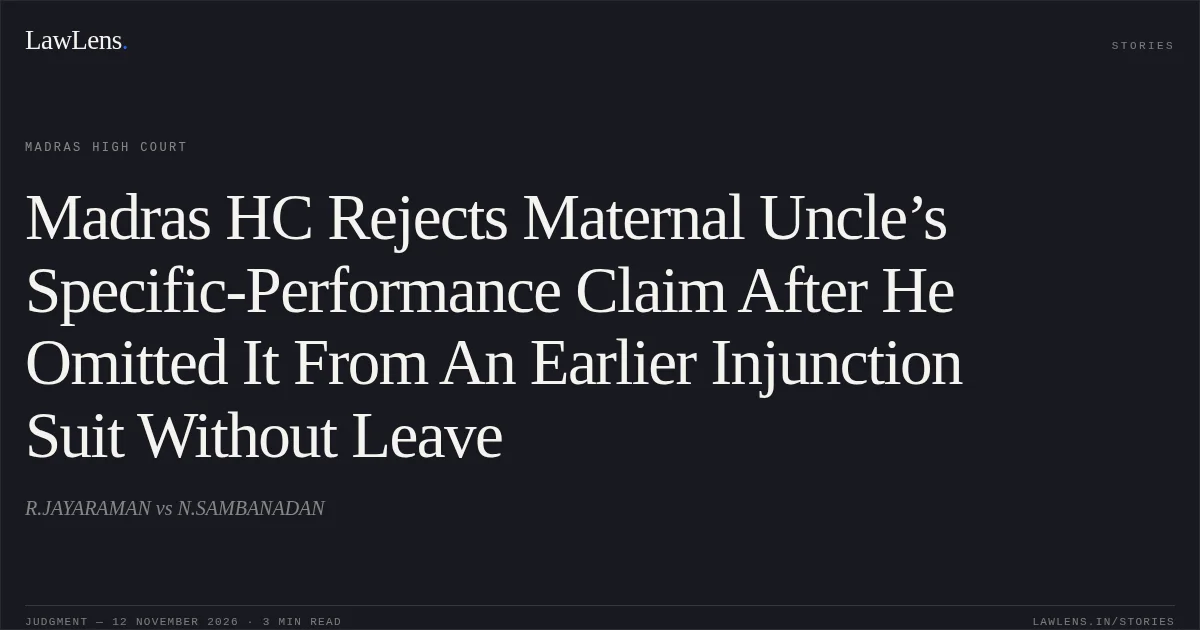
i.Whether the subsequent specific-performance suit was barred by Order II Rule 2 CPC because the plaintiff had earlier sued for an injunction without leave to omit the specific-performance relief.
p. 6 · ¶ 8(i) · pp. 11–13 · ¶ 15–18ii.Whether the plaintiff proved readiness and willingness to perform the agreement, in light of the delay and the alleged failure to take steps to complete the sale.
p. 6 · ¶ 8(ii) · pp. 10–12 · ¶ 12–14iii.Whether the agreement’s execution and payment of the alleged advance could be accepted despite the five-year period for paying the comparatively small balance and the parties’ asserted fiduciary relationship.
p. 6 · ¶ 8(iii) · pp. 10–11 · ¶ 1303Law Applied
Order II Rule 2 CPC bars a later suit for a relief omitted from an earlier suit where the relief arises from the same cause of action, unless leave to omit it was obtained; Order II Rule 2(3) concerns such leave.
pp. 11–13 · ¶ 15–18Under Section 16(c) of the Specific Relief Act, a plaintiff seeking specific performance must plead and prove readiness and willingness to perform the essential terms of the contract. The court also referred to Section 20 of that Act as governing the discretionary relief of specific performance.
pp. 8–9 · ¶ 9.4 · pp. 10–14 · ¶ 13–19The judgment cited J.P. Builders v. Ramadas, Sukhwinder Singh v. Jagroop Singh, Sukhbir Singh v. Brij Pal Singh, N.P. Thirugnanam v. Dr. R. Jagan Mohan Rao, Thirugnanasambandam v. Kaliaperumal and Govindappa Naidu v. C. Sidda Chetty in support of the readiness-and-willingness requirement and its discussion of the successive suits.
pp. 12–14 · ¶ 16–17Provisions in the judgment · 3 · Linked ones open on LawLens
Code of Civil Procedure, 1908 Section 100
Specific Relief Act, 1963 Section 20
Transfer of Property Act, 1882 Section 52
04Reasoning
The Court considered the alleged advance and the five-year period for payment of the relatively small balance suspicious, and held that the plaintiff had not established the mode of payment or readiness and willingness to complete the transaction.
pp. 10–12 · ¶ 13–14It also noted the defendant’s allegation that the plaintiff had managed family affairs and obtained signatures on blank papers, and found that the plaintiff had not specifically denied the asserted fiduciary circumstances.
pp. 10–12 · ¶ 13–14On the successive-suit issue, the Court reasoned that the defendant’s denial of the agreement had given rise to a cause of action for specific performance when the earlier injunction suit was filed, and that the plaintiff had not obtained leave to omit that relief; it therefore held the later suit barred under Order II Rule 2 CPC.
pp. 11–13 · ¶ 15–1805Holding
The High Court allowed the second appeal, set aside the judgments and decrees of the courts below, and dismissed the specific-performance suit, with no order as to costs.
p. 16 · ¶ 22It dismissed the appellant’s application to record a compromise because it was not jointly presented, and dismissed the application to adduce additional evidence because the documents were not necessary for deciding the appeal.
pp. 14–15 · ¶ 20–21Original Court PDF
R.JAYARAMANvsN.SAMBANADAN
Click to open original judgment
Original judgment, available to read, download and summarize on LawLens.in