01Facts
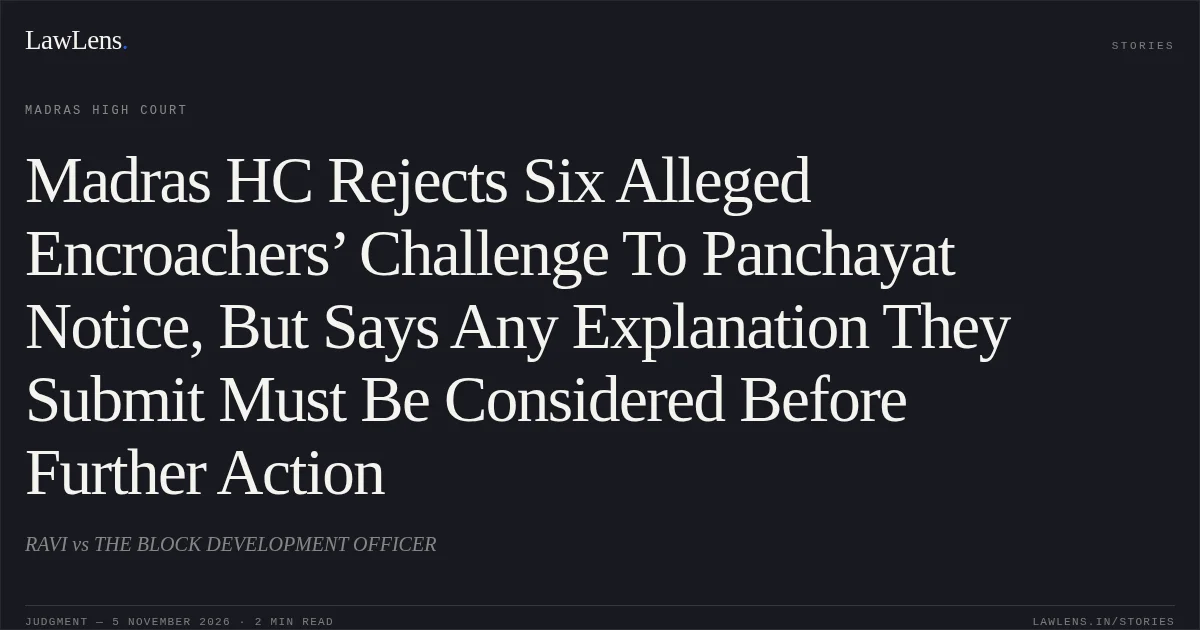
The petitioners challenged a notice dated 22 September 2026 issued by the Block Development Officer under Section 131(2) of the Tamil Nadu Panchayats Act, 1994, requiring them to remove alleged encroachments and warning of further enforcement action.
p. 2They contended that the land belonged to the HR & CE Department, that they held patta, and that they had not been given an opportunity to be heard.
p. 2The State submitted that the land was Government poramboke, that the patta related to a different survey number, and that the HR & CE Department had confirmed the land did not belong to the temple.
p. 3The petitioners sought certiorari to quash the notice.
p. 102Issues
i.1. Whether the notice issued under Section 131(2) of the Tamil Nadu Panchayats Act could be challenged as an order initiating eviction without affording the petitioners an opportunity to be heard.
pp. 2–3ii.2. Whether the petitioners had established grounds to quash the notice, including their claims of patta and HR & CE ownership.
pp. 2–3, 803Law Applied
Section 131(2) of the Tamil Nadu Panchayats Act, 1994, provides for action by the Executive Authority or Commissioner to secure the removal of encroachments on properties vested in Village Panchayats or Panchayat Union Councils; if removal is not secured within the prescribed time, the matter proceeds to the Revenue Department for action under the Tamil Nadu Land Encroachment Act, 1905.
pp. 4–7As explained in M. Jebaraj v. The Commissioner, Panchayat Union, Hosur and Others, 2026 MHC 100, the process is two-tiered: the Panchayat authority acts first, and, if the encroachment is not removed, the jurisdictional Tahsildar may initiate proceedings under the 1905 Act by issuing a notice under Section 7, followed, where appropriate, by a final notice under Section 6; an appeal lies under Section 10.
pp. 3–7Provisions in the judgment · 4 · Linked ones open on LawLens
Tamil Nadu Panchayats Act,1994 Section 131
Tamil Nadu Land Encroachment Act, 1905 Section 6Section 7Section 10
04Reasoning
The Court treated the impugned communication as a notice requiring the petitioners to remove the alleged encroachment, rather than as a completed eviction under the Land Encroachment Act.
p. 2, 7Applying the two-tier procedure in M. Jebaraj, it held that if the petitioners did not vacate, the Panchayat authority would report the matter to the Revenue Department, which would then have to follow the statutory procedure under the 1905 Act.
pp. 6–7The petitioners had not established an acceptable basis to quash the notice; however, they could submit their explanation and supporting documents for the authority’s consideration before further enforcement action.
p. 805Holding
The Court dismissed the writ petition, finding no acceptable ground to interfere with the notice.
p. 8It granted the petitioners liberty to submit an explanation and supporting documents, which the authority was to consider before initiating further enforcement action if the explanation was unsatisfactory.
p. 8No costs were ordered.
p. 8Original Court PDF
RAVIvsTHE BLOCK DEVELOPMENT OFFICER
Click to open original judgment
Original judgment, available to read, download and summarize on LawLens.in