01Facts
The appellant was prosecuted for allegedly marrying a fourteen-year-old girl on 10 January 2024 and having sexual relations with her; she later gave birth to a child.
p. 2The final report invoked Section 9 of the Prohibition of Child Marriage Act, 2006 (PCM Act) and Section 6 of the Protection of Children from Sexual Offences Act, 2012 (POCSO Act).
p. 2The Special Court’s record stated that the appellant had admitted the accusation and pleaded guilty, but contained no formal charge, and the purported plea was unsigned.
pp. 2–3The Special Court convicted him under Section 6 of the POCSO Act and Section 10 of the PCM Act.
pp. 2–3On appeal, the High Court called for the trial record and examined the validity of the charge and plea, the evidentiary basis for the convictions, and whether the appeal was barred as one from a conviction on a guilty plea.
pp. 3–4, 7–802Issues
i.1. Whether the appeal was barred under Section 416 of the Bharatiya Nagarik Suraksha Sanhita, 2023 (BNSS), where the conviction was recorded on an alleged guilty plea.
pp. 7–8ii.2. Whether the conviction could stand when no formal charge was shown to have been framed and the purported plea was not properly recorded or authenticated.
pp. 4–5iii.3. Whether the POCSO conviction could stand without evidence establishing the survivor’s age and other foundational facts.
p. 5iv.4. Whether the appellant could be convicted under Section 10 of the PCM Act when the final report invoked Section 9 and he had not been charged under Section 10.
p. 603Law Applied
Sections 251 and 252 of the BNSS (corresponding to Sections 228 and 229 of the Code of Criminal Procedure, 1973) require a charge to be framed, read over and explained to the accused, who must then be called upon to plead; a guilty plea must relate to a specific charge and be properly recorded.
pp. 4–5Section 416 of the BNSS restricts an appeal from a conviction on a guilty plea only where the conviction rests on a legally valid plea.
pp. 7–8Under Article 21 of the Constitution, an accused is entitled to a fair trial and adequate notice of the accusation.
p. 5For a conviction under Section 6 of the POCSO Act, the prosecution must establish the survivor’s age as a foundational fact; the presumption under Section 29 arises only after foundational facts are established.
p. 5Sections 9 and 10 of the PCM Act create distinct offences with distinct ingredients, and an accused cannot be convicted under Section 10 without notice of that charge.
p. 6Provisions in the judgment · 12 · Linked ones open on LawLens
Bharatiya Nagarik Suraksha Sanhita, 2023 Section 415Section 230Section 251Section 252Section 416
Protection of Children from Sexual Offences Act, 2012 Section 6Section 29
Prohibition of Child Marriage Act, 2006 Section 9Section 10
Code of Criminal Procedure, 1973 Section 228Section 229Section 375
04Reasoning
The contemporaneous record did not support the trial judge’s later explanation that charges had been framed: the B Diary recorded only general questioning, while neither the plea nor the judgment established that a specific charge had been read over and explained.
pp. 4–5The purported plea was also unauthenticated; accordingly, it was not a valid guilty plea and did not bar the appeal under Section 416.
pp. 4–5, 7–8Independently, no witness or document was produced to establish the survivor’s age or other foundational facts necessary for the POCSO conviction, so the Section 29 presumption could not supply the missing proof.
p. 5The PCM conviction was also defective because the appellant was convicted under Section 10, although the final report charged him under Section 9, and the alleged conduct was that he married the survivor, not that he performed or conducted the marriage.
p. 605Holding
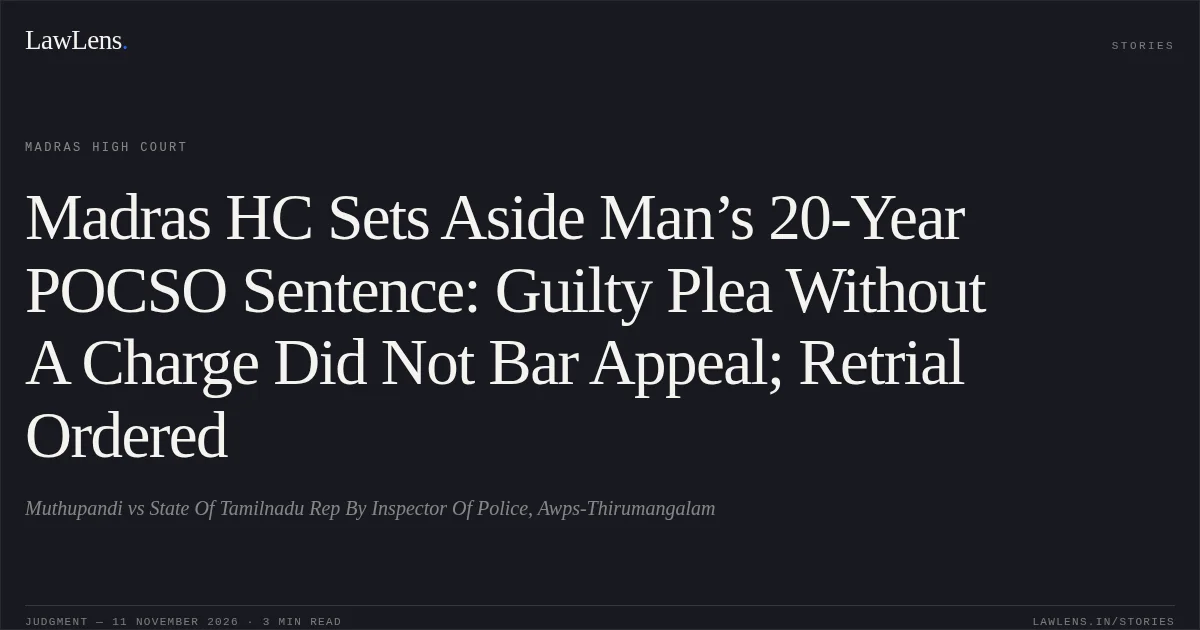
The High Court held that the appeal was maintainable and that the convictions could not stand because no valid charge or plea was recorded, the POCSO foundational facts were unproved, and the PCM conviction was under an uncharged provision.
pp. 7–8It set aside the convictions and sentences and remitted the matter to the Special Court to frame appropriate charges, record the appellant’s plea in accordance with law, conduct a trial and decide the case on its merits.
p. 8The appellant was to remain on bail and cooperate with the proceedings; the Court expressed no view on the merits of the prosecution case.
p. 8Original Court PDF
MuthupandivsState Of Tamilnadu Rep By Inspector Of Police, Awps-Thirumangalam
Click to open original judgment
Original judgment, available to read, download and summarize on LawLens.in