01Facts
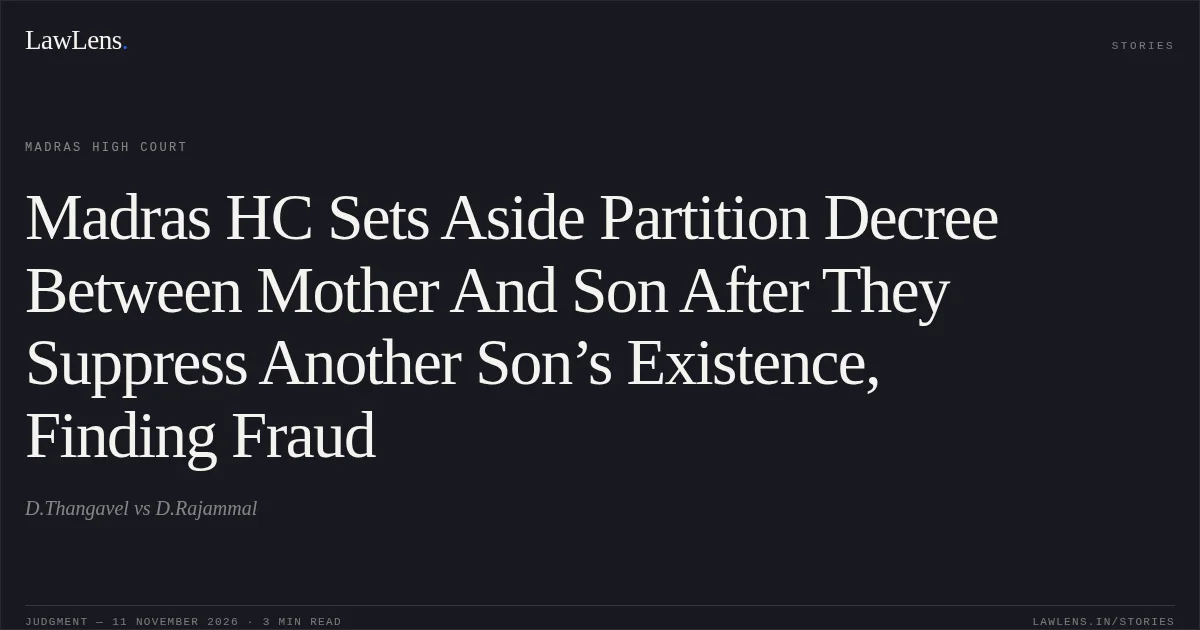
The first respondent, the petitioner’s mother, sued the second respondent, his brother, for partition, relying on two Wills said to have been executed by their father, Duraisamy, in favour of the respondents.
p. 2 · ¶ 2 · p. 4 · ¶ 6The suit alleged that the “A” schedule properties were ancestral and the “B” schedule properties were Duraisamy’s self-acquired properties.
p. 2 · ¶ 2 · p. 4 · ¶ 6The first respondent did not implead the petitioner and obtained a compromise decree allotting the properties to the second respondent.
p. 3 · ¶ 3The petitioner challenged the decree as collusive and fraudulent.
The Court noted that one of the Wills, marked as Ex.A1, referred to the petitioner as Duraisamy’s younger son.
p. 4 · ¶ 7The petitioner sought relief under Article 227 of the Constitution.
p. 1, Prayer02Issues
i.Whether the compromise decree could stand when the petitioner, an alleged necessary party whose rights were affected, had not been impleaded in the partition proceedings.
p. 4 · ¶ 7–8 · p. 9 · ¶ 12ii.Whether the High Court should exercise its supervisory jurisdiction under Article 227 to set aside the compromise decree on the basis of suppression of material facts, fraud, and collusion.
p. 9 · ¶ 12–1303Law Applied
Article 227 of the Constitution empowers the High Court to exercise supervisory jurisdiction where, among other circumstances, there is an apparent error, abuse of process, or an issue going to the root of the matter.
p. 5 · ¶ 9The Court relied on A.V. Papayya Sastry v. Government of A.P., as quoted in Satluj Jal Vidyut Nigam Ltd. v. Raj Kumar Rajinder Singh (Dead) through LRs, 2019 (14) SCC 449, for the principle that an order obtained by fraud is a nullity and may be challenged in appropriate proceedings.
pp. 5–7 · ¶ 9It also relied on State of Andhra Pradesh v. T. Suryachandra Rao, (2005) 6 SCC 149, for the principle that fraud or collusion intended to deprive another of property rights may render the resulting transaction void.
pp. 7–8 · ¶ 10It also relied on Geeta Bai and others v. K. Arjun Singh and others, SLP (Civil) Nos. 20008–20010 of 2026, for the proposition that a compromise decree obtained without impleading a necessary party is a nullity.
p. 8 · ¶ 1104Reasoning
The Court found that the petitioner’s status as Duraisamy’s son was undisputed and that Ex.A1 itself referred to him.
p. 9 · ¶ 12Because the respondents relied on the Wills to claim the properties, the Court considered the petitioner a necessary party to proceedings affecting the validity and effect of those Wills.
p. 4 · ¶ 7 · p. 9 · ¶ 12The plaint’s failure to disclose the petitioner’s existence, despite the reference in Ex.A1, supported the finding that material facts had been suppressed and that the compromise decree had been obtained to defeat his rights.
pp. 8–9 · ¶ 8, 12In those circumstances, the Court held that the apparent collusion and abuse of process justified intervention under Article 227, rather than relegating the petitioner to other remedies.
p. 9 · ¶ 1205Holding
The High Court allowed the revision and set aside the compromise judgment and decree as collusive and vitiated by suppression of material facts.
p. 10 · ¶ 13The matter was remitted to the trial court, with liberty to the first respondent to apply to implead the petitioner within four weeks of receiving the order.
p. 10 · ¶ 13If she failed to do so within that period, the suit would stand automatically dismissed for non-joinder of a necessary party.
p. 10 · ¶ 13No costs were awarded, and the connected miscellaneous petition was closed.
p. 10 · ¶ 13Original Court PDF
D.ThangavelvsD.Rajammal
Click to open original judgment
Original judgment, available to read, download and summarize on LawLens.in