01Facts
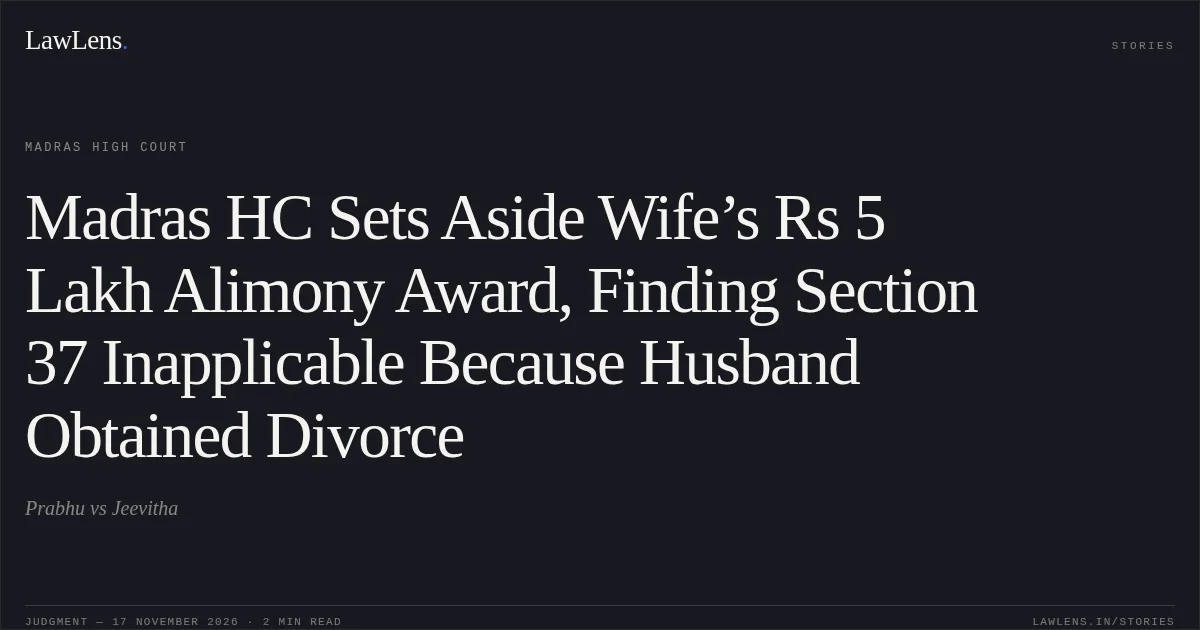
The husband obtained a divorce decree from the Principal District Judge, Tenkasi, in I.D.O.P. No. 7 of 2024. The Trial Court also directed him to pay the wife ₹5,00,000 as permanent alimony, although she had not filed the divorce petition.
pp. 1–3, 5The husband appealed only against the alimony direction, contending that Section 37 of the Divorce Act, 1869 did not authorize the award in these circumstances and that the parties had not filed the affidavits of assets and liabilities contemplated by Rajnesh v. Neha.
pp. 1–3, 5The wife opposed the appeal.
pp. 4–502Issues
i.1. Whether the Trial Court could award permanent alimony under Section 37 of the Divorce Act, 1869, where the husband—not the wife—filed the divorce petition and obtained the decree.
¶ 8 · p. 4ii.2. Whether the alimony direction could stand when the parties had not filed affidavits of assets and liabilities as contemplated by Rajnesh v. Neha.
¶ 4, 10 · p. 3, 503Law Applied
Section 37 of the Divorce Act, 1869, as set out in the judgment, permits the District Court to order permanent alimony where a decree of dissolution of marriage or judicial separation is obtained by the wife, having regard to matters including her fortune, the husband’s ability, and the parties’ conduct.
¶ 5 · p. 3The Court also relied on Rajnesh v. Neha, (2021) 2 SCC 324, stating that parties must file affidavits of assets and liabilities when the Court determines maintenance or permanent alimony.
¶ 4, 10 · p. 3, 5Provisions in the judgment · 3 · Linked ones open on LawLens
Divorce Act, 1869 Section 55Section 10Section 37
04Reasoning
The husband filed the divorce petition and obtained the decree; the wife neither sought nor obtained the decree. The Court therefore held that Section 37, as applicable to a decree obtained by the wife, did not authorize the Trial Court’s alimony award in this case.
¶ 9 · p. 5It further found that the Trial Court had not directed the parties to file affidavits of assets and liabilities before fixing permanent alimony, contrary to the procedure described in Rajnesh.
¶ 10 · p. 5In the Court’s view, the Trial Court’s consideration of the wife’s future livelihood did not cure these defects.
¶ 11–12 · p. 605Holding
The Court allowed the appeal and set aside the portion of the Trial Court’s order directing the husband to pay ₹5,00,000 as permanent alimony.
¶ 13 · p. 7It left the wife at liberty to pursue a maintenance remedy in accordance with law. No costs were awarded, and the connected miscellaneous petition was closed.
¶ 13 · p. 7Original Court PDF
PrabhuvsJeevitha
Click to open original judgment
Original judgment, available to read, download and summarize on LawLens.in