01Facts
The parties married according to Christian rites on 21 October 1993 and had no children.
pp. 1–4The husband petitioned for dissolution of the marriage under Section 10(1)(x) of the Divorce Act, 1869, alleging that the wife used insulting language, treated him disrespectfully, and left the matrimonial home in January 2017.
pp. 1–4The wife denied the allegations and asserted that the husband had sold her jewellery to purchase land and had left her without supporting the family.
pp. 1–4The Principal District Court, Thoothukudi, granted a decree of divorce on 24 February 2023.
pp. 1–4The wife appealed under Section 55 of the Act.
pp. 1–4At trial, the husband testified as P.W.1 and the wife as R.W.1; the husband marked four documents, while the wife marked none.
p. 402Issues
i.1. Whether the trial court’s decree dissolving the marriage on the ground of cruelty was liable to be set aside
p. 4 · ¶ 8ii.2. Whether the wife’s alleged conduct and language toward the husband amounted to mental cruelty warranting divorce under Section 10(1)(x) of the Divorce Act, 1869
pp. 5–9 · ¶ 10, 14, 1703Law Applied
Section 10(1)(x) of the Divorce Act, 1869, provides for dissolution of a marriage on the ground of cruelty; the appeal was brought under Section 55 of that Act.
pp. 1–2Relying on Gurbux Singh v. Harminder Kaur, (2010) 14 SCC 301, the Court noted that whether conduct amounts to cruelty depends on its effect on the particular person and circumstances, and the party seeking relief bears the burden of proving that effect.
pp. 7–8 · ¶ 16–17It also considered Mary Margret v. Jos P Thomas, (2022) 1 DMC 629, for the proposition that cruelty is assessed in light of the evidence and circumstances, including the nature and persistence of the conduct.
p. 8 · ¶ 18Provisions in the judgment · 2 · Linked ones open on LawLens
Divorce Act, 1869 Section 55Section 10
04Reasoning
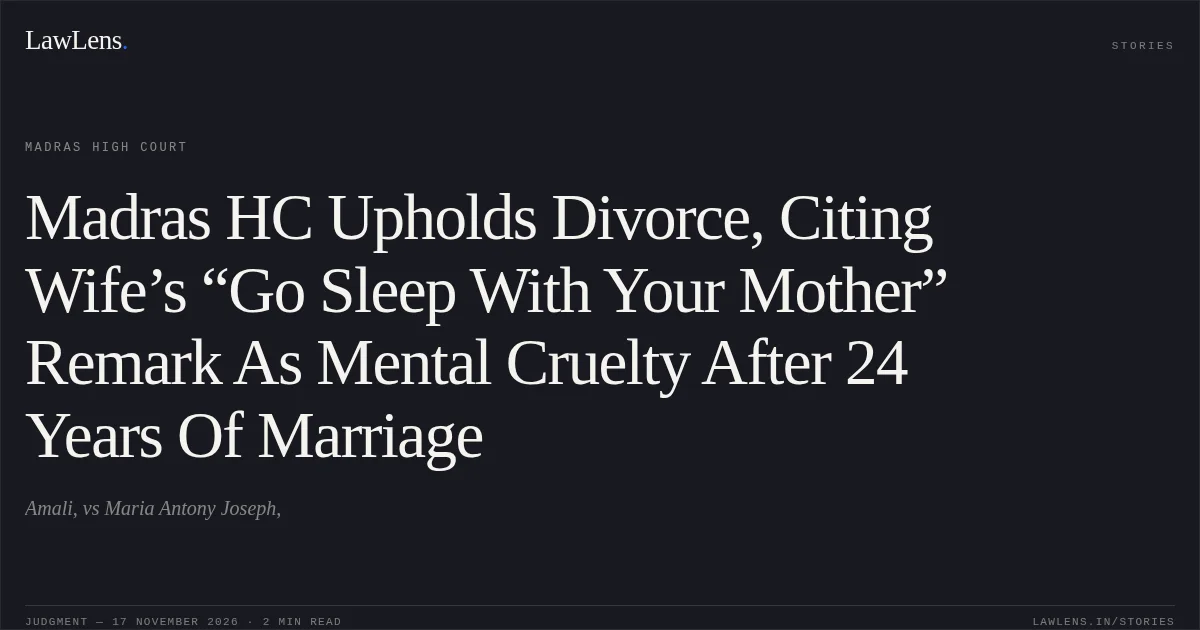
The Court treated the expressions “thlh Nghlh” and “rhfr; nrhy;Yq;fs;” as potentially ordinary incidents of family life, but considered the alleged statement telling the husband to “go and sleep with his mother” unacceptable and capable of causing considerable mental agony in the circumstances of the marriage.
p. 5, 8 · ¶ 10, 17It found that the husband’s testimony about the expressions had not been challenged in cross-examination and therefore treated those allegations as proved.
p. 7 · ¶ 14The Court also noted that the wife had left the matrimonial home in January 2017 and had not filed a petition for restitution of conjugal rights; it rejected her claim that the husband bought land with proceeds from her jewellery, finding the alleged sale and proceeds unproved.
pp. 5–7 · ¶ 10–11, 15On its reappraisal of the evidence, the Court agreed with the trial court that the wife’s conduct amounted to mental cruelty.
p. 6, 9 · ¶ 13, 2005Holding
The Court answered against the wife, holding that the evidence supported the finding of mental cruelty and that the trial court’s decree did not warrant appellate interference.
p. 9 · ¶ 20It dismissed the appeal, upheld the divorce decree dated 24 February 2023 in D.O.P. No. 82 of 2017, made no order as to costs, and closed the connected miscellaneous petition.
p. 10Original Court PDF
Amali,vsMaria Antony Joseph,
Click to open original judgment
Original judgment, available to read, download and summarize on LawLens.in