01Facts
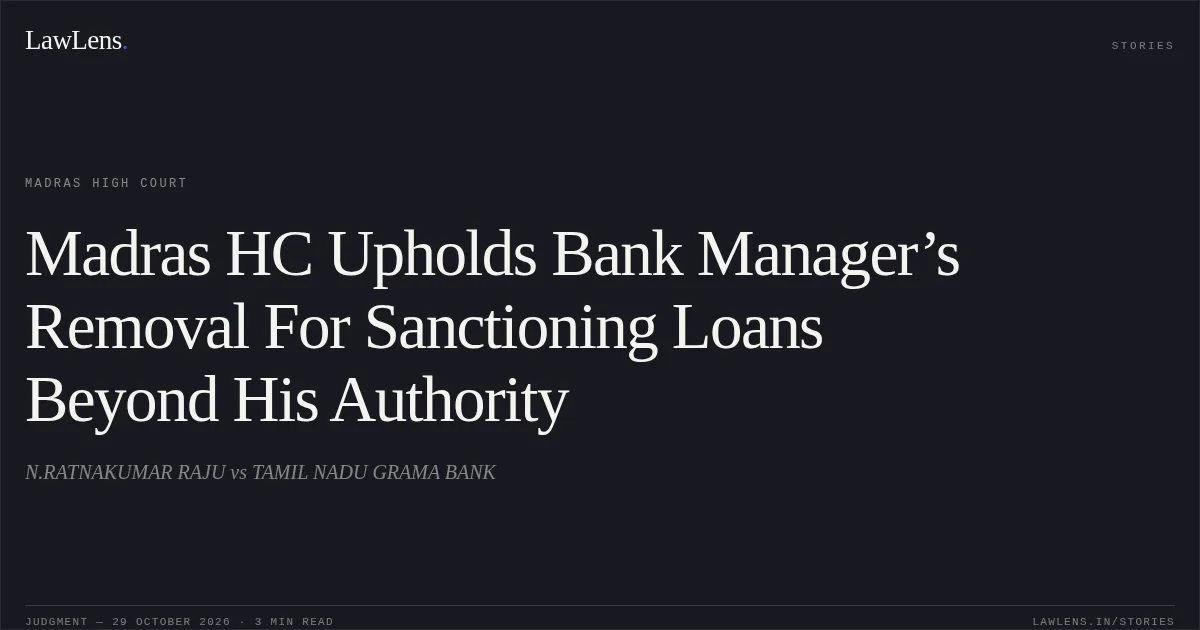
The petitioner, a bank officer who was serving as Branch Manager at Cuddalore, was suspended in August 2008 and charged with irregularities in sanctioning loans. Following a departmental enquiry, the Enquiry Officer found all but Charges 8 and 10 proved; the Disciplinary Authority disagreed on those two charges and ordered the petitioner’s removal from service on 27 October 2009.
pp. 2–3After earlier appellate proceedings and two remands by the High Court, the Appellate Authority again confirmed the removal order on 23 April 2024. The petitioner challenged both orders under Article 226, alleging, among other things, defective charges, inadequate proof and reasons, discrimination, and disproportionate punishment.
pp. 3–502Issues
i.1. Whether the disciplinary and appellate findings were liable to be set aside for inadequate evidence, procedural unfairness, or perversity
pp. 4–5 · pp. 11–15ii.2. Whether the Appellate Authority adequately addressed the petitioner’s objections concerning overlapping charges and the defence raised
pp. 7–10iii.3. Whether removal from service was disproportionate to the misconduct found proved
pp. 15–1603Law Applied
In judicial review under Article 226, the High Court does not sit as an appellate authority or reappraise evidence; it intervenes where the decision is procedurally unfair, contrary to natural justice, unsupported by evidence, or perverse.
p. 6Where some evidence supports the disciplinary finding, the applicable standard is preponderance of probabilities, not proof beyond reasonable doubt (State of Haryana v. Rattan Singh, cited at p. 6 and applied at p. 14).
p. 6 · p. 14A disciplinary authority that accepts an Enquiry Officer’s findings need not give elaborate reasons, though the decision must indicate application of mind; an authority differing from those findings must support its conclusion with reasons (authorities discussed at pp. 8–10).
pp. 8–10Acting beyond one’s authority may constitute misconduct, and bank officers are expected to exercise due care in handling public funds (Disciplinary Authority-cum-Regional Manager v. Nikunja Bihari Patnaik and State Bank of India v. Bela Bagchi, discussed at p. 13).
p. 13A writ court may interfere with punishment where it is shockingly disproportionate, but should not substitute its own view of the penalty otherwise.
pp. 10–11 · pp. 15–1604Reasoning
The Court found that the impugned appellate order had addressed the alleged overlap between charges and identified the borrowers and deficiencies underlying the findings, thereby curing the lack of discussion that had led to the earlier remand.
pp. 7–10It rejected the challenge to the documentary evidence, noting that the documents related to the Bank, had not been alleged to be forged or fabricated, and their admission had not been objected to during the enquiry or before the authorities.
pp. 11–12Applying the limited scope of judicial review, the Court concluded that the disciplinary findings were supported by evidence and were not perverse; the petitioner’s reliance on practices followed by predecessors did not excuse acting beyond his authority.
pp. 13–15Given the substantial financial loss attributed to the irregular loan sanctions and the petitioner’s responsibility as an officer, the Court found no basis to treat removal as disproportionate.
pp. 15–1605Holding
The Court answered the issues against the petitioner, holding that the disciplinary and appellate findings disclosed no reviewable error and that the penalty was not disproportionate.
pp. 15–16The writ petition was dismissed, with no order as to costs; the connected miscellaneous petition was closed.
p. 16Original Court PDF
N.RATNAKUMAR RAJUvsTAMIL NADU GRAMA BANK
Click to open original judgment
Original judgment, available to read, download and summarize on LawLens.in