01Facts
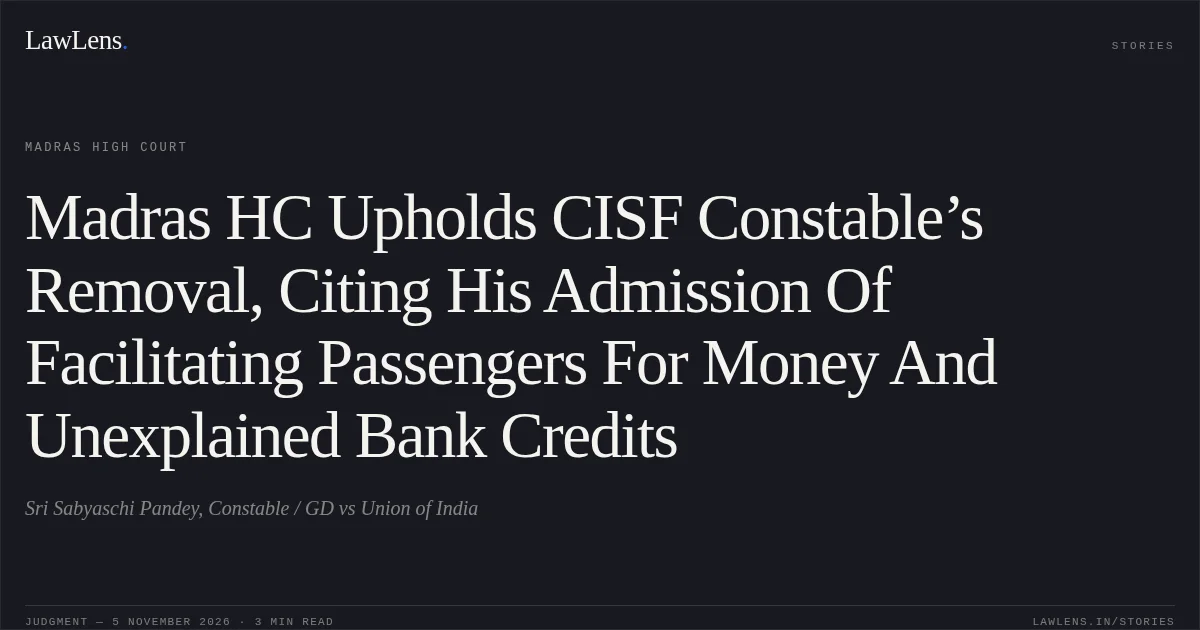
The petitioner, a CISF Constable deputed to the Intelligence Bureau in Delhi, faced a charge memorandum dated 24 March 2020 alleging misconduct connected with facilitating passengers and unexplained bank credits.
pp. 2–3The enquiry officer found both charges proved; the disciplinary authority imposed removal from service, and the petitioner’s subsequent challenges were rejected.
pp. 2–3The judgment’s account of the dates and authorities for the disciplinary, appellate and revisional orders is internally inconsistent: its narrative gives removal on 8 July 2020, appeal decision on 4 November 2020, and revision decision on 7 April 2021, while the prayer describes the challenged orders differently.
pp. 2–302Issues
i.1. Whether the absence of a seizure mahazar, having regard to Section 12 of the CISF Act and Rule 14, vitiated the disciplinary proceedings.
pp. 7–10ii.2. Whether Section 21(3) of the CISF Act barred the disciplinary proceedings for being initiated outside the prescribed three-month period.
pp. 11–12iii.3. Whether the removal order was made by an authority lacking competence because the petitioner’s appointing authority was the President of India.
pp. 5–6, 13–14iv.4. Whether the enquiry was vitiated by inadequate proof of documents, lack of witnesses with direct knowledge, or the venue of the enquiry.
pp. 4–5, 15–17v.5. Whether the absence of criminal prosecution, the authorities’ consideration of the evidence, or the adequacy of their reasons warranted judicial interference.
pp. 4–6, 19–2403Law Applied
Section 12 of the CISF Act concerns search and seizure in specified circumstances; the Court held it was not applicable stricto sensu to departmental proceedings against a CISF member for misconduct, and in any event the petitioner admitted the seizure.
pp. 7–10Section 21(3), concerning legal proceedings against members for acts done or intended in the discharge of their duties, does not impose a three-month limitation on disciplinary proceedings against a member for misconduct.
pp. 11–12Under Rule 32(1) of the CISF Rules and Schedule I, the disciplinary authority for an enrolled member is the authority specified in the Schedule; the Court held that the competent CISF authority could impose removal on a Constable.
pp. 13–14Disciplinary guilt is determined on the preponderance of probabilities, and judicial review does not permit reappreciation of evidence or substitution of findings where some evidence supports them; interference may be warranted for recognised grounds such as perversity or procedural unfairness.
p. 15The Court relied on B.C. Chaturvedi v. Union of India, Deputy General Manager (Appellate Authority) v. Ajai Kumar Srivastava and Indian Oil Corporation v. Ajit Kumar Singh for the limits of judicial review.
p. 15It also relied on AAI v. Pradip Kumar Banerjee for the principle that detailed reasons are not invariably required where the disciplinary authority accepts the enquiry findings, provided it applies its mind to the evidence.
pp. 16–17, 23–24Provisions in the judgment · 5 · Linked ones open on LawLens
Central Industrial Security Force Act, 1968 Section 8Section 11Section 12Section 21Section 32
04Reasoning
The Court rejected the seizure objection because Section 12 did not govern this internal disciplinary matter and the petitioner had admitted that the phone was seized; it also found no limitation bar because Section 21(3) did not apply to disciplinary action for the petitioner’s misconduct.
pp. 8–12It found the disciplinary authority competent under Rule 32(1) and Schedule I.
pp. 13–14On the evidentiary challenge, the Court distinguished State of U.P. v. Saroj Kumar Sinha: witnesses had been examined to introduce and explain the documents, and the petitioner’s admissions, passenger information on the phone, unexplained bank credits and undisclosed flat purchase provided evidentiary support for the findings.
pp. 12–15, 17–18, 20–22The absence of a criminal complaint did not invalidate the disciplinary process, and the Court found the appellate and revisional orders demonstrated application of mind.
pp. 19–20, 23–24Applying the limits of judicial review, it found no perversity or other recognised ground for interference.
pp. 21–2405Holding
The Court held that the petitioner had not established a legal or procedural defect warranting judicial review and dismissed the writ petition.
p. 18The connected miscellaneous petition was closed, with no order as to costs.
p. 18Original Court PDF
Sri Sabyaschi Pandey, Constable / GDvsUnion of India
Click to open original judgment
Original judgment, available to read, download and summarize on LawLens.in