01Facts
The petitioner, A2, and her husband, A1, were accused of borrowing ₹1.71 crore from the second respondent for their company, agreeing to transfer 50% of its shares, and failing to transfer the shares or repay the balance after making a partial repayment
¶ 2(a), 14In 2020, the High Court granted the petitioner anticipatory bail subject to, among other conditions, direct payment of ₹1.10 crore to the complainant; that condition was not complied with
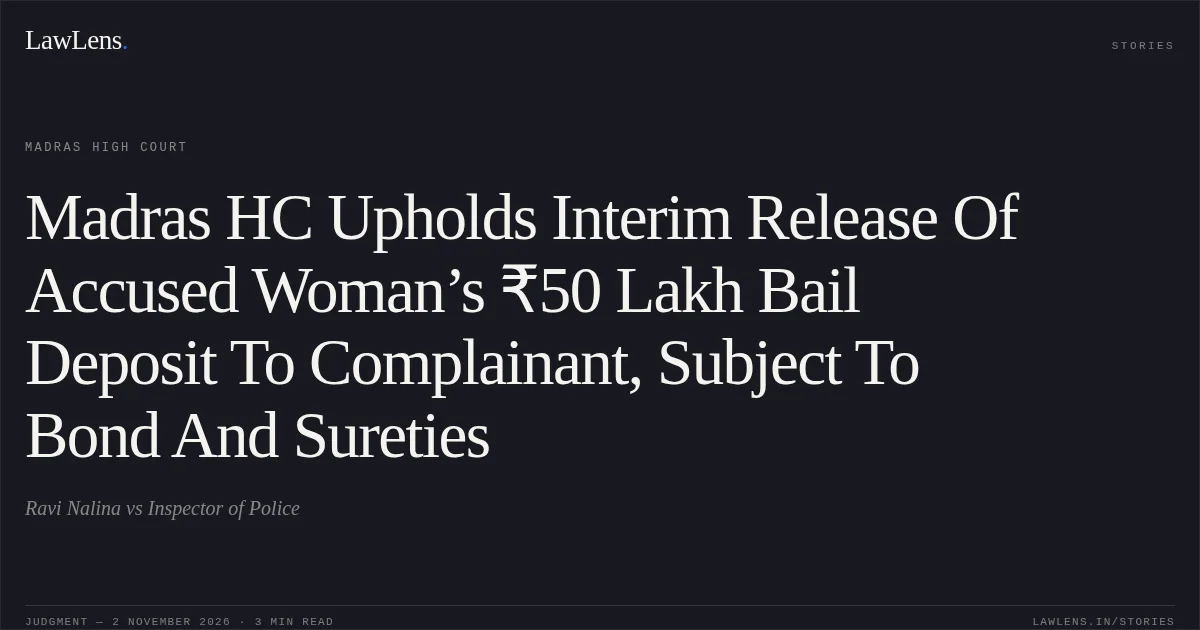
¶ 2(b), 14After subsequent proceedings, the petitioner surrendered and obtained bail from the Trial Court in April 2026 on condition that she deposit ₹50 lakh, which she did
¶ 2(f)–(g)The complainant then sought interim custody of the deposit under Section 497 of the BNSS.
¶ 2(h)–(j)The Trial Court granted custody subject to a bond for ₹50 lakh and two sureties of ₹25 lakh each, one being a blood surety, and made release subject to the outcome of pending litigation.
¶ 2(h)–(j)The petitioner’s revision challenging that order was dismissed
¶ 2302Issues
i.1. Whether the Trial Court’s order under Section 497 of the BNSS disclosed illegality, jurisdictional error, or material irregularity warranting interference in revision
¶ 9ii.2. Whether interim custody of the ₹50 lakh deposit could be granted to the complainant, subject to conditions, in the circumstances of the case
¶ 903Law Applied
Section 497 of the BNSS empowers the competent criminal court to make appropriate orders concerning the custody and disposal of property produced before it or in its custody during an investigation, inquiry, or trial; the court must consider the nature of the property and how it came into its custody
¶ 10That power cannot be used as a substitute for civil recovery or to determine disputed rights finally; interim release must be supported by the circumstances and safeguards that preserve the parties’ rights
¶ 11, 17, 20Revisional interference is warranted where an order discloses an error of law, jurisdictional defect, material irregularity, or miscarriage of justice
¶ 13In Rakesh Baban Borhade v. State of Maharashtra, (2015) 2 SCC 313, the Supreme Court permitted withdrawal of money deposited during anticipatory-bail proceedings, without prejudice to the parties’ contentions and subject to the outcome of pending litigation; the decision does not create an automatic entitlement to withdrawal in every case
¶ 18–19Provisions in the judgment · 1 · Linked ones open on LawLens
Bharatiya Nagarik Suraksha Sanhita, 2023 Section 497
04Reasoning
The High Court treated the earlier ₹1.10 crore payment condition and the later ₹50 lakh deposit as relevant background, but held that the later bail order had to be construed on its own terms and that the earlier condition did not automatically entitle the complainant to the deposit
¶ 16–17, 22It nevertheless found that interim custody could be considered under Section 497 if that power was independently and lawfully exercised.
The Trial Court’s order was conditional, subject to the outcome of pending litigation, and did not finally determine the complainant’s monetary claim or the petitioner’s guilt
¶ 20–21The High Court therefore found no sufficient ground for revisional interference
¶ 2105Holding
The Court answered the issues against the petitioner and dismissed the criminal revision, confirming the Trial Court’s order granting the complainant interim custody of ₹50 lakh subject to the stipulated conditions
¶ 23It clarified that interim custody was not a final determination of entitlement or a finding of guilt; the parties’ monetary claims remained open for determination by the competent forum, and the Trial Court was to proceed with the criminal trial uninfluenced by the High Court’s observations
¶ 24Original Court PDF
Ravi NalinavsInspector of Police
Click to open original judgment
Original judgment, available to read, download and summarize on LawLens.in