01Facts
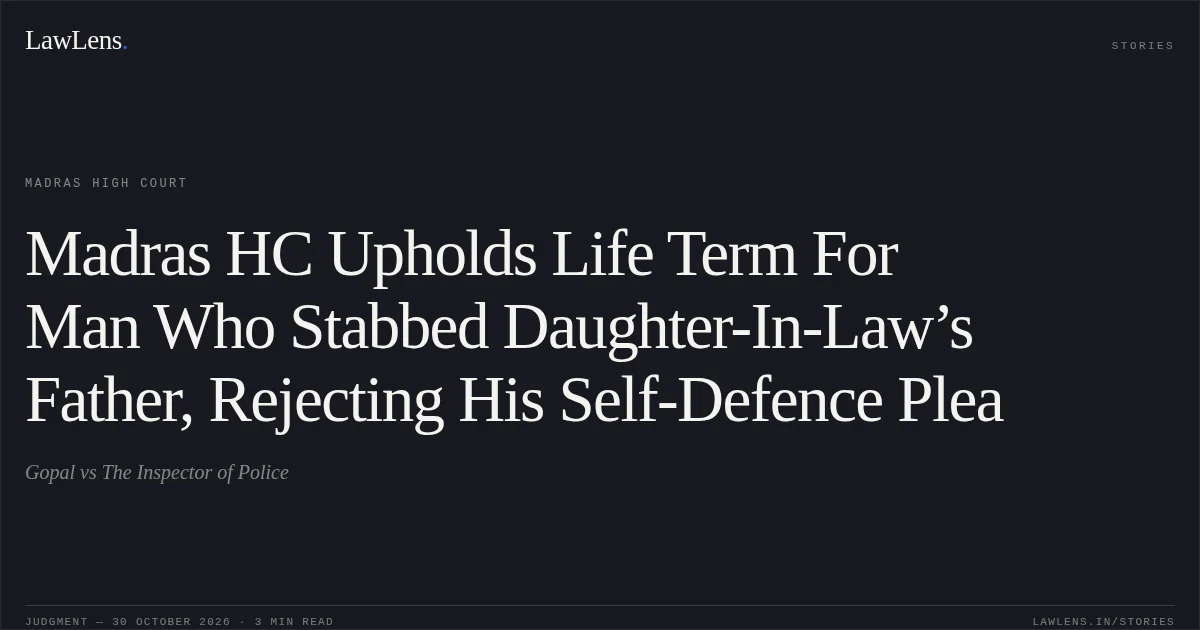
Gopal appealed his convictions under Sections 341, 302 and 506(ii) of the Indian Penal Code (IPC), arising from the fatal stabbing of Ganesan.
pp. 2–8, 26The prosecution alleged that Gopal, who suspected Ganesan of causing his son’s death by sorcery and had disputes with Ganesan’s daughter over property and livestock proceeds, waylaid and stabbed Ganesan in the early hours of 10 February 2019.
pp. 2–8, 26Ganesan’s wife, P.W.1, and daughter, P.W.2, identified Gopal as the assailant; he died in hospital the following day.
pp. 2–8, 26The trial court imposed life imprisonment for murder and concurrent sentences for the other offences.
pp. 2–8, 26On appeal, Gopal challenged the witnesses’ presence, the failure to seize their blood-stained clothes, the non-examination of independent witnesses, and the rejection of his plea of private defence.
pp. 2–8, 2602Issues
i.1. Whether the prosecution proved beyond reasonable doubt that Gopal committed offences under Sections 341, 302 and 506(ii) IPC
p. 9ii.2. Whether the convictions and sentences imposed by the trial court were sustainable, including in light of Gopal’s plea of private defence
pp. 9, 18–2503Law Applied
The Court applied Sections 341, 302 and 506(ii) IPC to the charged offences and Sections 96–102 IPC to the right of private defence.
pp. 18–23Under Section 105 of the Indian Evidence Act, the accused bears the burden of establishing a defence such as private defence on a preponderance of probabilities, though that burden may be discharged from the prosecution evidence; the right to cause death under Section 100 IPC requires reasonable grounds to apprehend death or grievous hurt, and the right lasts only while the apprehension continues.
pp. 18–23Applying Section 134 of the Evidence Act, the Court reiterated that evidence is assessed by quality, not number, and that reliable related witnesses may sustain a conviction [p. 13; Gulam Sarbar v. State of Bihar, (2014) 3 SCC 401; Namdeo v. State of Maharashtra, (2007) 14 SCC 150].
p. 13It also relied on the principle that private defence is defensive, not retaliatory, and cannot justify an offensive once the need to defend has passed [pp. 24–25; Shahjahan v. State of Kerala, 2007 AIR SCW 2123].
pp. 24–25Provisions in the judgment · 21 · Linked ones open on LawLens
Code of Criminal Procedure, 1973 Section 164Section 207Section 209Section 313Section 374
Indian Penal Code, 1860 15 provisions
Section 96Section 97Section 98Section 99Section 100Section 101Section 102Section 103Section 104Section 105Section 106Section 302Section 307Section 341Section 506Bharatiya Sakshya Adhiniyam, 2023 Section 108
04Reasoning
The Court found P.W.1 and P.W.2’s accounts credible and consistent with the complaint, their statements recorded under Section 164 CrPC, the medical evidence, and the recovery of the knife; it considered their relationship to the deceased insufficient, by itself, to discredit them.
pp. 11–14, 16–17, 25The evidence that the occurrence took place under street lighting and the prompt reporting also supported the prosecution case.
pp. 14–15The Court held that the absence of seized blood-stained clothes and independent eyewitnesses did not undermine otherwise reliable evidence.
pp. 7–8, 17It rejected private defence because the appellant had no recorded injuries, the deceased sustained serious stab and cut injuries, and the evidence did not establish a reasonable apprehension of death or grievous hurt that could justify causing death.
pp. 17–18, 2505Holding
The Court answered the issues against Gopal, held that the prosecution had proved the offences beyond reasonable doubt, and found the trial court’s convictions and sentences legally sustainable.
p. 26It dismissed the appeal, cancelled the appellant’s bail bonds, and directed that he be secured to serve the remaining sentence.
p. 2, 26The sentences—including life imprisonment under Section 302 IPC—were to run concurrently.
p. 2, 26Original Court PDF
GopalvsThe Inspector of Police
Click to open original judgment
Original judgment, available to read, download and summarize on LawLens.in